Castelmantova: A Sixteenth-Century Castle in Italy


Site at a Glance
- Rating
- 4.8
- Popularity
- Very Low
- Country
- Italy
- Primary era
- Early Modern
- Eras represented
- Early Modern
- Civilizations
- Duchy of Milan
- Site type
- Military
- Remains
- Castle
On this page9 sections
History
Castelmantova is a sixteenth-century castle in Italy, located at Campremoldo Sotto in the municipality of Gragnano Trebbiense. Its site had already been associated with fortification by the thirteenth century, and the present complex was later rebuilt and repeatedly altered by successive owners.
Medieval predecessor
A fortified building probably stood here during the thirteenth century, when northern Italian politics were marked by conflict between the Guelfs, who broadly supported the papacy, and the Ghibellines, who were associated with the Holy Roman Empire. The fortification was captured and plundered by Guelf forces in the 1220s before ultimately being burned.
Borla rebuilding and ducal administration
At the beginning of the fifteenth century, Francesco Borla, a physician serving the Duke of Milan, received permission from the duke to rebuild the fortification. Construction of the castle is dated to the sixteenth century. In 1636, the building was burned during military operations in which it was involved. It remained in Borla family ownership until the death of Giovanni Battista Borla later that year, after which it passed into the ducal estates administered by the Farnese, the ruling dynasty whose territories included the Duchy of Parma and Piacenza.
Savini, Civardi, and later owners
In 1658, authorities authorized the transfer of the castle to Giovanni Pietro Savini, who purchased it for himself and for Giulia del Sole, the guardian of his children. Del Sole sold the property to Gian Giacomo Civardi in 1660, and Civardi began reconstruction work. The counts Civardi retained the castle until 1854, when Count Giacomo Civardi sold it to Carlo Besini, a nobleman from Modena who lived in Mantua. Besini gave the castle the name Castelmantova in remembrance of the Lombard city of Mantua.
At the beginning of the twentieth century, ownership passed to the Sutti-Guasconi family. In 1925, the property was transferred to Carlo Prati.
Remains
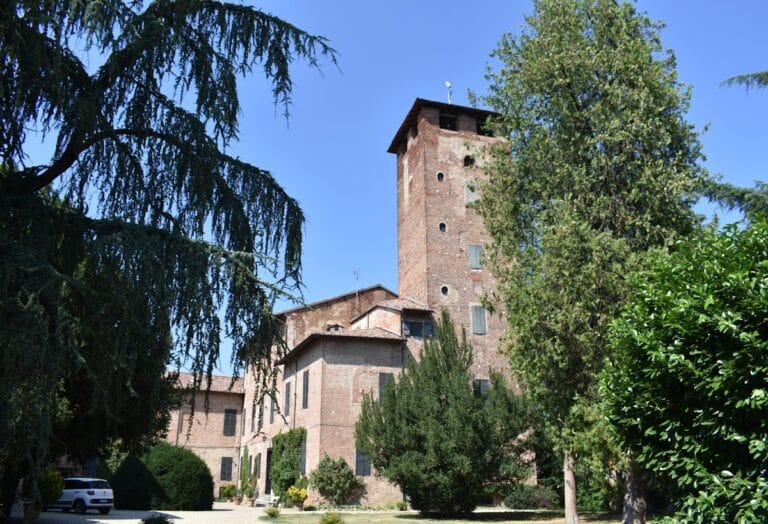
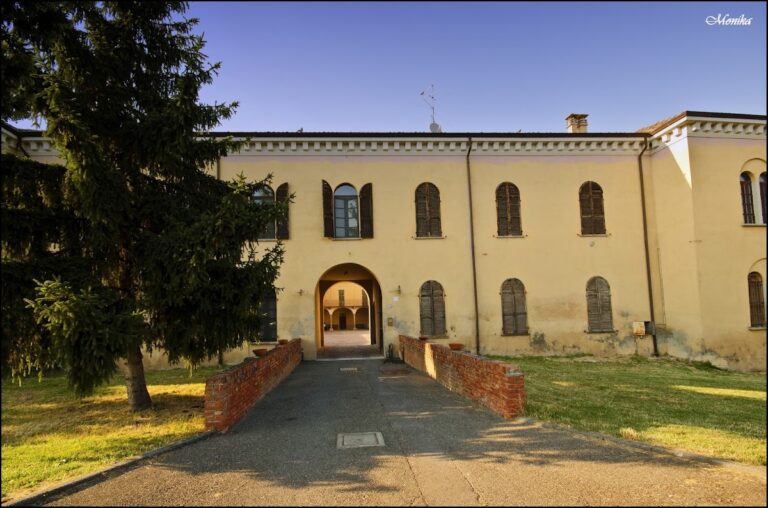
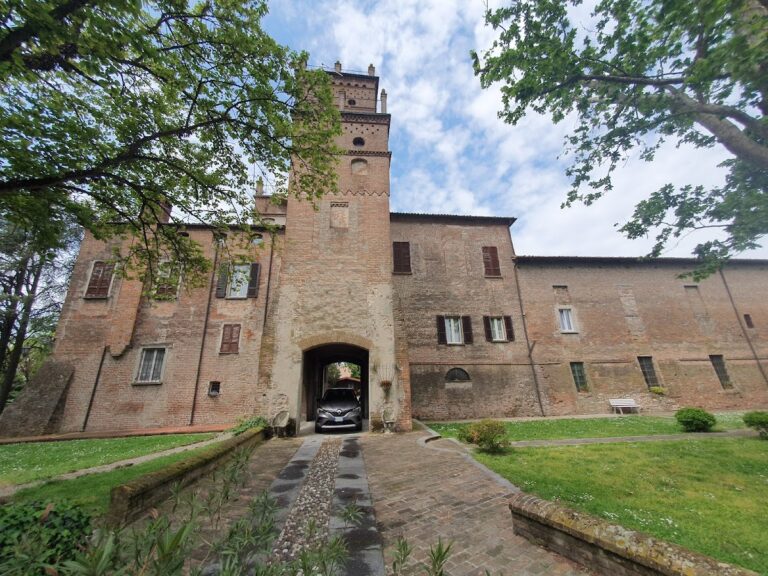
Castelmantova stands on the right bank of the Luretta stream in the open Po Plain. The complex has a square plan and has been extensively changed over the centuries. Two towers occupy diagonally opposite corners, while surviving defensive elements, an inner courtyard, and a surrounding park preserve different phases of the site.
Castle and grounds
Fortified plan and defenses
The southern tower retains the remains of a pusterla, a small postern gate intended for limited access, together with parts of its drawbridge. Several gun openings also survive. A torus-profile cordon, a projecting horizontal band of masonry with a rounded molding, extended along the moat. Its presence on the southern and eastern sides was still recorded in the final years of the eighteenth century. The drawbridge remains are among the visible elements associated with the original fortified construction.
Courtyard and portico
Inside the castle, a courtyard is bordered on three sides by a portico and loggia arranged across the ground and first floors. Tuscan pilasters divide the spaces between the columns. They support two architraves, horizontal structural bands, of which the first forms the parapet of the upper floor and the second carries the eaves cornice.
Park chapel
A park surrounds the castle and contains a chapel with a Baroque facade organized in two orders of pilasters. The interior preserves paintings made in 1885 by Giovan Battista Ferrari. They depict members of the Besini family and peasants, linking the chapel’s decoration to the nineteenth-century ownership of the property.