Roccacolonnalta Castle: A Medieval Fortress in Italy

Site at a Glance
- Rating
- 3.7
- Popularity
- Very Low
- Country
- Italy
- Primary era
- Medieval
- External website
- Open
- Eras represented
- Medieval
- Civilizations
- Unclassified
- Site type
- Military
- Remains
- Castle
On this page8 sections
History
Roccacolonnalta Castle is a medieval fortress in San Ginesio, Italy, built during the thirteenth century when the Brunforte family controlled territories around Sarnano and San Ginesio. Situated at about 700 metres above sea level, it became a contested stronghold during the territorial conflicts of the period.
Brunforte control and the conflict with San Ginesio
In 1265, San Ginesio attacked the castle while pursuing territorial claims against the Brunforte family. The dispute was linked to Rinaldo Brunforte, who had supported the imperial cause of Frederick II. In 1264, Pope Urban IV sent Cardinal Simone Paltanieri, a senior church official acting as the pope’s representative, to summon Rinaldo to Rome. Rinaldo was expected to face excommunication and the loss of his territories, but he did not appear. Paltanieri then released the inhabitants of Sarnano from their subjection to the Brunforte, and San Ginesio attacked with the cardinal’s support.
The fighting continued until 1272, when Brunforte control was confirmed again. San Ginesio gained full control of Roccacolonnalta Castle in 1330, after Ottaviano Brunforte sold it.
Successive lordships and later decline
From the second half of the fourteenth century through the fifteenth century, the fortress was controlled by the Da Varano, the ruling family of the Duchy of Camerino, of which San Ginesio formed part. After the fall of the Camerino rulers, the castle passed to Francesco Sforza, a fifteenth-century military leader and ruler, before returning to San Ginesio around the middle of the fifteenth century.
On 23 March 1487, Pope Innocent VIII authorized San Ginesio’s municipal government to impose a tax to fund repairs to the fortress. Its decline followed a fire in the sixteenth century. In 1664, the municipality took limestone from the castle for the restoration of Santa Maria di Pieca Church and for construction in the Roccacolonnalta hamlet. The reuse lowered the walls, and the removal of masonry continued until the 1950s. During the Second World War, one of the fortress towers was used as an artillery target.
Interpretations, tradition, and archaeological study
In the 1970s, Father Giacinto Pagnani proposed that the fortress had Templar origins. The Templars were a medieval military-religious order associated with the protection of pilgrims and Latin Christian rule in the Holy Land. Pagnani connected the theory with the Brunforte family’s participation in the early Crusades, but the interpretation remains hypothetical. Local historian Rossano Cicconi pointed out that the castle was not mentioned in the 1244 division of Fildesmido da Mogliano’s possessions, when territories near Sarnano were assigned to his nephew Rinaldo Brunforte. The theory consequently places an earlier structure, possibly dating from the eleventh century, with the Brunforte arrival understood as a restoration rather than the original construction.
Local tradition tells of a young girl’s golden loom buried beneath the fortress. In the legend, forest spirits known as the Polliccini supplied her with wool inside the castle and protected the surrounding natural world. During the 2000s, studies by the Sapienza University of Rome, the Municipality of San Ginesio, the former Monti Azzurri Mountain Community, and private participants examined the site. Proposals for a dedicated medieval centre and renovation with natural materials were developed but not implemented.
Remains
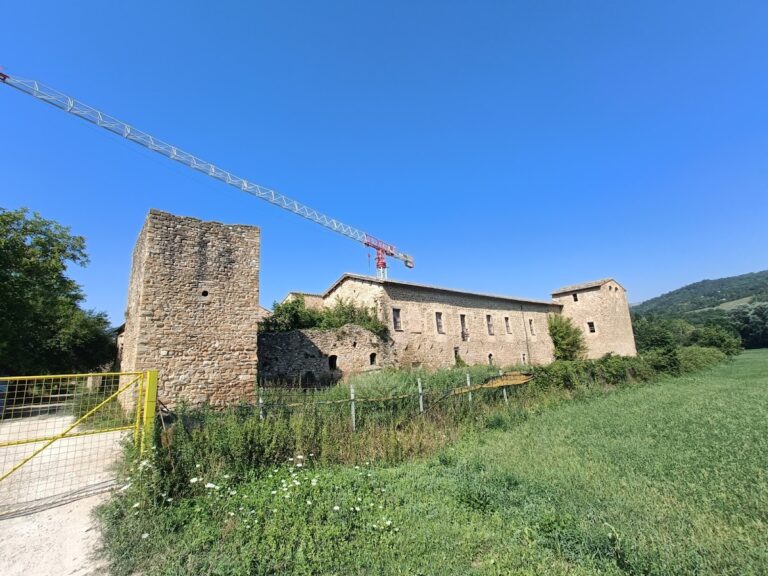
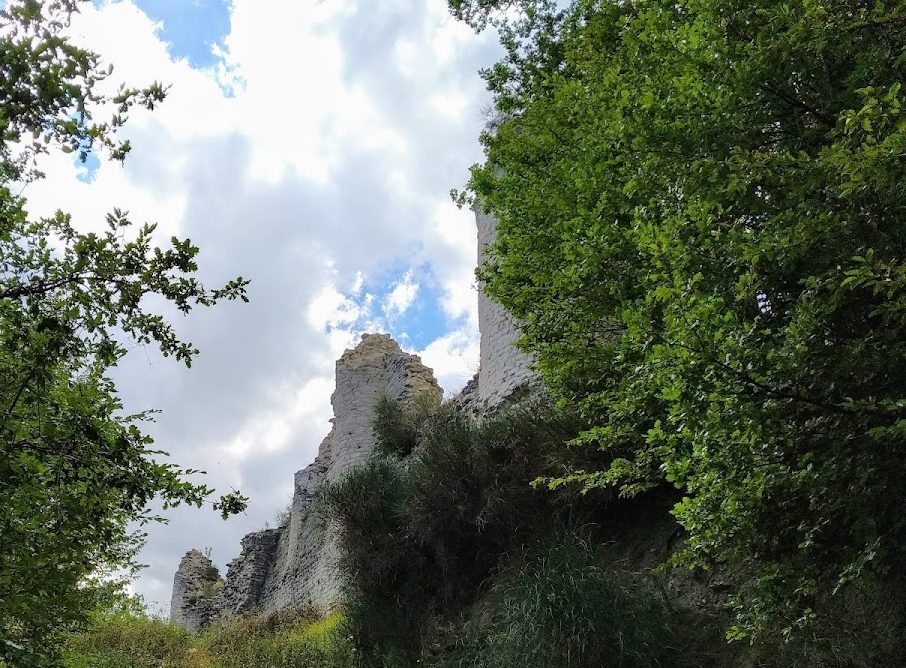
Roccacolonnalta survives as a limestone ruin built with local Marche craftsmanship. The fortress has been interpreted as having a quadrilateral plan, with towers, principal walls, a keep, and defensive walls that once enclosed the complex. The keep, or principal fortified tower, formed the stronghold within the castle. The reduction of the walls through centuries of limestone removal has strongly shaped the surviving form.
Fortress fabric
Walls, towers, and keep
The surviving remains include fragments of the towers, the main walls, the keep, and the surrounding defensive walls. Their construction in local limestone reflects the building practices of the Marche. The forms of the towers have been compared with those at Krak des Chevaliers in Syria, a comparison used in the hypothetical argument for an earlier, possibly eleventh-century phase of the fortress.
Ceramic finds
Excavations by the School of Specialization in Art History at the Sapienza University of Rome, conducted from 2006 to 2008, recovered about 2,500 ceramic items near the towers and central courtyard. The material belongs to several periods and includes household vessels such as bottles and plates, together with more prestigious wares coloured yellow, ochre, green, brown, and blue. Some pieces came from Deruta and Tuscany. Differences among the ceramics have been interpreted as evidence of use on different occasions and by people of different social classes.
Nearby sites