Santa Chiara Monastery: A Poor Clare Monastic Complex in Camerino, Italy
Site at a Glance
- Rating
- 4.5
- Popularity
- Very Low
- Country
- Italy
- Primary era
- Medieval
- External website
- Open
- Eras represented
- Medieval, Early Modern
- Civilizations
- Unclassified
- Site type
- Religious
- Remains
- Monastery
On this page12 sections
History
Santa Chiara Monastery is a late-fourteenth-century ecclesiastical complex in Camerino, Italy, whose development began under the da Varano dynasty and whose buildings contain elements characteristic of fifteenth- and sixteenth-century central Italian architecture. Located in the historic centre’s Borgo San Venanzio district, it was first dedicated to Santa Maria Nova and later became a monastery of the Poor Clares, the female Franciscan order founded by Saint Clare of Assisi.
Foundation and Olivetan Use
The church and an adjoining building were commissioned by Giovanni I da Varano, known as Spaccaferro. The complex probably grew from an earlier fortified property called Belmangeri or Belmagneri. On 18 July 1384, Giovanni donated the property to the Olivetan monks, a Benedictine reform congregation. They retained it until 1483, when they transferred to the convent of San Matteo at Coldibove, subsequently renamed Santissima Annunziata di Coldibove.
The Olivetans’ presence established Santa Maria Nova as a religious centre within the da Varano lordship. Two large Crucifixion paintings in the former refectory belong to this phase. One may have been commissioned by the order between 1398 and 1401, while the finished mural is attributed to Giovanni di Corraduccio and probably dates from the second decade of the fifteenth century.
The Poor Clares and Camilla Battista
After the Olivetans left, the Poor Clares moved into the monastery. Giulio Cesare da Varano built a new structure east of the older monastery for his daughter Camilla Battista da Varano, who became known as Sister Battista. She entered the community with eight companions on 4 January 1484. The act of possession required strict observance of poverty, while the lordship of Camerino supplied the nuns’ maintenance.
The monastery was embellished soon afterward. Its inlaid wooden choir was completed in 1489, and further work followed in 1491. Sister Battista lived there for most of her life, apart from stays at Atri, Fermo, and Sanseverino Marche, and served several times as abbess. To strengthen observance of religious life, she translated Giovanni da Capistrano’s explanation of the Rule of Saint Clare into the vernacular. Her work was titled Declaration on the Chapters of the Rule of the Order of Saint Clare.
Concerned that the community was becoming too large for its income, Sister Battista obtained a decree from Minister General Francesco Lichetti limiting the monastery to forty-five nuns. She died on 31 May 1524 and was buried in the nuns’ choir. About three decades later, an attempt to move her body to a separate tomb led to the discovery that it was considered incorrupt. The confessor ordered it returned to the common burial place and covered with earth, lime, and water, a decision that destroyed the body and may have reflected fears that she had died of plague.
Reform, Restoration, and Devotion
When Camerino returned to the immediate authority of the Holy See in 1545, the papacy confirmed the endowment granted by Giulio Cesare da Varano. During an apostolic visitation in 1572, Pietro De Lunel judged the monastery too small for its sixty inhabitants. He ordered a double grille in the parlatory adjoining the confessor’s house and another in the parlatory near the entrance. He also required the removal of a bench by the entrance so that visitors would not remain talking with the nuns for long periods.
Restoration in 1593 included rebuilding the choir floor and the nuns’ burial place. Sister Battista’s remains were found again, and the bones were said to give off a sweet perfume. What tradition identified as her tongue was placed in a silver reliquary, while the bones remained in the choir until 1626. Further restoration and examination of the remains took place in the mid-eighteenth century.
In 1843, the Sacred Congregation of Rites approved the cult of Blessed Battista, and Camerino held major celebrations the following year. The object traditionally identified as her tongue was placed in a new silver reliquary donated by the archbishop. Her bones were reassembled inside a wax figure representing her lying down, preserving the form in which her remains were presented for devotion.
Earthquakes, Suppression, and Reconstruction
The earthquake of 28 July 1799 almost completely destroyed the church and monastery, leaving the refectory standing. The complex was rebuilt in the following years, with substantial changes to the arrangement of its rooms. During the Napoleonic period, the Royal State took possession of the monastery and its appurtenances on 2 May 1808. The nuns were forced to leave two years later, although they returned before 1820. Between 1832 and 1835 they repaired the choir vault and undertook further restoration.
After Italian unification, Lorenzo Valerio issued a decree suppressing the monastery on 13 January 1861. The confiscation of ecclesiastical property left the nuns in severe poverty, while public funds supported restoration of the church and monastery between 1867 and 1880. The municipality decided to sell the complex on 3 October 1896. It was purchased on 3 April 1897 by Sister Maria Angela, born Giuseppina Barberis of San Maurizio di Casale Monferrato.
In 1897, Orazio Orazi’s painting of Sister Battista’s death was installed on the main altar. It was later replaced by a seventeenth-century painting and had returned to the altar before 1962. Heavy snowfall caused the choir roof to collapse on 1 January 1904. Domenico Indivini’s carved choir was removed and transferred to the Church of Santissima Annunziata, then used as the municipal museum. It returned to Santa Chiara in 1944, and the room containing the wooden choir was reconstructed in 1959.
The earthquake of 26 September 1997 severely damaged the complex and made it unusable. Restoration was completed in 2008. Another major earthquake in 2016 again made the monastery unusable, and heritage-protection authorities moved much of its artwork to secure storage. In September 2018, a new building was inaugurated on part of the former monastery gardens. It contains a guesthouse, dormitories, and a church, where Domenico Indivini’s Crucifix and a case containing a resin statue with Sister Battista’s remains were placed.
Remains
Plan, Facades, and Cloister
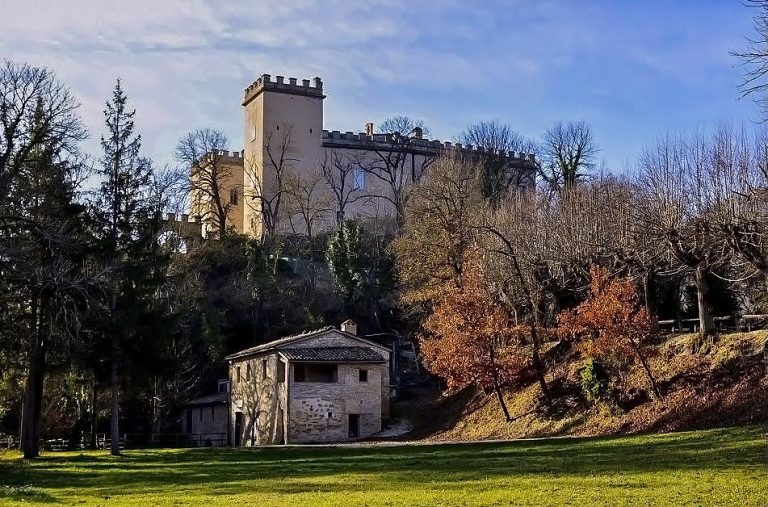
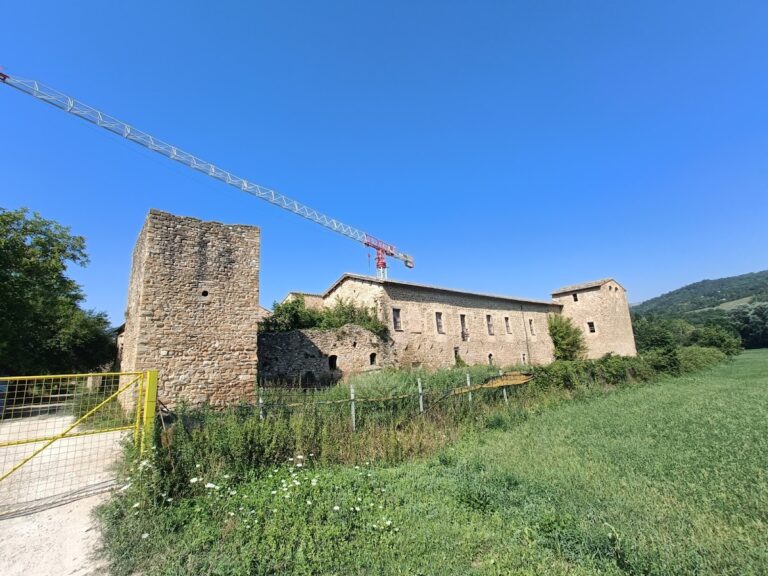
The monastery has a roughly parallelepiped plan between Via Coldibove, which leads toward the cemetery, and Via A. Medici. Sandstone masonry forms the complex, probably originally beneath a complete plaster covering. On Via A. Medici, the two-level facade has three ground-floor doors serving the guesthouse, the principal monastery entrance, and the picture gallery. Seven square grilled windows occupy the ground floor, with further windows above. Buttresses and openings reveal changes connected with altered uses and the earthquakes of 1799, 1997, and 2016. The guesthouse entrance for groups of pilgrims is on Via Coldibove.
A square cloister forms the monastery’s central module. Communal rooms open around its ground floor, where a sequence of arcades carries cross-vaulted ceilings. Cells facing the street occupy the upper floor alongside a spacious hall and a library. A smaller wing encloses the garden and the post-2016 building containing the new monastery, church, and guesthouse. The former garden extended along the hill crest toward the cemetery.
Church and Choir
The church is a single-nave building incorporated into the complex on Via Coldibove. The nave continues into the room containing Domenico Indivini’s carved and inlaid wooden choir, signed and dated 1489. The two spaces are contiguous, with columns and a light partition wall separating their sides at the apse. The church was first dedicated to Santa Maria Nova and later to Santa Chiara.
The arrangement of the church changed over time. The earlier entrance lay on the choir side toward Via A. Medici and was probably raised above the nave floor. A passage behind the choir stalls enabled the nuns to reach the choir. Later, the entrance was brought to nave level and placed against the rear wall. A cross-vaulted room beside the church was arranged as a crypt and connected to it by a doorway. It contains Sister Battista’s remains, while an adjoining room became a museum dedicated to her.
Indivini’s choir was commissioned by Sister Battista da Varano, who probably also supplied its religious imagery. After its removal following the 1904 roof collapse, it returned to the monastery in 1944. The room housing the choir was rebuilt in 1959, allowing the late-fifteenth-century work to remain associated with the church for which it was made.
Refectory and Medieval Walls
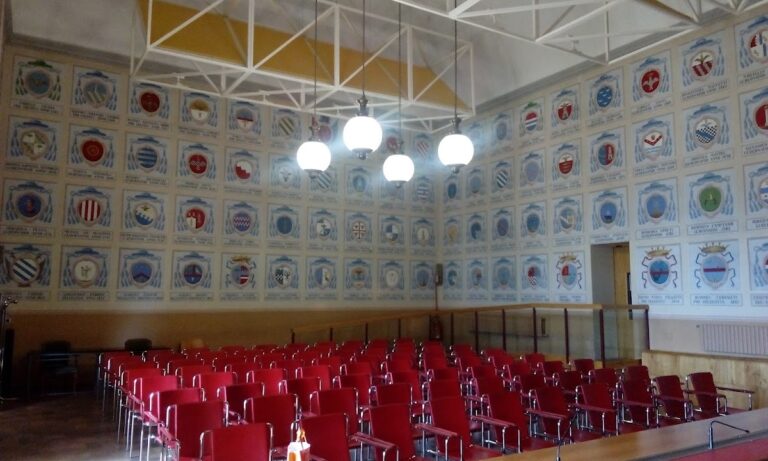
The former refectory is one of the communal rooms opening onto the cloister. It served as the dining hall during the Olivetan period and the early years of the Poor Clare community. Until the 2016 earthquake, the large rectangular room was used as a picture gallery and conference room. A passage leads toward the garden, and a laboratory adjoins the hall.
The laboratory contained a large fireplace associated with one of Sister Battista’s first mystical visions. The fireplace was destroyed over the centuries and reconstructed after the 1997 earthquake in its original position and proportions, using a photograph reproduced in a volume of her spiritual writings. Beside the laboratory, a former storeroom contains a large pointed arch. The arch marks the position of the fourteenth-century walls that protected Borgo San Venanzio and formed part of Giovanni da Varano’s possessions.
Crucifixion Paintings
Two opposing wall paintings of the Crucifixion occupy the former refectory. One is an incomplete painted work with a surviving sinopia, an underdrawing prepared beneath a fresco. The other is a finished mural that was detached during restoration and placed in its present position. Both show Christ and the two thieves surrounded by a crowd. In the coloured section of the first painting, four angels collect the blood flowing from Christ’s wounds.
The finished composition includes Mary Magdalene embracing the cross on the left and Saint John the Evangelist with clasped hands on the right. Behind John, a white-robed figure identified by Mario Sensi as Bernardo Tolomei presents a kneeling figure. That figure may be Giovanni da Varano, known as Spaccaferro, or Rodolfo III, lord of Camerino when the mural was made. Other members of the da Varano court may appear among the figures on foot and horseback, while the first horseman on the left is identified as Longinus. The crosses of the two thieves are partly visible at the edges.
Frescoes and Devotional Works
An early-sixteenth-century fresco of the Annunciation covers the rear wall of the entrance corridor. A rectangular classical-style frame encloses the scene, whose composition reflects the influence of Luca Signorelli, especially his 1491 Annunciation at Volterra. Two da Varano coats of arms in the upper corners connect the commission with that family, particularly Sister Battista.
The Archangel Gabriel holds lilies in the fresco. They refer to the three lilies that, according to Sister Battista’s Spiritual Life, Christ gave her as a sign of her call to monastic life. Similar lilies appear on some choir stalls, linking the corridor painting with the monastery’s devotional imagery.
Domenico Indivini’s late-fifteenth-century Crucifix was formerly placed above the main altar of the old church and later occupied the same position above the altar in the new Church of Santa Chiara. It is made from two walnut pieces. One forms the head, torso, and legs, while the other forms the arms. The inclined head, half-closed eyes, wounds, visible veins, and blood on the face and chest emphasize Christ’s suffering. Resin was used to render the blood, and the work is attributed to Indivini, who also made the choir in 1489.
A second wooden Crucifix associated with Sister Battista probably dates from the last quarter of the fifteenth century and is attributed to an artist working from German stylistic models. Its head, torso, and legs were carved from one piece of wood, with a separate piece for the arms. The polychrome sculpture combines materials, including peg-like nipples and a cord crown of thorns that originally carried thorns. Sister Battista’s writings describe private devotion before a crucifix, including kneeling at Christ’s feet each Friday and trying to produce a tear in memory of the Passion. The identity of this sculpture as the crucifix described in those writings remains uncertain.
A small fifteenth-century wooden Christ Child, a Nativity sculpture, is attributed to Indivini on stylistic grounds and because of his relationship with the Franciscans of Camerino. When found, the figure wore an elaborate eighteenth-century robe, crown, and jewellery. Restoration removed later plaster breeches and returned it to its original nude state, although it continues to be dressed during the Epiphany rite of kissing the Christ Child. Its naturalistic pose places one finger beneath the chin, a gesture associated with silence and meditation in enclosure. An eighteenth-century ring remains attached to that finger. Tradition connects the ring with a mystical episode involving Sister Battista, while another tradition says that Blessed Pietro da Mogliano gave her the figure when she entered the monastery.
Main-Altarpiece Painting
The former main-altarpiece painting shows Saint Clare, Saint Camilla Battista da Varano, and Blessed Pietro da Mogliano. It is an oil painting on canvas whose original seventeenth-century artist is unknown. A second painted layer dates from 1760, the year of Pietro da Mogliano’s beatification, and a later intervention added a halo to Sister Battista after 1843.
Saint Clare originally held a chalice, which was later changed to a monstrance, a vessel used to display the consecrated host. She descends from a cloud while looking toward Pietro, and Sister Battista watches with outstretched arms, presenting the scene as a mystical vision. The canvas was intended for the main altar. From the late nineteenth century it alternated there with Orazio Orazi’s 1882 painting of Blessed Battista Varano’s funeral. After 1962, it was placed at the rear of the church when Indivini’s Crucifix was installed on the altar.
Nearby sites