Zahínos Castle: A Fifteenth-Century Fortress in Spain


Site at a Glance
- Rating
- 4.3
- Popularity
- Very Low
- Country
- Spain
- Primary era
- Medieval
- Eras represented
- Medieval
- Civilizations
- Crown of Castile
- Site type
- Military
- Remains
- Castle
On this page4 sections
History
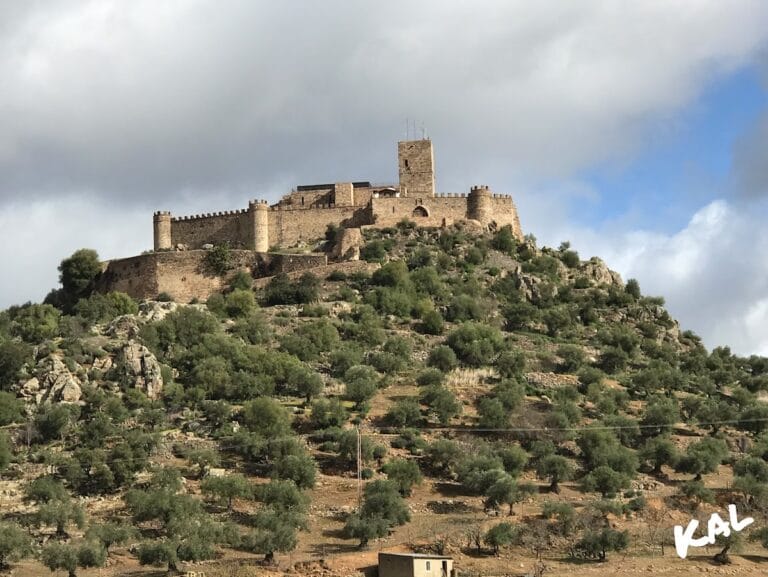
Zahínos Castle is a mid-fifteenth-century defensive construction in Spain, built as a military fortification on the summit of a hill. Commissioned by Don Juan de Alconchel, it was historically known as “Castro Fuerte,” and the present town of Zahínos developed around it.
Templar Associations
Zahínos appears to have Templar origins. The Knights Templar were a medieval military-religious order that held and administered territories in parts of Iberia. After the Reconquista, the long medieval expansion of Christian kingdoms into territories ruled by Muslim polities on the Iberian Peninsula, nearby Jerez de los Caballeros became the capital of a bailiwick, an administrative district governed by or associated with a military order or another authority. A 1272 chapter act of the Knights Templar included Zahínos within this district.
The town consequently had its own legal custom, the Fuero de Baylío. This regional practice governed matrimonial property and inheritance and was associated particularly with parts of Extremadura. The castle’s later role as a hilltop military stronghold reflects Zahínos’s position within this longer territorial history.
Protection and Survival
Castillo de Zahínos has been protected as a Bien de Interés Cultural historic ensemble since 3 September 1991. This Spanish legal designation protects significant cultural heritage. The castle also falls under the general protection established by the Decree of 22 April 1949 and Spain’s Historical Heritage Law 16/1985. Its surviving remains are publicly owned and attached to the town hall.
Remains
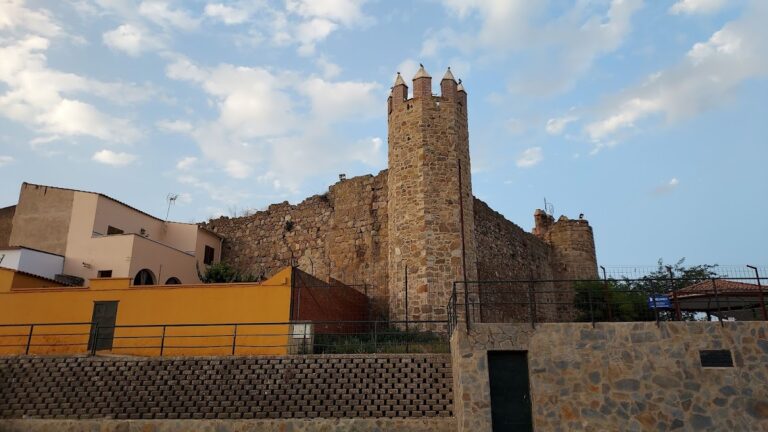
The fortification occupied the highest part of Zahínos, on a hill approximately 480 metres above sea level. The surviving castle remains consist of a single cylindrical tower, so the arrangement of the complete fortification cannot be reconstructed with certainty. The tower is built of stone laid in rubble masonry and dates from the fifteenth century.
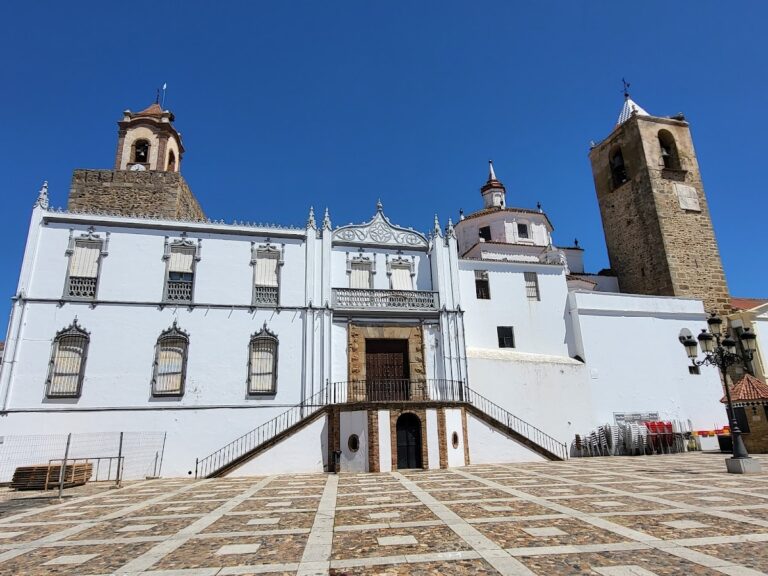
The tower stands on a low cylindrical base about 1.5 metres high. Its base is slightly wider than the tower itself, creating the appearance of a raised podium. A balustrade was added to the crown, an unusual feature for a fortification, but the building’s military character remains clear. The surviving structure is in good condition and is physically attached to the town hall.
Nearby sites