Château de Blanchefort: A Medieval Fortified Castle in France


Site at a Glance
- Rating
- 4.7
- Popularity
- Very Low
- Country
- France
- Primary era
- Medieval
- External website
- Open
- Eras represented
- Medieval
- Civilizations
- French
- Site type
- Military
- Remains
- Castle
On this page8 sections
History
Château de Blanchefort is a former fortified castle in France, above Rennes-les-Bains in the Aude department of Occitanie. Construction began in the eleventh century, and the castle was first recorded in 1067 as the castrum de Blancafortis, a fortified stronghold whose name refers to the white rock of its summit. It overlooks the confluence of the Sals and the Rialsesse, which are respectively a tributary and a sub-tributary of the Aude.
Origins and Ecclesiastical Lordship
An earlier stronghold is traditionally said to have been built on the site by the Visigoths, a Germanic people who established a kingdom across much of southwestern Gaul and Hispania, during the tenth century. This early phase remains uncertain. Another tradition attributes the order for the castle’s construction to Blanche of Castile, the medieval queen who governed France as regent during the minority of her son Louis IX, after a visit to Rennes-les-Bains.
In 1100, Château de Blanchefort belonged to the former Abbey of Jaffus. It passed to the powerful Abbey of Alet in 1119, in a transfer mentioned in a papal bull issued by Pope Callixtus II. In 1125, the castle’s lord, Bernard, submitted to Bernard-Aton IV Trencavel, a viscount.
Conflict and Changing Lordship
Tradition places a gold mine at the castle in 1130 and associates it with the Knights Templar, a medieval Catholic military order involved in protecting pilgrims and fighting in the Crusades. The same legend claims that the supposed mine concealed gold taken from a Visigothic treasure discovered in the earlier stronghold.
In 1209, during the Albigensian Crusade, Château de Blanchefort aligned with the Cathars, a medieval Christian movement condemned as heretical by the Catholic Church. The crusade was the campaign launched that year against Cathar communities and their political supporters in southern France. Simon de Montfort, its leading military commander and a major territorial lord in the conquered region, captured the castle. Guillaume de Blanchefort, its lord, fled, and Pierre de Voisins, an associate of Simon de Montfort, took possession and imposed heavy taxes.
The castle remained for a long period in the Gilbert de Voisins family before passing, among other families, to the d’Hautpoul family. It was enlarged and remodelled during the fourteenth century. The introduction of cannons in the sixteenth century and the Treaty of the Pyrenees in 1659 reduced its importance as a frontier stronghold. That treaty ended the Franco-Spanish War and altered the political frontier between France and Spain.
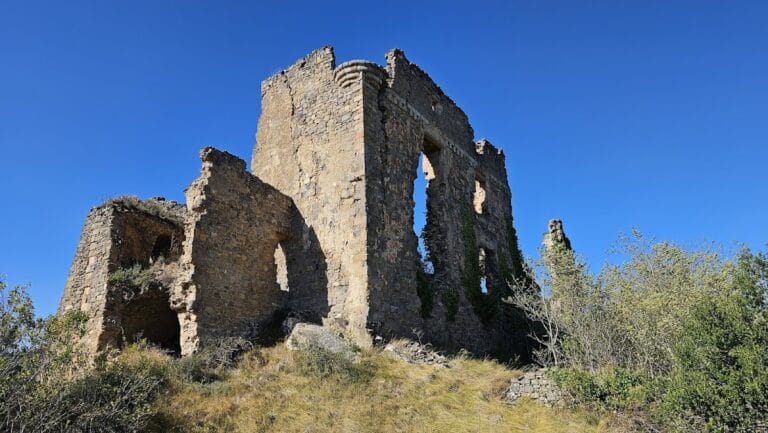
Château de Blanchefort was later abandoned. It does not appear on Roussel’s map of 1713, which surveyed the castles of the region, and it now survives as an abandoned ruin.
Remains
Fortified Summit
The castle occupied a rocky summit of white stone and formed a small fortified complex. Its courtyard was enclosed by curtain walls, defensive walls surrounding an internal area. Because the entrance door stood several metres above ground on a small cliff, access to the courtyard was provided by a ladder. The surviving traces preserve the relationship between the elevated entrance, the courtyard, and the defensive enclosure.
Surviving Structures
Square Keep
The principal tower was a square keep measuring 7 metres on each side. Its walls were 1.5 metres thick, and its foundations survive at the summit. A trapezoidal building is also represented by surviving traces within the small fortified complex.
Cistern and Wall Foundations
A cistern at least 2 metres deep supplied drinking water. Its foundations are described as well preserved. Other surviving remains include traces of the curtain walls around the courtyard, together with the foundations of the keep and the cistern.
Nearby sites