Fragsburg: A Fourteenth-Century Hill Castle Above Merano, Italy
Site at a Glance
- Rating
- 4.3
- Popularity
- Very Low
- Country
- Italy
- Primary era
- Medieval
- External website
- Open
- Eras represented
- Medieval, Early Modern
- Civilizations
- Habsburg, Holy Roman Empire
- Site type
- Military
- Remains
- Castle
On this page13 sections
History
Fragsburg is a fourteenth-century hill castle in Italy, standing above Merano in South Tyrol. Built by the Tyrolean nobleman Otto von Auer after he received the Tifrags estate as a feudal fief, it occupied a defensible position above the Merano basin and remained connected with noble families, ecclesiastical foundations, and changing forms of ownership for centuries.
Origins and the Auer family
The hill may have been occupied in prehistoric times and may also have had a Roman-period fortification. The medieval estate was associated with a man named Jenl at the beginning of the fourteenth century. On 16 December 1349, the upper Tifrags estate was granted to Hermann of Hafling, and in 1351 Merano burgrave Konrad of Schenna transferred it to the procurator Ambach.
Otto von Auer built the castle after obtaining the Tifrags estate and the adjoining mountain as a fief. Ludwig the Brandenburger authorized the grant in 1356 or 1357. Ludwig, a member of the Wittelsbach dynasty and ruler as Duke of Upper Bavaria and Margrave of Brandenburg, had acquired the property from the Poor Clares, a Franciscan contemplative order of women based at the convent of Anger in Munich.
The Auer family retained Fragsburg, with brief interruptions, until the extinction of the Auer von Fragsburg line with Heinrich von Auer in 1479. In 1376 Hans von Auer founded the Holy Cross benefice, an endowed ecclesiastical foundation supporting a priest or religious service. He provided it with property in Hafling, Hagen in Untermais, Obermais, Zenoberg, and Algund. Because Fragsburg lay in the parish of Mais, approval was required from Stams Abbey, a Cistercian monastery to which the parish had belonged since 1273. Duke Leopold II confirmed the foundation at Bolzano on 12 January 1376.
Hans von Auer’s death in 1394 led to an inheritance dispute between his sons-in-law, Hermann of Liebenberg and Sigmund of Villanders. A judgment ordered Hermann to transfer half of Fragsburg to Sigmund. In 1414, Auer relatives from Labers besieged the castle.
From territorial fief to aristocratic residence
During the Starkenberg feud of 1422, a conflict in Tyrol between the Starkenberg noble family and territorial authorities, Fragsburg passed to the territorial ruler of Tyrol. In 1469 it was briefly granted, or possibly pledged, to Christoph Botsch. Shortly before his death, Heinrich von Auer surrendered the fief in favor of the knight Arnold von Niederthor.
The Niederthor family held Fragsburg until Georg von Niederthor died there in 1556. In 1563 Balthasar Scheck of Niedermontan, also known as Balthasar Scheck of Goldrain, acquired the fief for 4,400 gulden. His daughter Magdalena married Hans Christian von Sarnthein, and their son Friedrich was probably the heir. He is recorded as the owner from 1586.
Christoph Bracken the Younger acquired Fragsburg for his family in 1588 and entered the Tyrolean nobility register on 15 May 1592. Ownership later passed to his cousin Matthias Philipp, whose son Hildebrand Prack of Asch became the last member of that line to hold the property.
The Mamming family succeeded the Pracks in 1615 or 1616. The wealthy merchant family had entered the Free Imperial Knighthood in 1564. Rochus and Ferdinand von Mamming served as councillor of the treasury and seneschal at the Innsbruck court. In 1672 Ferdinand’s son Benedikt received the rank of imperial baron, and the family adopted the title Barons of Steinachheim at Fragsburg and Rabland. Benedikt became a count in 1695 and probably commissioned the Steinachheim residence in Merano, now the city museum.
Private ownership, hotel use, and restoration
The Mamming family converted Fragsburg from a feudal fief into allodial property, meaning land held in free ownership rather than from a superior lord, in 1805 or 1813. The family retained it until 1830. In 1835 Julius Cornet, an Austrian opera singer and then director of the Brunswick court opera, purchased the castle. After his death, it was sold to a farmer, then acquired by Baroness Bludowsky and later by Count Joseph von Trauttmansdorff. Baron Erwin von Kettenburg owned it before 1894, and around 1930 the castle passed into bourgeois private ownership.
In 1904 the Counts Deuster of Kitzingen converted Fragsburg into a hotel. After South Tyrol was annexed to Italy, the property was expropriated for the National Combatants’ Organization, used as a colony, and given the Italianized name Verruca. During the Second World War, nearly all of the original furnishings were lost, although parts of the furnishings in the chapel and two other rooms survived.
After the war, private owners acquired Fragsburg and returned it to hotel use. The castle underwent complete restoration in 2001. In 2019 the Ortner family acquired it and reunited it with the adjoining Castel Fragsburg hotel property, which originated from the same estate. Fragsburg also appears in Felix Dahn’s historical novel The Crusaders: A Tale from the Thirteenth Century, where it is described as a female-inherited fief, a feudal holding that could pass through the female line.
Remains
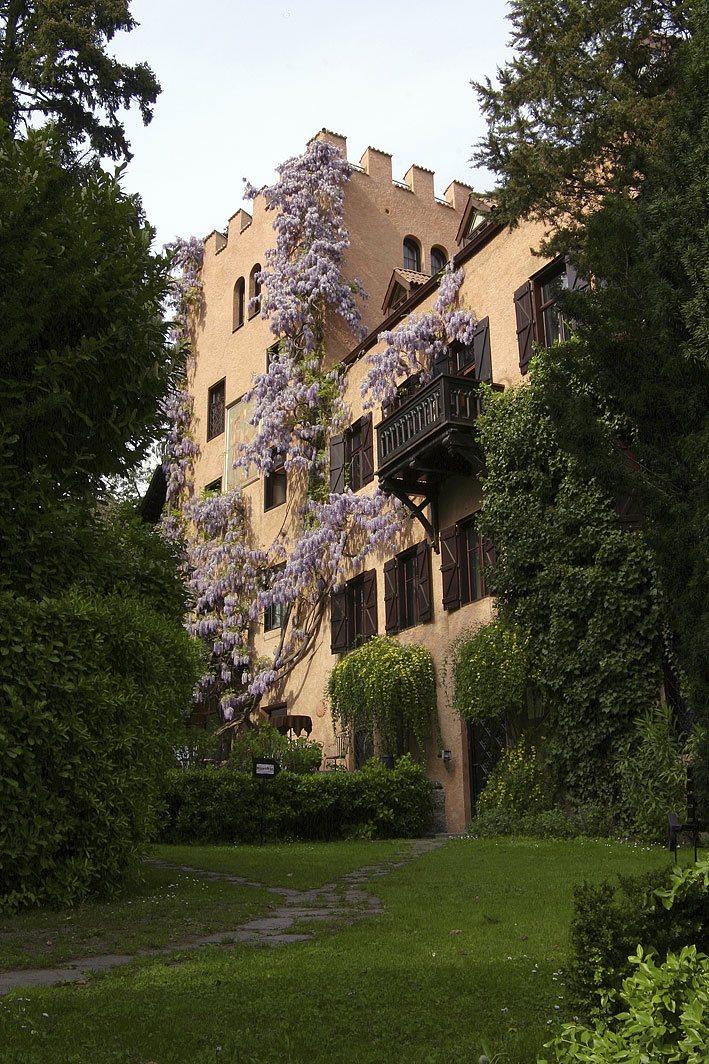
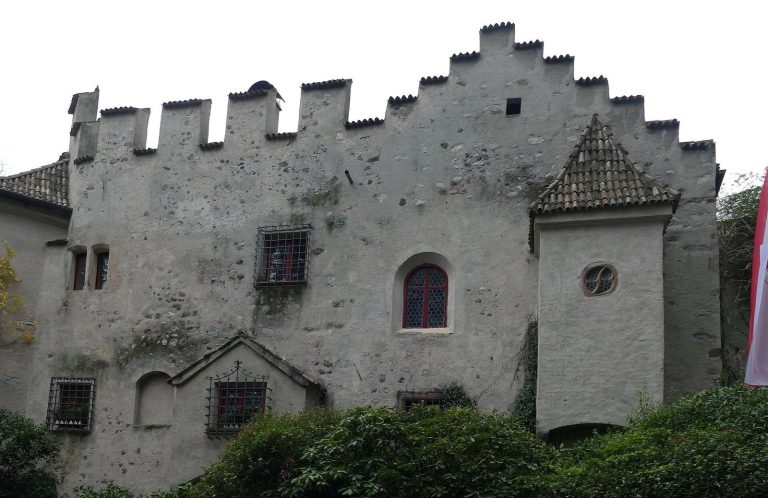
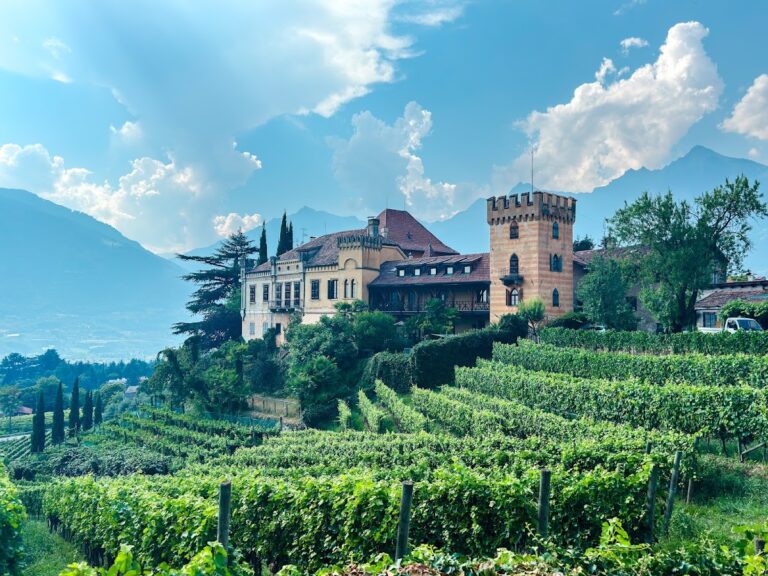
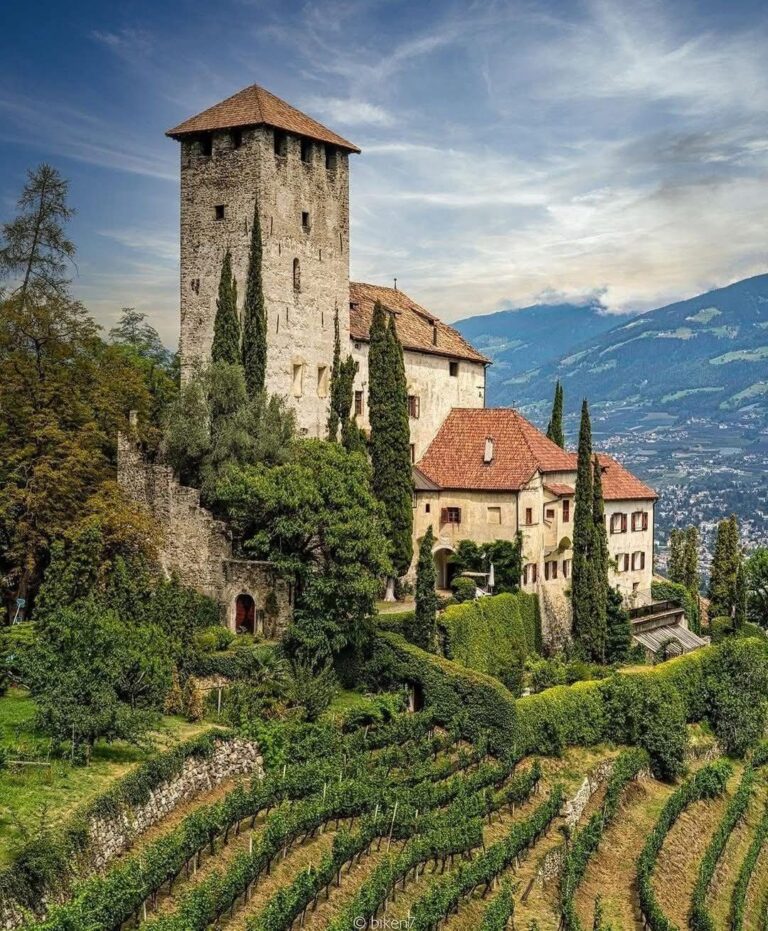
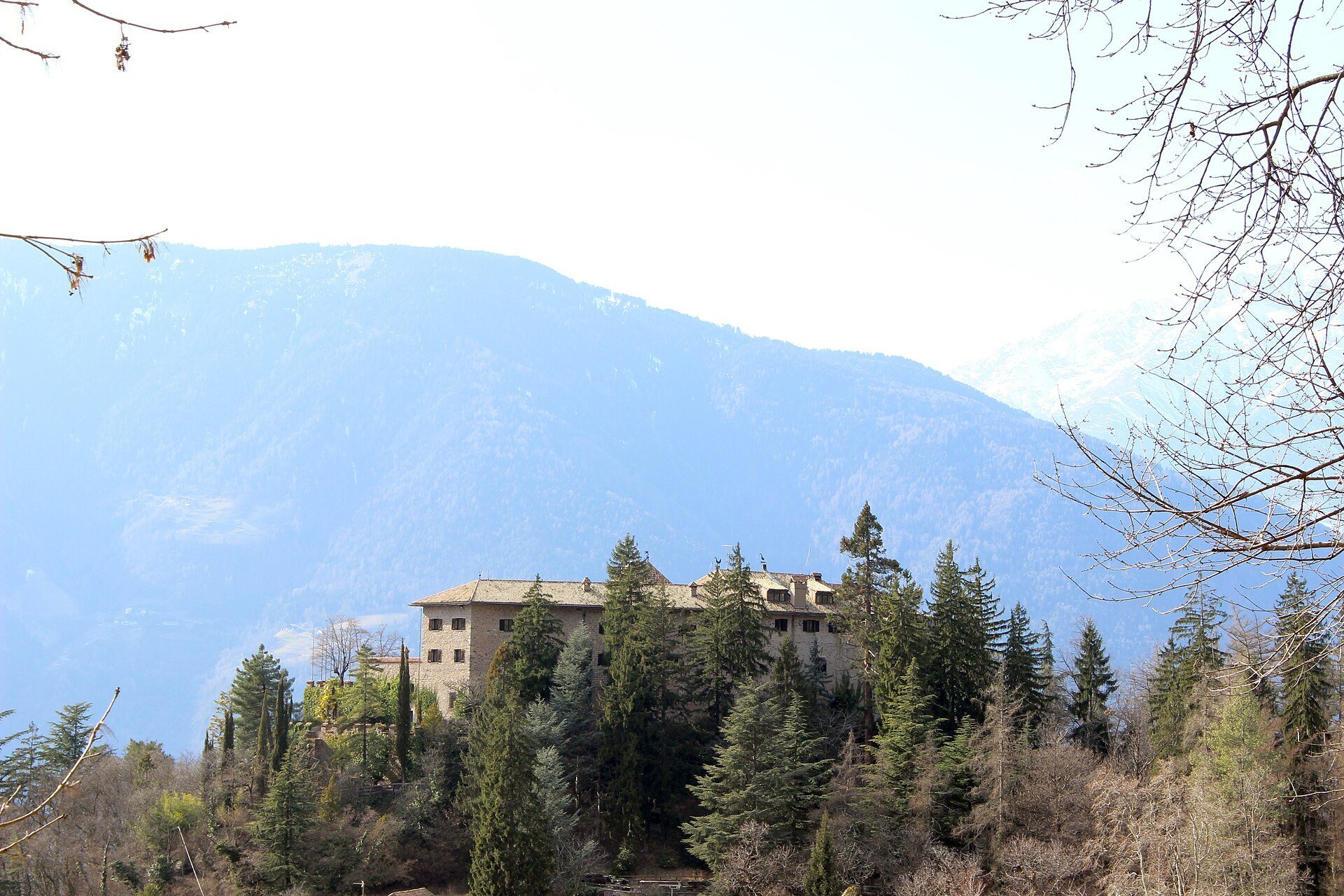
Fragsburg is a high-elevation hill castle on the slopes descending from the Tschögglberg toward the Adige Valley. It stands more than 800 metres above sea level, roughly 500 metres above the Merano basin, and overlooks Sinich. The complex combines a substantial inner castle with an outer defensive area between fortifications, a quadrangular tower, and a small outer bailey that forms a forecourt around the first gate.
Inner castle and residential buildings
Fortifications and tower
The inner castle contains the main defensive and residential structures, including the quadrangular tower and a palas, the principal residential building of a medieval castle. The palas was enlarged during the fifteenth and sixteenth centuries. The outer defensive area, or zwinger, lies between the fortifications, and its gate bears the date 1547.
Palas and interior rooms
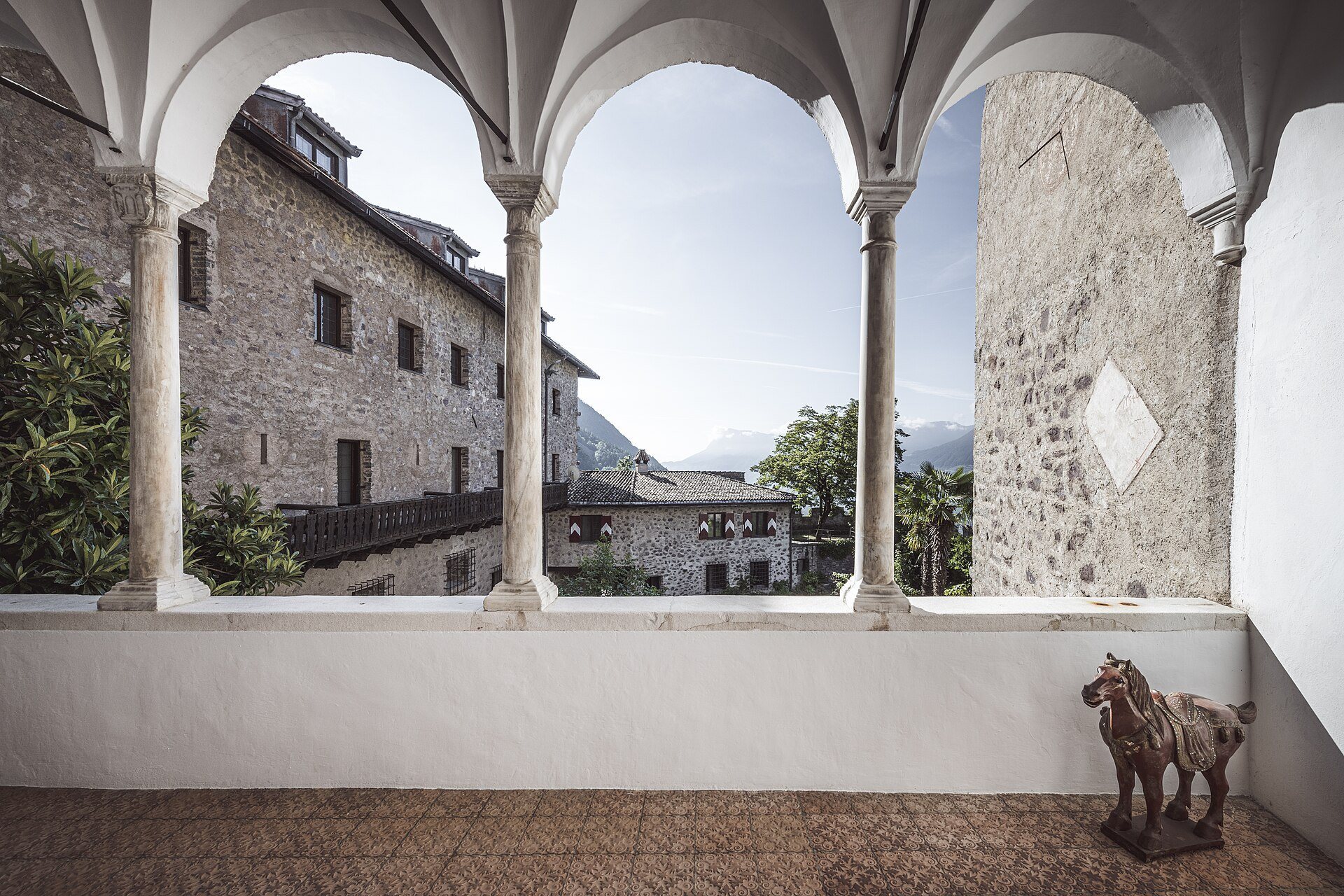
The residential rooms contain groin-vaulted ceilings and doors framed with white marble. Lintel beams carry the Niederthor family arms and the dates 1543, 1544, and 1546. A centrally positioned knights’ hall has elaborate wood paneling and served as a dining hall.
Chapel and loggia
A two-storey loggia and a two-storey chapel form part of the castle complex. The chapel was consecrated in 1376 and has round-arched openings and marble columns on its upper storey.
Gates and dated features
The outer-bailey gate carries two coats of arms, an inscription referring to Jörg von Niederthor, and the date 1551. A sundial dated 1546 was recorded on the tower around 1930. In the nineteenth century, the castle hill was unforested, leaving the battlemented curtain wall widely visible. August Lewald’s travel descriptions from the early 1830s describe the castle’s condition and the lives of its inhabitants; he wrote his book at Fragsburg.
Associated buildings and landscape features
Castel Fragsburg
Castel Fragsburg, also called the Fragsburg hunting lodge, is a separate building southwest and below the castle. It was originally constructed in the seventeenth century as a hunting lodge for the owners of Fragsburg. The building now forms part of the hotel complex reunited with the castle property in 2019.
Sinichbach waterfall
The Sinichbach waterfall, also called Fragsburg Waterfall, is a hydrological natural monument located about a fifteen-minute walk from Fragsburg.