Lebenberg Castle: A Medieval Fortress Complex in Italy


Site at a Glance
- Rating
- 4.6
- Popularity
- Low
- Country
- Italy
- Primary era
- Early Modern
- External website
- Open
- Eras represented
- Medieval, Early Modern, Modern
- Civilizations
- Holy Roman Empire
- Site type
- Military
- Remains
- Castle
On this page12 sections
History
Lebenberg Castle is a hilltop fortress complex in Italy, above Tscherms in South Tyrol, probably built by the Lords of Marling in the second half of the thirteenth century. The Lords of Marling were a branch of the Lords of Lana, and the castle later became the seat of the Lebenberg family. Its long development reflects successive noble owners, major extensions, and changing artistic styles.
The Lords of Marling and Lebenberg
The name appears in several medieval forms, including Lewenberch in 1271, Lewenberg in 1308, and Lebenberch in 1340. It derives from Middle High German words for lion and mountain. In 1940, during the Fascist period, the name was Italianized as Monteleone, and the castle is also known as Castel Monteleone. Members of the Marling family are recorded between 1236 and 1270. Rudolf’s son used the designation “of Meringa and Lebenberg” in 1260, while the sons of Cunz von Mering were calling themselves “of Lebenberg” by 1286.
Transfer to the Fuchs von Fuchsberg family
The castle remained with the Lebenberg family until 1426. Leonhard von Lebenberg died in 1421, and the family’s male line ended with Petermann von Lebenberg in 1426. The heiress Dorothea von Lebenberg then transferred the property through her marriage to Wolfhart, also known as Wolfgang, Fuchs von Fuchsberg. The Fuchs von Fuchsberg family, a Tyrolean noble lineage, substantially enlarged and altered the complex during its ownership. Their work helped create the irregular arrangement around winding inner courtyards that characterizes the castle.
Later ownership and museum use
After the Fuchs von Fuchsberg family became extinct in 1828, Lebenberg Castle passed through several owners, including the Miagro and Miagro von Fuchs families. Adrian van Rossem van Sinoutskerke, a Dutchman, acquired the property in 1924, and his descendants still occupy part of the castle. The remaining part houses a castle museum. Its interiors were arranged by the present owners with the help of earlier descriptions, plans, and inventory registers, while its furnishings range from the Gothic period through the Empire style. The castle is protected as a cultural heritage monument in South Tyrol and as Italian national heritage.
Remains
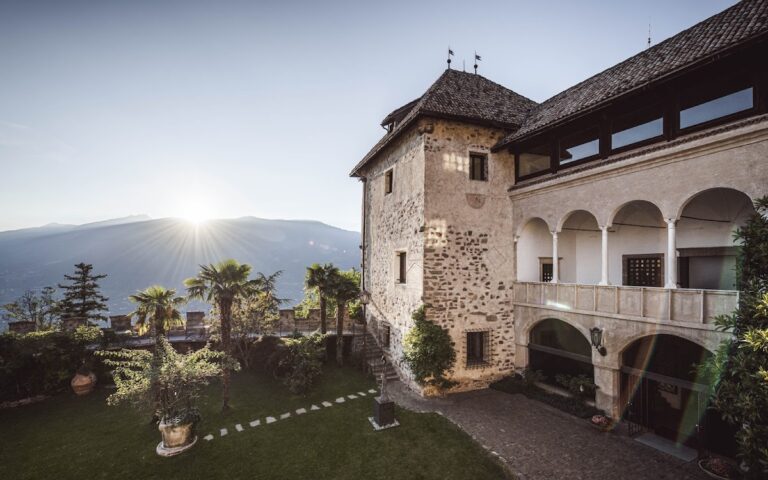
Lebenberg Castle occupies a moraine hill before the slopes of the Marlinger Berg. Its buildings form a large, irregular fortress complex grouped around winding inner courtyards, many of them shaped by the extensions and alterations undertaken by the Fuchs von Fuchsberg family. The courtyards are characteristic of the sixteenth century, while a Rococo ornamental garden surrounds the complex. The castle is described as one of South Tyrol’s largest fully furnished castle complexes, with a stated building area of 380 square metres.
Chapel and historic interiors
Castle chapel
The three-storey castle chapel is dedicated to Saint Stephen. It originated in the fourteenth century and was remodeled in the sixteenth century. Its original phase belongs to the Gothic period, while some of the castle’s stucco and wooden ceilings date from approximately a century after the chapel’s sixteenth-century remodeling.
Furnished rooms
The castle rooms are fully furnished and contain notable frescoes. Among them are recently rediscovered paintings of the Fourteen Holy Helpers, a group of Christian saints traditionally invoked together for protection from particular illnesses and dangers. The museum also contains a collection of medieval weapons.
Halls and decorative features
Hall of Knights
The Hall of Knights contains a large wall fresco presenting the genealogy of the Fuchs family across twelve generations. The composition includes 264 figures and records the family’s dynastic identity within the castle’s historic interiors.
Rococo mirror hall
A Rococo mirror hall is fitted with Venetian mirrors. Rococo is an eighteenth-century European style known for ornamental decoration, and the hall forms part of the castle’s later decorative arrangement.
Napoleonic Hall
The room known as the Napoleonic Hall contains an Empire-style tiled stove. Empire was an early nineteenth-century European style, and this feature contributes to the range of periods represented in the furnished complex.