Château d’Arguel: A Medieval Fortified Castle in France


Site at a Glance
- Rating
- 4.6
- Popularity
- Very Low
- Country
- France
- Primary era
- Medieval
- Eras represented
- Medieval
- Civilizations
- Holy Roman Empire
- Site type
- Military
- Remains
- Castle
On this page7 sections
History
Château d’Arguel is a medieval fortified castle in Fontain, France, begun in the eleventh century under the first lords of Arguel. For roughly two centuries, successive lords took part in disputes involving the barons of the County of Burgundy, the historical region whose inhabitants were known as Comtois.
The lords of Arguel
Jacques d’Arguel became notorious for abuses and extortion against merchants crossing his lands. His reputation was also linked to the legend of the comet of the lord of Arguel. In 1336, during the struggle of the Comtois barons against Eudes IV, Duke and Count of Burgundy, Jacques d’Arguel was defeated and the castle was burned.
A testament made in 1306 transferred the lordship of Arguel to the Chalon family. Louis de Chalon, Prince of Orange, later had Château d’Arguel restored between 1430 and 1450.
Capture and dismantling
After the siege of Besançon in 1668, Condé captured the castle. Condé was a title held by princes of a branch of the French royal House of Bourbon. Louis XIV, king of France from 1643 to 1715, then ordered the castle dismantled. Captain Duchesne defended the site, while his wife, Jeanne-Claude Boituset, was noted for her heroism during its capture.
By 1827, the remains included a vaulted cellar, sections of masonry, and traces of the defensive ditches. The castle precinct now forms part of the registered site of Château d’Arguel and Saint George’s Cave, listed by the Bourgogne-Franche-Comté regional environmental authority.
Remains
Ridge-top layout
The castle occupied a rocky ridge above Arguel village. The village lay to the east, while the Doubs valley extended more than 250 metres below the ridge to the west, on the river’s left bank. The complex comprised a front castle and a rear castle, divided by a defensive ditch.
Front and rear castles
Among the identifiable features are the location of the east tower, the southern wall of the rear castle, and the ditch separating the two sections. These remains preserve the basic division of the fortified complex across the ridge.
Surviving masonry
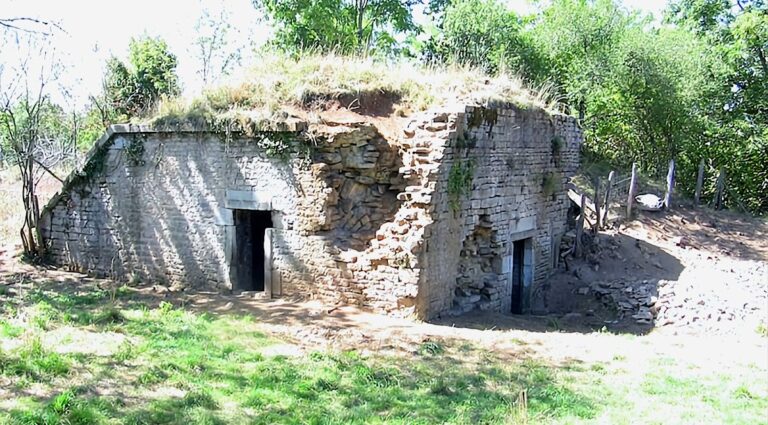
The site is now in ruins. Visible remains include the base of an enclosing defensive wall, fragments of masonry, and entrances to lower rooms. A vaulted cellar survives among the documented remains, while traces of the defensive ditches mark parts of the former perimeter. A coat of arms associated with the lords of Arguel is also recorded at the site.
Nearby sites