Castle Buonas: A Historic Castle Complex on Lake Zug


Site at a Glance
- Rating
- 4.9
- Popularity
- Very Low
- Country
- Switzerland
- Primary era
- Medieval
- Eras represented
- Medieval, Modern
- Civilizations
- Holy Roman Empire, Swiss
- Site type
- Military
- Remains
- Castle
On this page12 sections
History
Castle Buonas is a historic castle complex in Switzerland, located in Buonas within the municipality of Risch on a peninsula in Lake Zug. Its exact construction date is unknown, although an inscription above the portal points to 1071. The place first appears in a record dated 22 January 1130, which mentions the knights of Bochunna.
The Buonas and Hertenstein families
The Buonas family remained associated with the castle into the thirteenth century. Petrus de Buochnase was recorded in 1223, while Adelheid von Buonas, the family’s last representative, married Ulrich von Hertenstein in 1250. Through this marriage, the castle passed to the noble von Hertenstein family of Lucerne.
Ownership became entangled with territorial jurisdiction in the fifteenth century. In 1421, disputes between Zug and the Hertensteins led Zug to threaten a military seizure of the lordship and castle. The Hertensteins hired troops and placed them in the lordship, while Zug recruited soldiers for a confrontation. On 20 August 1424, the Tagsatzung, the federal assembly of the Old Swiss Confederacy, issued an arbitration ruling. The Hertensteins retained all their courts except high jurisdiction, which belonged to Zug.
Fire, rebuilding, and changing ownership
A fire destroyed the castle down to its foundations in 1478. Rebuilding was delayed by renewed disputes with Zug and disagreements among the heirs. Work began in 1494, and the replacement building was completed in 1498 with an additional storey.
Hertenstein rule ended in October 1654, when the last heiress married Johann Martin Schwytzer and transferred the inheritance to him. Schwytzer pursued better relations with Zug than the earlier lords had maintained. In 1782, Josef Xaver Thüring Schwytzer sold the castle for 37,625 guilders to two citizens of Zug, with Zug financing two-thirds of the purchase price. Repeated changes of ownership subsequently contributed to the neglect of the estate.
Nineteenth-century transformation
Count Mieczislaw de Komar of Paris acquired the castle in 1862 and carried out an extensive restoration. In 1871, the property passed to Carl August von Gonzenbach-Escher, director of the Zurich machinery manufacturer Escher-Wyss. He transformed the grounds into a park.
Between 1873 and 1877, Gonzenbach-Escher commissioned the English architect William Wilkinson to build the New Castle, a large Neo-Gothic villa. Neo-Gothic was a nineteenth-century revival of medieval Gothic forms. The villa was regarded as one of the principal works of secular Neo-Gothic architecture in Switzerland.
Loss and preservation
The New Castle was demolished in 1970 and replaced by a country house. Its owner, Annie Bodmer-Abegg, argued that the building was no longer economical to operate and no longer offered contemporary residential comfort. The Zug cantonal building authority accepted this reasoning despite criticism from the Federal Commission for the Preservation of Monuments and the architectural historian Paul Hofer of ETH Zurich.
The demolition is now regarded as one of the greatest losses of architectural substance in the canton of Zug. It also contributed to the canton’s later appointment of a full-time monument-conservation officer. In 1997, the Swiss pharmaceutical company Hoffmann-La Roche acquired the estate to establish a continuing-education center for senior staff and committed itself to preserving the historic buildings. The estate forms part of BLN landscape object no. 1309, “Lake Zug,” in Switzerland’s national inventory of landscapes and natural monuments of national importance.
Remains
Castle Buonas occupies a peninsula on Lake Zug within an extensive park. The surviving historic core is the Old Castle, while the later country house stands on the site of the demolished New Castle. Facilities associated with the Roche training center are also present within the estate.
Historic buildings
Old Castle
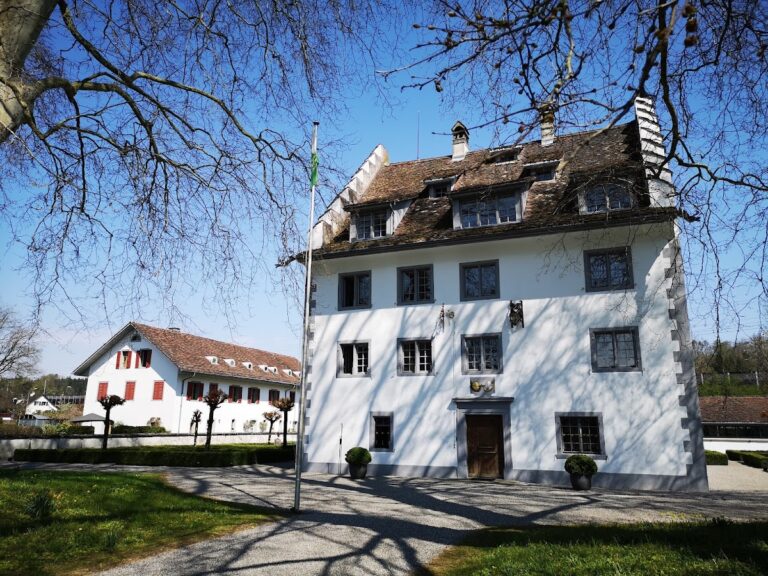
The Old Castle is the surviving historic castle building. Its portal carries an inscription associated with the date 1071, while the site’s first written mention dates to 1130. The building stands within the park beside the fountain known as the Zugerbrunnen.
New Castle site
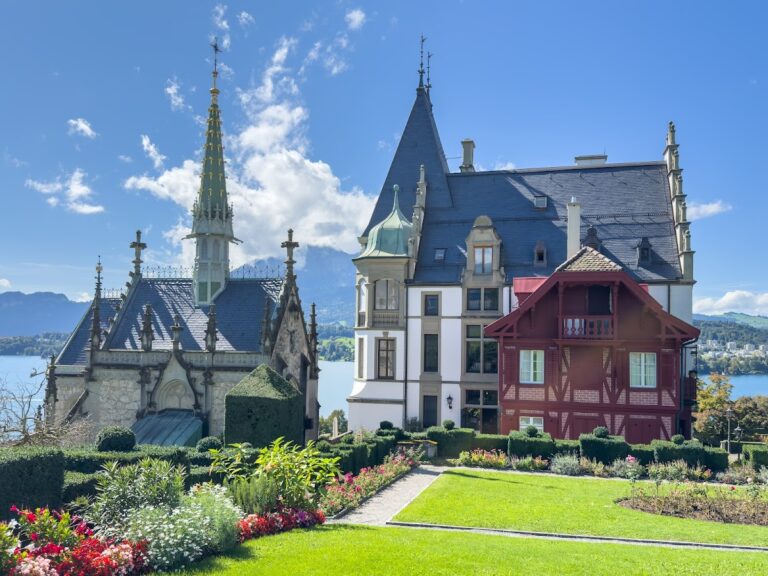
The New Castle was a large Neo-Gothic villa constructed between 1873 and 1877 to designs by William Wilkinson. It was demolished in 1970, and a country house now occupies its place within the estate.
Park and present complex
Parkland and rhododendron garden
The grounds include an extensive park with a southern section containing a rhododendron garden. The Zugerbrunnen fountain is located beside the Old Castle, adding a defined water feature to the historic grounds.
Roche training center
The present complex includes facilities of the Roche training center alongside the Old Castle and the later country house. These buildings form part of the estate’s current arrangement within the park.
Nearby sites