Château de Roche-sur-Loue: A Rebuilt Classical Château in France


Site at a Glance
- Rating
- 4.1
- Popularity
- Very Low
- Country
- France
- Primary era
- Early Modern
- External website
- Open
- Eras represented
- Medieval, Early Modern
- Civilizations
- French, Holy Roman Empire
- Site type
- Domestic
- Remains
- Castle
On this page6 sections
History
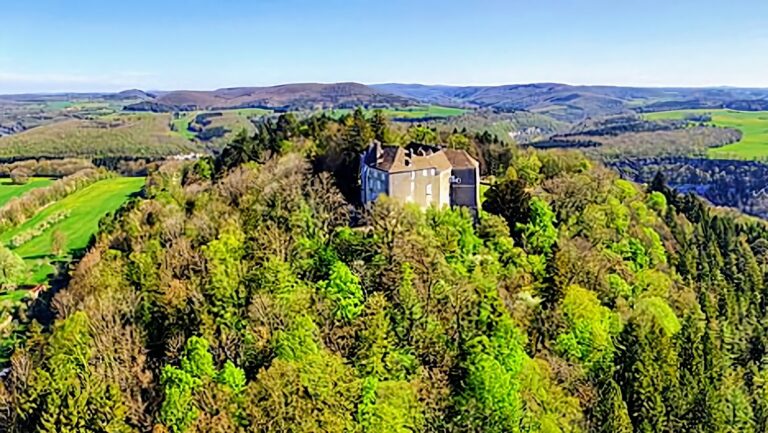
Château de Roche-sur-Loue is an eleventh-century fortified castle at Roche-sur-Loue in France, now within the commune of Arc-et-Senans. Completely rebuilt in 1756, it became a Classical-style château that incorporated the site of the earlier fortress and its strategic position.
Medieval fortress and the Jura Salt Route
During the medieval period, Arc-en-Valloye and Sonans, which correspond to present-day Arc-et-Senans, belonged to the lords of Salins, who held their lands as vassals of the County of Burgundy. Roche-sur-Loue was the eastern of two fortified houses protecting the area. Château-Rouillaud stood to the west, but it was burned in 1638.
In 1080, the lordship and its original fortress belonged to Countess Étiennette of Burgundy, the wife of Count William I of Burgundy and mother of Pope Callistus II, who served as pope from 1119 to 1124. The fortress controlled a communications junction on the Jura Salt Route and a ford across the Loue River. Its principal fortified tower stood where the present entrance gate is located.
From seigneurial estate to Classical residence
After 1615, the estate belonged to the de Brun family. In 1694, the family obtained its elevation to a marquisate, a territorial lordship held by a marquis and historically associated with strategically important lands.
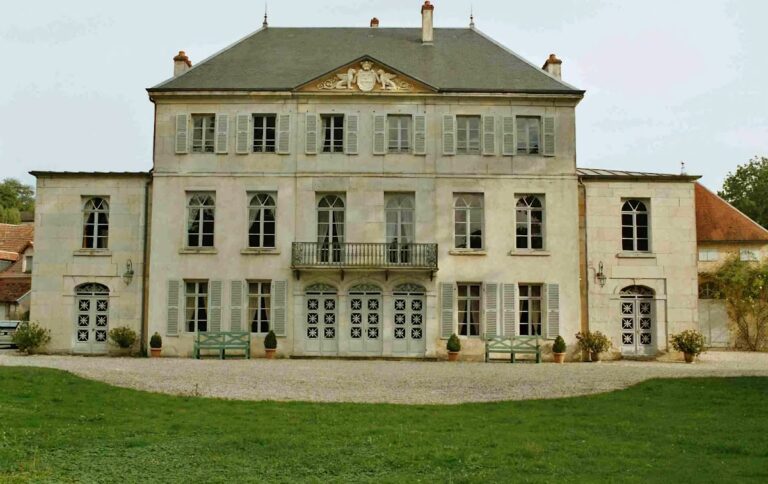
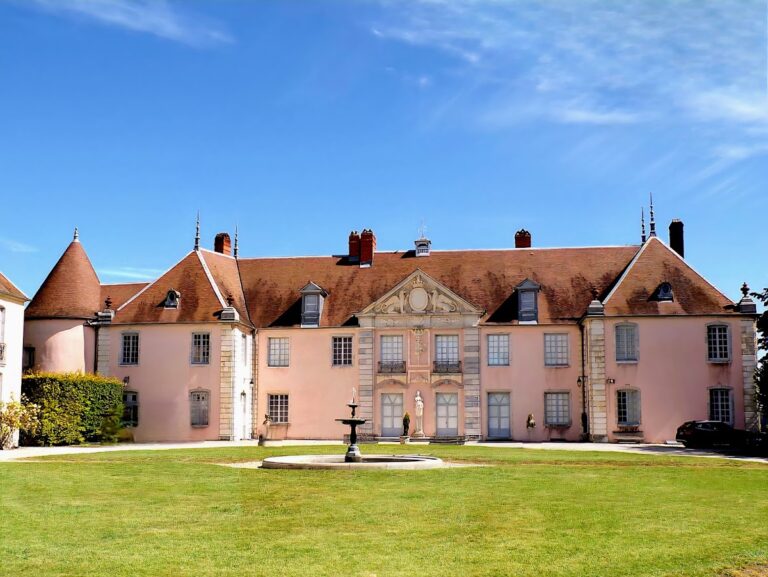
In 1756, the Marquis of Grammont, heir to the preceding owners, completely reconstructed the château over the original fortress. The rebuilding created an elegant residence between two square towers and added an imperial-style roof, a curved roof form rising toward a rounded or bulbous profile rather than a simple pitched shape.
Industrial transformation and modern protection
The neighboring Royal Saltworks of Arc-et-Senans was built in 1775. Although the locality had no underground salt deposits, the saltworks was established because the Chaux Forest provided abundant firewood. Its first hundredweight of salt was produced in 1779.
In 1864, Amédée Caron, a nineteenth-century industrialist associated with the estate, transformed the château again and introduced industrial activity there. The property is privately owned and used as a hotel. It has been listed as a historic monument since 1974, with protection covering its façades and roofs.
Remains
The surviving château combines the scale and arrangement of an eighteenth-century residence with the position of the medieval fortress beneath it. The main residential body has one full floor and an additional level beneath the attic. Two square towers or pavilions flank the residence, while the building is covered by a slate roof.
Residence, towers, and entrance
The eighteenth-century château is organized between two square towers, giving the rebuilt residence a clear symmetrical form. Its principal body contains the living accommodation, with the extra level set below the attic. The slate roof includes the imperial-style profile introduced during the eighteenth-century reconstruction.
The original fortified tower occupied the location of the present entrance gate. This surviving alignment preserves the relationship between the medieval defensive complex and the later château, whose façades and roofs are protected as historic fabric. The building is described as being in excellent condition.
Nearby sites