Ewsum: A Former Borg and Estate in the Netherlands
Site at a Glance
- Rating
- 4.8
- Popularity
- Very Low
- Country
- Netherlands
- Primary era
- Medieval
- External website
- Open
- Eras represented
- Medieval, Early Modern, Modern
- Civilizations
- Dutch, Holy Roman Empire
- Site type
- Military
- Remains
- Castle
On this page16 sections
History
Ewsum is a former borg and country estate in the Netherlands, near Middelstum, whose surviving buildings and grounds reflect the development of a fortified residence from the Middle Ages into a landed estate. It stood east of the Boterdiep in the historic area of Den Oert, and is traditionally regarded as the ancestral castle of the Van Ewsum family, although that identification remains uncertain.
Origins and the Van Ewsum family
A forged charter claims that an earlier stronghold at De Oert was destroyed by the people of Groningen around 1250. It then attributes a new borg nearby to Jonker Ewe of De Oert, who supposedly commissioned it in 1278. The new foundation was called Ewesheim, meaning “Ewe’s home,” and this name later developed into Ewsum. The borg is first mentioned in a charter of 1371. A related charter dated 1353 is also a forgery, and it is uncertain whether it preserves any genuine historical information.
The Van Ewsum family took its name from the borg and became one of the most influential families of the Ommelanden, the historic countryside surrounding Groningen, between the fourteenth and sixteenth centuries. Ewe’s daughter Menneke married Hidde Tamminga of Hornhuizen. Hidde reportedly adopted the name Ewesma to prevent the family name from dying out.
A tradition recorded by the historian Ubbo Emmius says that Focko Ukena killed Hidde in 1428 after defeating his forces, then arranged the marriage of his daughter Bawe to Hidde’s son Ewe. The story is problematic because annals record Hidde as late as 1431. Menneke may have had Ewsum rebuilt after Hidde’s death. Stone from nearby demolished borgen was purchased in 1439, 1442, and 1443, while the original complex was probably a steenhuis, a compact medieval stone-built fortified residence.
Onno van Ewsum and fifteenth-century fortification
Hidde’s younger son Onno inherited Ewsum in 1428. During the first half of the fifteenth century, he constructed a defensive wall surrounded by water, together with a gatehouse, and later added a corner tower. In 1472 he built a massive gun tower in response to the growing use of firearms during conflicts between the Schieringers and Vetkopers, rival political factions in medieval Friesland and the northern Netherlands. The city of Groningen unsuccessfully attempted to prevent its construction.
Onno travelled to the Holy Land in 1450 with Albert Jarges, a former mayor of Groningen. Both men were knighted in Jerusalem. Jarges drowned in the Jordan during an attack by Saracens, while Onno was captured and later ransomed himself. A tradition holds that his safe return led him to rebuild and enlarge the church at Middelstum.
Onno greatly increased the family’s property holdings. At his death in 1489, he possessed 1,899 hectares of land, held another 647.5 hectares jointly with the Tamminga family, and owned houses in Groningen and Norden. His children subsequently used the name Van Ewsum.
War, damage, and contested inheritance
During the Gelderse Wars, conflicts involving Guelders and competing powers in the northeastern Netherlands, Onno’s surviving sons Abeke, Relof, and Wigbold supported Albert of Saxony and Edzard I of East Frisia against Groningen. Groningen troops heavily damaged Ewsum and Mensinge in 1499. After Groningen recognized Edzard’s rule in 1506, the Van Ewsums restored both properties.
Abeke, commander of Appingedam under Edzard, died childless in 1503. Wigbold received Ewsum, while Relof received Mensinge. In 1514 the brothers supported George of Saxony and helped him capture Appingedam. They were knighted after the town’s capture, during which part of the population was killed. When George’s forces were later defeated, he transferred his rights to Emperor Charles V in 1515. The brothers refused to recognize the transfer and fled. Wigbold was released from his oath to George in 1515 and from his oath to Charles V in 1520, after which Charles allowed him to return to the Ommelanden.
Wigbold did not immediately reoccupy Ewsum. He lived at Nienoord and concentrated on strengthening his legal position in Vredewold. After his death in 1528, keepers probably managed Ewsum rather than members of the family occupying it themselves.
Sixteenth-century enlargement
After Beetke’s death in 1554, Johan van Ewsum received Ewsum and Mensinge. He preferred Mensinge but may also have stayed at Ewsum. In 1561 he installed stained-glass windows and probably a fireplace that is now in the Rijksmuseum in Amsterdam. He enlarged the borg, added a stair tower, and moved the entrance.
Johan supported the Reformation, the movement that challenged established Catholic authority in western Christianity, but he fought Protestants during the Schmalkaldic War, a conflict between Protestant princes and the Catholic emperor in the Holy Roman Empire. He later remained neutral during the first invasion associated with the Battle of Heiligerlee. Johan died heavily indebted in 1570.
His son Aepco, also called Onno, supported Spain and died childless in 1599. After other heirs had died, Ewsum passed to Johan’s daughter Susanna, who was married to the commander Jacques Salencijn. Because the estate was heavily indebted, Susanna transferred Ewsum to her cousin Caspar van Ewsum, commander of Coevorden, to prevent its sale. Caspar initially stopped the sale but bought the borg himself at auction in 1601. In 1610 he gave it to his cousin Luirdt, Baron Ripperda of Winsum.
From fortified residence to country estate
After Luirdt Ripperda’s death in 1616, his widow, Ida Lewe of Zandeweer, sold Ewsum to the Groningen mayor Abel Coenders. Coenders installed stained-glass windows in 1628 and died the following year. Through the division of his estate, Ewsum passed to Evert Lewe of the Asinga borg at Ulrum, who acted as legal guardian for Coenders’s grandchildren.
After Evert Lewe’s death in 1641, his son Johan received Ewsum and the Middelstum borg Asinga in 1648. Around 1649 Johan extensively rebuilt Ewsum in the style of Scheltkema-Nijenstein. The work changed the complex from a fortified residence into a country estate. Johan added a tower, lowered the gun tower, and encased its lower section with a new layer of stone. Parts of the borg were demolished shortly before 1657, and the western schathuis, an agricultural and service building belonging to a borg estate, was built that year.
A painting by Jan Janz. de Stomme from 1657 or 1658 shows Ewsum with two gun towers, although the site never possessed a second gun tower. Around 1649 Johan also acquired Mentheda and became lord of all Middelstum. He retained the seigneurial rights of Asinga, meaning local governmental, judicial, or economic privileges attached to a lordship or estate, even after selling that borg.
Ewsum remained in the Lewe family through the eighteenth century. After Evert Lewe’s death around 1670, the property passed to his son Evert, then to his brother Reint in 1680, and subsequently to Johan, Reint Jan Lewe, and Edzard Jacob. After Edzard Jacob’s death in 1753, his widow Allegonda Maria Rengers retained the estate until her death in 1798.
Nineteenth-century demolition and modern preservation
A sale of the estate was delayed in 1798 because the Batavian Republic, the French-supported Dutch republic that existed from 1795 to 1806, temporarily prohibited transfers by former officeholders who had fled abroad. The restriction affected Edzard Jacob’s eldest son Reint Jan, who had held a senior office in the Ommelanden and had fled to Norden. The estate remained unsold after the restriction was lifted.
An inventory made around 1800 listed Ewsum, its lands, two houses in Groningen, 2,135 grazen of land, and 65 farmsteads near Middelstum and Stitswerd. The land produced an annual income of 7,700 guilders. Cash and bonds amounted to 26,778 guilders, against approximately 118,635 guilders in debts and overdue interest.
After Reint Jan’s death in 1800, Ewsum passed to his younger brother Egbert. Egbert transferred it with its rights to his son Edzard Jacob in 1805. Edzard Jacob established his office at Ewsum, made the house habitable, and repaired it. He unsuccessfully attempted to sell the property privately in 1851. The estate was sold publicly in 1856 to Hendrik Willem Wierda, later mayor of Winsum. Edzard Jacob died the same year while travelling to Ouderkerk, where he intended to settle.
Wierda demolished the deteriorated borg and the western schathuis in 1863. The gun tower and eastern schathuis survived. Five stone coats of arms from the tower facade were moved to the facade of Ekenstein. Much of the other stone and rubble was dispersed across Groningen, while Wierda used a large quantity to harden the Oosterbuursterweg, now called Oosterburen. The ground around the borg was excavated to a depth of 1.7 metres, and many objects from the property were transferred to the Groningen Museum.
The grounds remained neglected for several decades. Siemon Ludolf Vinhuizen bought them in 1916 and felled the linden trees around the borg in 1917. In 1932 he commissioned the architect Sietze Albert Veenstra to build a large farm building behind the eastern schathuis in the Amsterdam School style, an early twentieth-century Dutch movement known for expressive brickwork and sculptural ornament.
Between 1984 and 1994, the State Forestry Service created the Middelstumerbos village woodland south of Ewsum’s entrance avenue. During the early 1990s, a programme restored the borg grounds and surviving buildings. The gun tower was restored in 1991, and the inner and outer moats were dredged in 1994. In 1993, Jacob Vinhuizen’s descendants sold Ewsum and its surrounding lands to the State Forestry Service, which leased the property to the Stichting Groninger Borgen.
Archaeological research in 1998 located rubble from the foundations of the western schathuis and a feature that may have belonged to an earlier borg or to one of the two schathuizen. The Stichting Beheer Borgterrein Ewsum received the grounds in 2006 and has held them on a long lease from the State Forestry Service since then. Restoration has included a fruit wall and greenhouse, drainage, paths, a vegetable garden, and work on the surviving schathuis. Ewsum is protected as a Rijksmonument, a Dutch monument of national importance, under monument number 515606.
Remains
Ewsum’s surviving historic fabric consists principally of the characteristic 1472 gun tower and the eastern schathuis. These structures belong to a larger estate landscape that once included the borg, a second schathuis, parkland, moats, gardens, lanes, ponds, and associated agricultural grounds. The borg stood east of the Boterdiep in Den Oert and was reached across a bridge called Toptil. An entrance road led from the surrounding estate grounds toward the residence.
Fortified core
The fifteenth-century defensive complex was surrounded by water and included a shield wall, a gatehouse, a later corner tower, and the heavy gun tower. The earlier residence was probably a steenhuis. A copy of a painting from around 1600 appears to show part of such an older stone-built structure behind the stair tower, suggesting that the borg may have incorporated an earlier building.
Gun tower
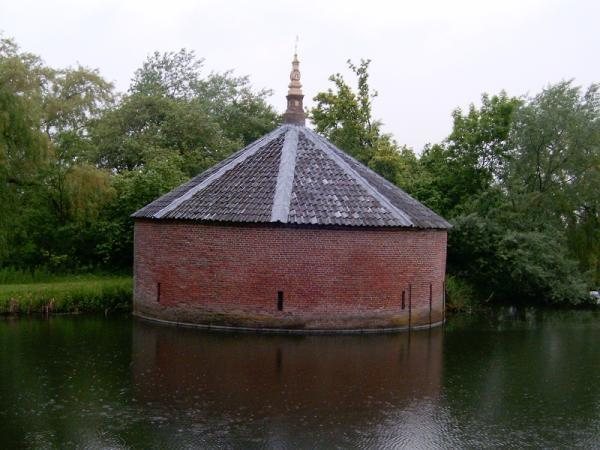
Built in 1472, the gun tower is almost 12 metres in diameter, with walls more than 2 metres thick. It was adapted to the increasing use of firearms during the conflicts between the Schieringers and Vetkopers. The tower originally had an additional upper floor, which was removed during Johan Lewe’s rebuilding around 1649. At the same time, its lower section was enclosed with a new stone layer, leaving the tower in a lowered form. The structure was restored in 1991.
Later borg structures
Johan van Ewsum’s sixteenth-century enlargement added a stair tower and relocated the entrance. Around 1649, Johan Lewe added another tower and rebuilt the complex after the model of Scheltkema-Nijenstein. The transformation made the residence function as a country estate rather than primarily as a fortified dwelling. Five stone coats of arms that had been set into the gun tower facade were removed in 1863 and reused on the facade of Ekenstein.
Agricultural and service buildings
Western schathuis
The western schathuis was built in 1657 as part of the estate’s agricultural complex. It was demolished with the borg in 1863. Archaeological work in 1998 found rubble from its foundations, preserving evidence of its former position within the grounds.
Eastern schathuis
The eastern schathuis survives and is associated with a large farm building constructed behind it in 1932. The complex includes a coachman’s residence on the south side, a coach house with a horse stable in the middle, a harness-cleaning room to the north, and livestock accommodation beneath a second roof. The former schathuis also contains a restored coach house used as a tea room and exhibition space.
Grounds and archaeological features
The 1798 sale description listed two schathuizen, one with an orangery, as well as gardens, boundary avenues, lanes, canals, ponds, trees, plantations, and an estate area of approximately 11 grazen. It also mentioned a summerhouse or garden pavilion on the Boterdiep, an apple orchard with a pond, and the former sites of the demolished Asinga and Mentheda borgen with their roundels and moats. A roundel was a circular earthwork or fortified enclosure associated with an earlier stronghold.
The grounds now include dredged inner and outer moats, a replanted linden avenue, a fruit wall with greenhouse, drainage, paths, and a vegetable garden. A stone foundation uncovered beneath the borg during the 1863 demolition may have belonged to a tower. The subsequent excavation of the surrounding ground to 1.7 metres altered the archaeological setting, while stone and rubble from the demolished buildings were reused or dispersed.
Decorative and movable remains
Stained-glass windows were installed at Ewsum in 1561 and 1628. A fireplace probably installed during the 1561 enlargement is now held by the Rijksmuseum in Amsterdam. Other objects from the borg were transferred to the Groningen Museum.
A portrait painting of Johan Lewe’s sons, made by Jan Janz. de Stomme in 1657 or 1658, depicts Ewsum with two gun towers. The image provides a view of the estate’s appearance at that time, although the site never possessed a second gun tower.