Burg Grimnitz: A Romanesque Askanian Border Castle in Germany


Site at a Glance
- Rating
- 3.6
- Popularity
- Very Low
- Country
- Germany
- Primary era
- Medieval
- External website
- Open
- Eras represented
- Medieval
- Civilizations
- Holy Roman Empire, Margraviate of Brandenburg
- Site type
- Military
- Remains
- Castle
On this page5 sections
History
Burg Grimnitz is a Romanesque border castle in Germany, located in Joachimsthal and built for the Askanian margraves, the Brandenburg branch of a medieval ruling dynasty. Its construction is placed in 1247–1297, although its exact age is uncertain, and the first known documentary mention dates from 1297. The castle stood on the edge of the Uckermark, a historical region in northeastern Germany, where it secured the road toward the Uckermark and Pomerania between Lake Werbellin and Lake Grimnitz.
Margravial Hunting Residence
Grimnitz already existed during the joint rule of the Brandenburg margraves Johann I and Otto III. Alongside its frontier function, it served as a hunting residence on the edge of the Schorfheide, a large forested area in Brandenburg. After the territories of Johann I and Otto III were divided, the castle passed to the Johannine line and became the preferred hunting residence of Otto IV. His successors, including Waldemar the Great, continued to stay there regularly.
The complex began to decline from around 1340. Under Elector Joachim I, a prince entitled to participate in the election of the Holy Roman Emperor, the castle was restored in 1514. It was subsequently modernized by the master builder Caspar Theiss. In 1529, Grimnitz hosted the signing of the inheritance treaty between Brandenburg and Pomerania, giving the castle a role in the political settlement of the region.
Glassmaking and Decline
Between 1571 and 1584, during the rule of Elector Johann Georg, the court physician and court alchemist Leonhard Thurneysser established the Grimnitz glassworks. A court alchemist was a court-employed specialist whose work included alchemy, experimental substances, and related medical or metallurgical knowledge. The glassworks moved several times within Joachimsthal before relocating through Althüttendorf to Neugrimnitz, north of Althüttendorf.
During the Thirty Years’ War, a prolonged European conflict, Burg Grimnitz was heavily damaged and partly destroyed. In the eighteenth century, it was definitively abandoned to decay. A building-materials dealer acquired the ruins for demolition in 1860, but his heirs donated them to the German Emperor Wilhelm I in 1885. The ruins are now owned by the Grimnitz Glassworks Association.
Remains
Hilltop Castle Remains
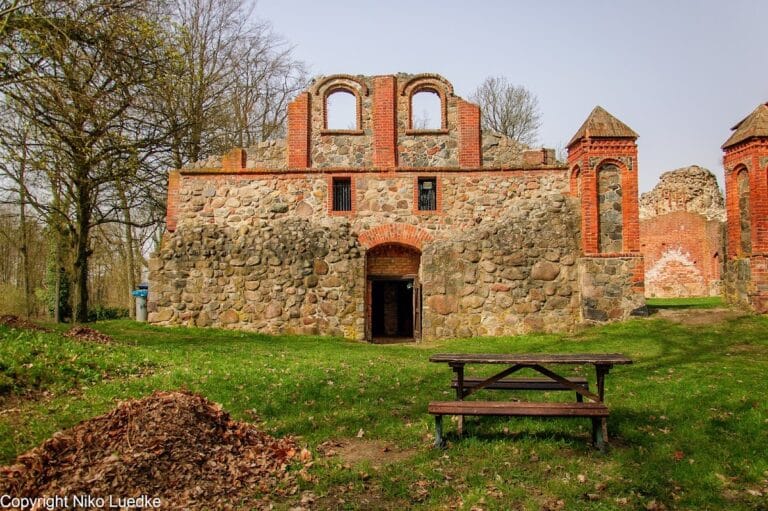
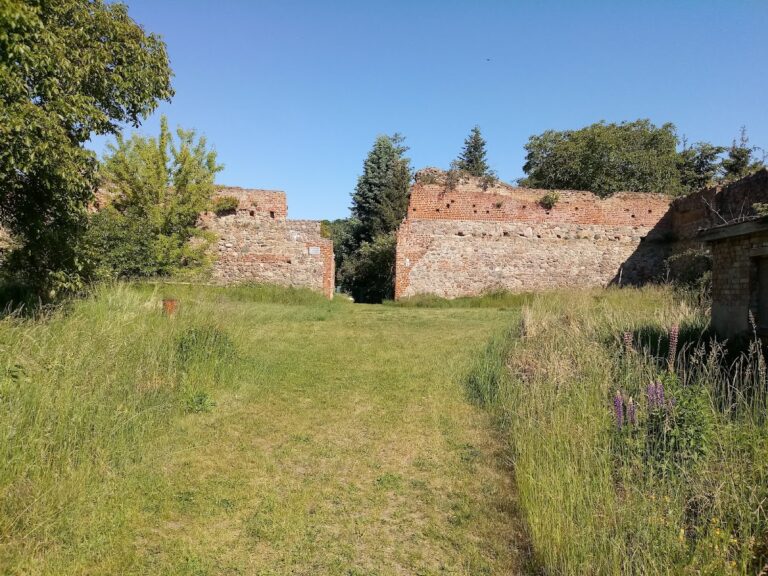
Burg Grimnitz occupies a sandy elevation in a settled area of Joachimsthal’s Grimnitz district. The hilltop setting formed the physical basis of the castle’s defensive position. The surviving complex is limited to archaeological and partial structural remains, including the exterior grounds, a cellar vault, foundations of the surrounding wall, and the former fortification ditch. Together, these elements preserve the outline and defensive character of the Romanesque castle while reflecting the damage, destruction, and later deterioration that shaped its present condition.
Nearby sites