Ringenwalde Church: A Gothic Fieldstone Church in Germany


Site at a Glance
- Rating
- 4.8
- Popularity
- Very Low
- Country
- Germany
- Primary era
- Medieval
- Eras represented
- Medieval, Early Modern, Modern
- Civilizations
- German, Holy Roman Empire, Kingdom of Prussia, Margraviate of Brandenburg
- Site type
- Religious
- Remains
- Church
On this page10 sections
History
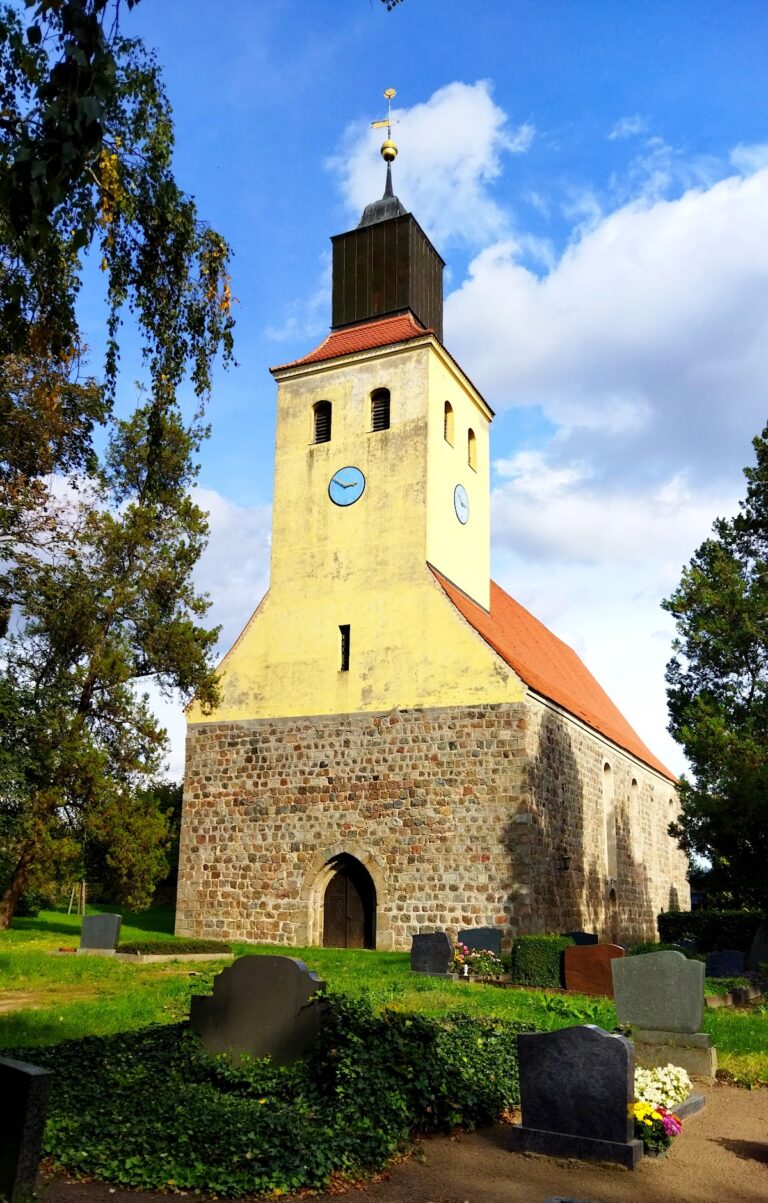
Ringenwalde church is a medieval Protestant church in Germany, located in Temmen-Ringenwalde, Brandenburg. Built in the second half of the thirteenth century in the Gothic tradition, it was consecrated in 1280 and became part of the Oberes Havelland church district within the Evangelical Church of Berlin-Brandenburg-Silesian Upper Lusatia. Its history includes repeated destruction, rebuilding, changing patterns of patronage, and the survival of important furnishings from the sixteenth through the eighteenth centuries.
Medieval Foundation
The original church was a rectangular fieldstone building with a rectangular choir and a low tower covered by a gabled roof. A threshold beam between the nave and choir dates from the 1230s, while dendrochronology, the dating of timber through its annual growth rings, places the choir roof structure around 1408–1409. These surviving wooden elements preserve evidence of the building’s early construction and later medieval development.
Fire and Rebuilding
A fire in 1580 destroyed the church down to its fieldstone base. Master builder Baltasar Gottschalk rebuilt the structure, which was reconsecrated in 1590. The tower superstructure was constructed in half-timbering during this rebuilding phase. A local legend later attributed the tower’s destruction to the Devil, who was said to have become angry about the church’s construction and thrown a large stone at it.
The church was destroyed again during the Thirty Years’ War, the European conflict of 1618–1648 that involved religious, dynastic, and political struggles across the Holy Roman Empire and neighboring regions. It was subsequently rebuilt, continuing the cycle of repair and adaptation that shaped its present form.
Eighteenth-Century Renewal
In 1760, the church received an organ made by Johann Peter Migendt, an eighteenth-century organ builder. Its patron, Wilhelm Joachim von Ahlimb, donated the instrument and renewed almost the entire church inventory for the four-hundredth anniversary of the county. Only a few earlier pieces remained from the previous furnishings. The pulpit altar is believed to date from 1759, and the wooden baptismal font from 1758, placing much of the interior’s present character within this period.
Nineteenth- and Twentieth-Century Changes
The nineteenth century brought a south porch and an addition for a crypt. In 1890–1891, the earlier wooden tower superstructure was demolished and replaced with a Neo-Gothic brick tower. The new tower was inaugurated in November 1891. The same period also saw the incorporation of older colored glass into ornamental glazing and the enlargement of the east-gable windows.
In 1913, the organ was converted from mechanical action, which uses physical linkages, to pneumatic action, which transmits the player’s movements through air pressure. The Eberswalde firm Albert Kienscherf expanded it to two manuals, an independent pedal division, and fifteen speaking stops, meaning audible ranks of pipes. The patronage gallery, a private viewing gallery for the church’s patronage family, was demolished in 1958, and part of it was attached to the north wall. The altar’s color scheme was redesigned in 1959.
Later work addressed both the building and its furnishings. An electric blower was installed for the organ by the Eberswalde firm Fahlberg in 1977. The roof was renovated in 1992, and the interior stove was restored during work on the nave, with the most recent work completed in 2003 by the Ringenwalde master stove setter Winfried Rathnow. In 1985, organ researcher Wolf Bergelt identified the instrument as a Migendt organ. Organbau Rühle restored it in 2006, largely returning it to its 1760 condition, while Ringenwalde restorer Gerhard Prückner reconstructed its original painted finish. The church is listed in Brandenburg’s monument database under number 09130600.
Remains
Building and Tower
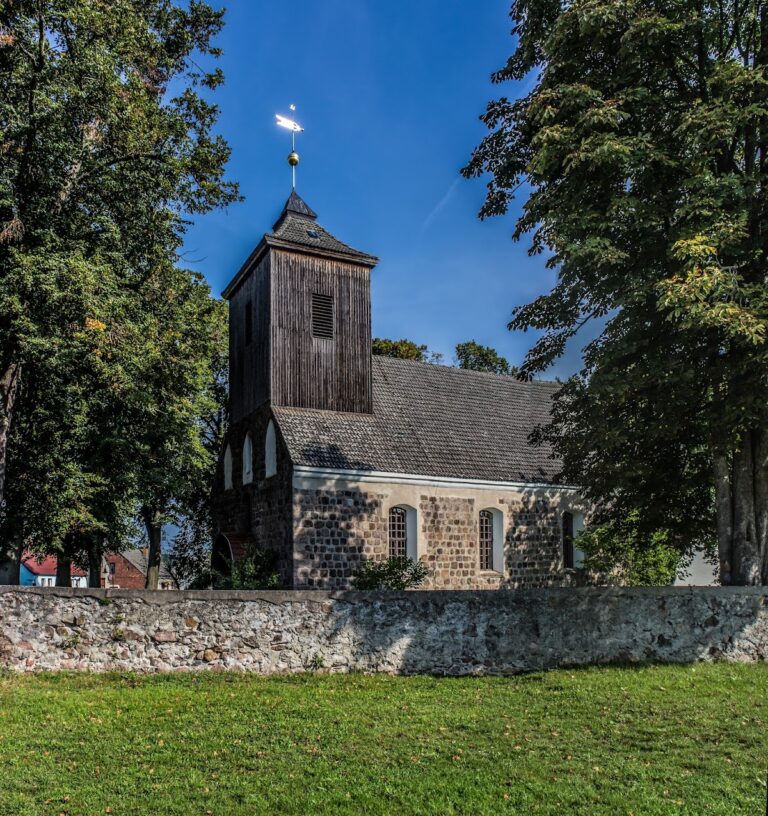
Ringenwalde church survives as a simple rectangular fieldstone hall with a flat ceiling beneath a gabled roof. The original west tower is as wide as the nave. Its old base now supports a square Neo-Gothic brick superstructure with a pointed roof. The tower rises 37.5 meters and has two pointed-arch sound openings on each side, oriented toward the four cardinal directions. Its entrance is a fourfold-recessed pointed-arch portal dating from the late nineteenth-century rebuilding, and a tower clock made by the Berlin firm Rochlitz forms part of the later structure.
The east gable is decorated with vertical blind arcades, shallow arches that do not open into the wall. It contains two pointed-arch windows, with a third opening between them bricked up, and a circular window above. The pointed-arch windows were enlarged in the nineteenth century and fitted with brick reveals. The circular opening indicates that the church formerly had a wooden barrel vault, a continuous curved ceiling, rather than the flat ceiling visible today.
Interior Furnishings
Much of the interior furnishing dates from around 1760. The pulpit altar, an integrated structure combining preaching and altar services, is believed to have been made in 1759. The wooden baptismal font dates from 1758. Their forms are more restrained and rigid than the Rocaille decoration of the organ case. Rocaille was an ornamental style of the Rococo period based on asymmetrical shell-like, scrolling, and rockwork motifs. The altar cross probably dates from the sixteenth century.
The north choir window contains three round panes donated in 1599 and showing biblical scenes. They were incorporated into ornamental glazing in 1891. Other nineteenth-century windows preserve the names and dates of additional pastors and sextons. Two sandstone epitaphs, commemorative monuments for deceased members of the patronage family, honor Joachim Wichmann von Ahlimb, who died in 1717, and Karl Wilhelm von Ahlimb, who died in 1720. Each monument includes a high-quality marble bust.
The movable furnishings include a communion chalice approximately 18 centimeters high, dating from the sixteenth century, and a pewter candlestick from 1671. A second candlestick was stolen in 1969. An iron stove from the second half of the nineteenth century stands inside the church and was restored to working order in 2003.
Organ
Migendt’s organ originally had eight, or possibly nine, stops on one manual. A stop is a controllable set of pipes with a particular sound, while a manual is a keyboard played by the hands. Kienscherf’s 1913 work added a second manual and an independent pedal, altered the case, and installed pneumatic action. After the 2006 restoration, the instrument has twelve stops, including a later three-stop pedal added by Rühle on the model of the organ in the castle church at Stettin, now Szczecin in Poland. This addition differs from the organ’s 1760 configuration.
Approximately 80 percent of the original Migendt pipes survive. The organ case also contains two putti, childlike decorative figures. A rope connected to the stop action of the trumpet stop makes them raise their arms and bring their trombones to their mouths when the stop is drawn.
Bells
The tower contains two bells. The larger dates from 1320 and measures 107 centimeters in diameter. The smaller was cast in 1618 and has a tooth frieze and the inscription O rex glorie veni cum pace, meaning “King of Glory, come with your peace.” A third bell, cast in 1731, was melted down during the Second World War.