Fischenich Castle: A Medieval Hill Castle in Germany


Site at a Glance
- Rating
- 3.3
- Popularity
- Very Low
- Country
- Germany
- Primary era
- Medieval
- Eras represented
- Medieval
- Civilizations
- Holy Roman Empire
- Site type
- Military
- Remains
- Castle
On this page8 sections
History
Fischenich Castle is a medieval hill castle in Germany, located in Fischenich, now part of Hürth in North Rhine-Westphalia. The Lords of Fischenich built it on the slope of the Vorgebirge during the twelfth or thirteenth century. They served the archbishop of Cologne as ministeriales, members of the medieval service nobility who carried out administrative, military, and judicial duties for powerful lords. The ruins are regarded as the remains of the oldest surviving castle complex among the fortifications of the Vorgebirge between Cologne and Bonn, as well as an important example of high-medieval castle building in the Rhineland.
The Fischenich lords and Electoral Cologne
The earliest named lord was the knight Contze, or Conrad, von Fischenich. In 1309 he transferred the castle to Archbishop Heinrich of Cologne as a fief and as an “open house” of the archbishopric. This arrangement made the fortress available to the archbishop for military or administrative use and defense. During Heinrich’s conflict with the city of Cologne, an arbitration ruling in 1320 pledged the castle and the town of Brühl to the people of Cologne. Contze nevertheless continued to hold Brühl and the town as burgrave, a castle governor responsible for administration and defense, with twenty armed men paid for by the archbishop.
The castle house remained with the von Fischenich family for more than five generations. Through the marriage of Jutta von Fischenich to Dietrich von Zweiffel, it passed into the Zweiffel family. Dietrich received it as a fief in 1455, followed by their sons Johann in 1480 and Albrecht in 1502. Although Fischenich lay within the Duchy of Jülich, the castle itself was held as a fief of Electoral Cologne, the territory ruled by the archbishop of Cologne in his role as a prince-elector of the Holy Roman Empire. Its feudal holders represented the Cologne knighthood in the Electoral Cologne Diet and held the associated right to vote.
Transfer among noble families
Hermann von Fischenich received the castle from his relative Albrecht von Zweiffel in 1502. In 1565, Hermann’s daughter Margarethe brought it through her marriage to Winand von Moelenbach, known as Breil, into the Breil family. The marriage settlement also included the Frentzenhof at Fischenich and other estates.
Odilia von Breil, Winand’s daughter, married Wilhelm von Goltstein of Müggenhausen in 1594. Two years later, the couple bought the castle and castle house at Fischenich, along with their grounds and buildings, from Odilia’s brother Hermann von Breil and his wife Anna Perez for 40,000 thalers. The purchase included the Frentzenhof. Part of that property was a free knightly estate held as hereditary property rather than as a feudal fief, while other parcels belonged to the court district of the abbess of St. Maria im Kapitol in Cologne.
The belief that Fischenich Castle was destroyed during the Truchsessian War of 1584 and remained a ruin afterward conflicts with the 1596 sale document, which describes both the castle and the castle house as still existing. After Odilia’s second marriage to Conrad Quad of Wickrath at Alsbach in 1611, the castle passed to the Quad family. Following her death in 1639, her son Rutger Quad of Wickrath at Alsbach and Fischenich received it as a fief.
The estate under the Wolff Metternich family
In 1725, Franz Wolfgang Anton, Imperial Baron of Quadt of Wickrath at Alsbach and Fischenich and a chamberlain of Electoral Cologne, sold the Fischenich knightly estate to Eleonore Anna Maria, widow of Johann Adolf II Wolff Metternich of Gracht and née Truchsess of Wetzhausen. The elector approved the sale. After Eleonore’s son Franz Josef, Count Wolff Metternich, died in 1741, Elector Clemens August enfeoffed her guardian in 1742 on behalf of the grandmother and the underage children. The house of Fischenich therefore remained subject to the archbishopric’s feudal authority.
The 1742 enfeoffment listed the earlier holders from Hermann von Fischenich through Winand von Breil, Conrad Quad and Odilia von Breil, and Friedrich Rutger Baron von Quadt of Wickrath at Fischenich and Alsbach. The Wolff Metternich family of Gracht retained the estate for later generations. Estate records from 1725 to 1742 describe the castle with its garden and orchard inside a hedge-enclosed area called the Kanin hedge, together with the site of a former vineyard. The property covered 12 morgens, a historical unit of agricultural land whose exact size varied by region, as well as 118 morgens of arable land, 9 morgens of meadows, and 70 morgens of woodland.
Decline and later ownership
The date of the castle house’s demolition is unknown. It may have followed damage inflicted by French forces during the coalition wars of 1794–1797. One section of the castle was deliberately retained so that the estate would continue to qualify for representation in the Electoral Cologne Diet. Its owners were still certified as possessing this status in 1831.
In 1825, Carl Anton Werres, physician of the Cologne district, described Fischenich Castle as the ruin of a formerly very large complex and noted that its loopholes remained visible. The Fischenich Raiffeisen Bank bought the estate from Ferdinand, Count Wolff Metternich of Gracht at Liblar, in 1903. Its agricultural lands were divided and sold to local farmers. In 1906, the Order of the Cellitine Sisters in Cologne acquired the castle grounds and established another branch there.
Remains
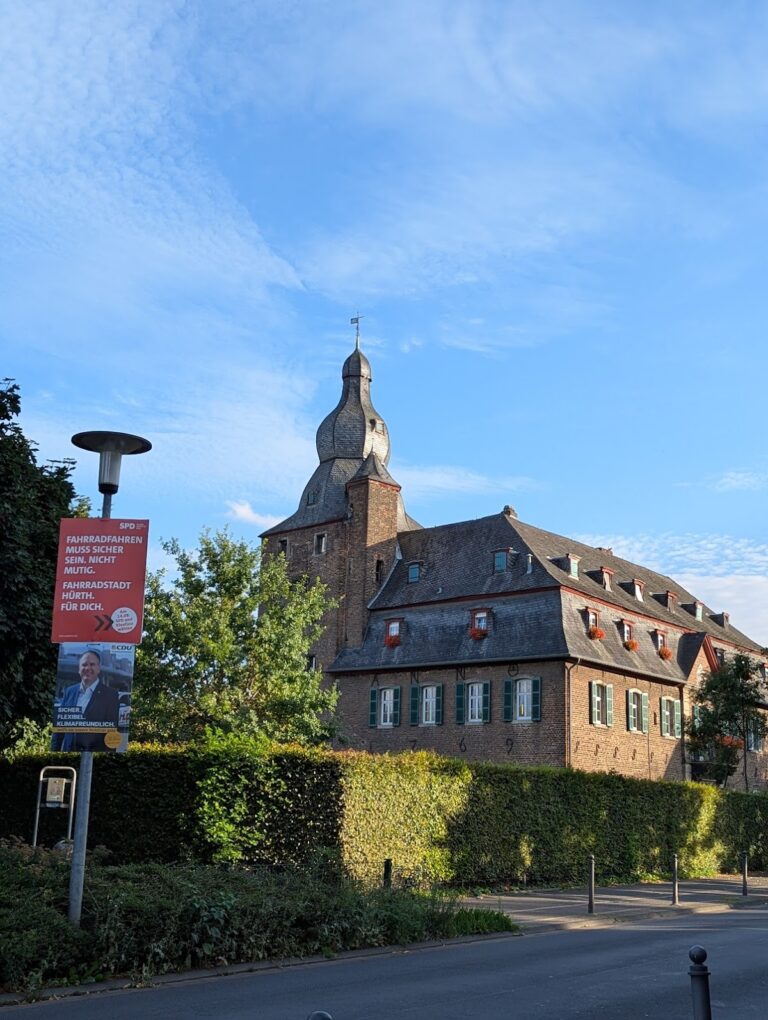
Fischenich Castle occupied a slope position within the settlement, between Gennerstraße, Augustinerstraße, and Jakobstraße. The former complex was an oval, round structure with four towers. Its surviving remains form a ring-shaped enclosure surrounded by a moat. The enclosing wall still rises approximately 6 to 10 metres. Two- and three-storey red-brick houses now surround the ruin in a roughly quadrangular arrangement, while the remains can be viewed from two points.
Castle enclosure
The surviving ring wall preserves the outline of the former hill castle and its moat. Its scale reflects the enclosure of a substantial fortified complex, while the surrounding buildings have incorporated the ruin into the settled landscape. The wall remains fragmentary but retains enough height and curvature to show the castle’s former circular plan.
Reused Roman aqueduct material
At least part of the castle wall was built with cast-concrete blocks taken from the nearby Roman aqueduct at the foot of the Vorgebirge. This Roman concrete, called opus caementitium, was made from aggregate and mortar and belonged to the Eifel Aqueduct, a major Roman water-supply system serving the Cologne region. The blocks are especially visible on the north side facing Augustinerstraße, where the ruin is accessible. They retain reddish hydraulic plaster from the aqueduct’s construction, together with a layer of lime-sinter deposits. The castle walls now form a station on the Roman Aqueduct Hiking Trail, which follows the former water conduit.
Nearby sites