Turmhügel Baumburg: A Medieval Motte Castle in Germany


Site at a Glance
- Rating
- 4.7
- Popularity
- Very Low
- Country
- Germany
- Primary era
- Medieval
- External website
- Open
- Eras represented
- Iron Age, Medieval
- Civilizations
- Holy Roman Empire
- Site type
- Military
- Remains
- Castle
On this page4 sections
History
Turmhügel Baumburg, also called Baumburg, Buenburg, Buwenburg, or Bawenburg, is a medieval motte castle site in Germany near Hundersingen, now part of Herbertingen in Baden-Württemberg. Built by the Lords of Baumburg-Hundersingen at the end of the twelfth century, around 1150–1200, it was an aristocratic hilltop fortification above the Danube.
The Lords of Baumburg-Hundersingen
The Lords of Baumburg-Hundersingen are recorded as possessing Baumburg in 1090 or 1092. The surviving castle phase, however, is dated to approximately 1150–1200. Among the family was Ulrich von Buwenburg, a minnesinger, meaning a medieval German-speaking poet and singer of courtly love poetry. On 15 March 1282, Dietrich von Baumburg sold a serf to the abbess and convent of Heiligkreuztal, a Cistercian religious community in Swabia.
Abandonment and Later Memory
Baumburg was abandoned at the end of the thirteenth century. By 1344, it was described as a Burgstall, the German term for a vanished castle site or mound without standing castle buildings. In the sixteenth century, Heiligkreuztal Monastery prohibited its reconstruction. A local oral tradition, The White Lady in Baumburg, was published in 1861 by Anton Birlinger and Michel Buck.
Remains
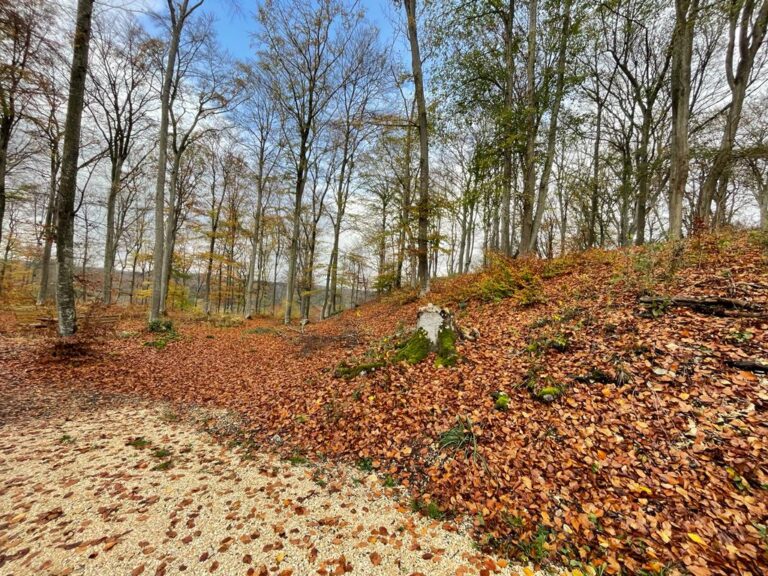
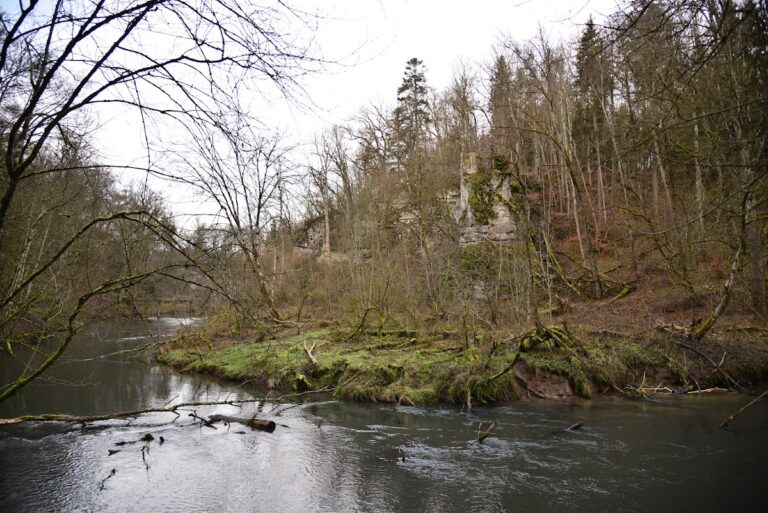
The surviving site consists of a raised castle mound and its surrounding ditch. This motte, a medieval castle form centered on an earthen mound, occupies a plateau measuring about 30 by 34 metres at an elevation of 603 metres above sea level. The plateau lies above the Danube on a slope falling steeply toward the river, near Heuneburg, a major prehistoric hillfort and settlement in southwestern Germany.
The plateau probably began as a large Iron Age burial mound. The medieval castle mound rises 9.3 metres and measures about 75 metres in diameter, while the surrounding castle ditch remains visible. Together, the mound and ditch preserve the main earthwork form of the former fortification, whose castle buildings no longer survive above ground.