Château de Sainte-Hermine: A Medieval Fortress and Louis XIII-Era Residence in France

Site at a Glance
- Rating
- 3.2
- Popularity
- Very Low
- Country
- France
- Primary era
- Early Modern
- Eras represented
- Medieval, Early Modern
- Civilizations
- French
- Site type
- Domestic
- Remains
- Castle
On this page8 sections
History
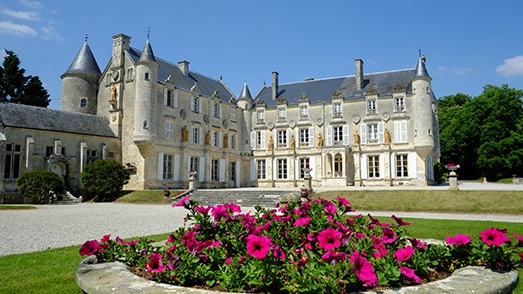
Château de Sainte-Hermine is a historic castle in France that developed from an early medieval defensive site into a baronial residence, with its present form largely created in the early seventeenth century. A defensive tower stood here by the tenth century on a strip of land surrounded on three sides by the river, while a trench added to the natural protection. The settlement grew under the fortress, establishing the site as both a stronghold and a center of local authority.
Early lordship and Saint-Hermand
The lordship probably took shape in the twelfth century. Pierre Troncas is the first known lord, while the succession becomes clearer around 1170 with Hervé de Mareuil. At that time, the fortress was called the tower or château of Saint-Hermand. Around 1120, the lord of La Réorthe ordered the construction of the Saint-Hermand priory and its church on land then known by that name. The church was destroyed by fire in 1263 and was presumably rebuilt. Around 1568, during the French Wars of Religion, the village was burned by Protestants, and the church bell tower also caught fire.
From the fourteenth century, the castle and the settlement beside it adopted the name Sainte-Hermine, while the community around the priory continued to be called Saint-Hermand. The castle chapel became Sainte-Hermine’s parish church, probably giving the newer settlement its name. The castle’s history was shaped by a succession of powerful families. In 1270, Eustache de Lusignan brought it as a dowry to Dreux de Mello. Eustache’s granddaughter Jeanne later received it as her dowry when she married Raoul de Brienne, Count of Eu and Constable of France. Their son, Raoul II de Brienne, was born at the castle and became constable in 1344. A constable was the French crown’s senior military officer.
Philippe III, known as Philip the Bold, visited Sainte-Hermine in March 1272 after returning from the Crusades. Philip was king of France from 1270 to 1285. By succession, the lordship later passed to Marie de Sully and then to the La Trémoille family. At the end of the sixteenth century, it belonged to Charlotte-Catherine de La Trémoille. Her controversial trial for allegedly poisoning her husband ended with her acquittal on 24 July 1596.
Protestant patrons and the rebuilding under Louis XIII
Charlotte-Catherine sold the barony to François des Nouhes, a Calvinist leader, companion of Henri IV, royal knight, lieutenant general, and governor of Fontenay-le-Comte. Henri IV was king of France from 1589 to 1610 and also known as Henry of Navarre. François’s son Jacques des Nouhes married Anne de Mornay, daughter of the Protestant leader Philippe Duplessis-Mornay. Henri IV endowed the couple, and Jacques became Marquis and governor of Bas-Poitou. A marquis was a high-ranking noble title traditionally linked to the administration or defense of a frontier territory.
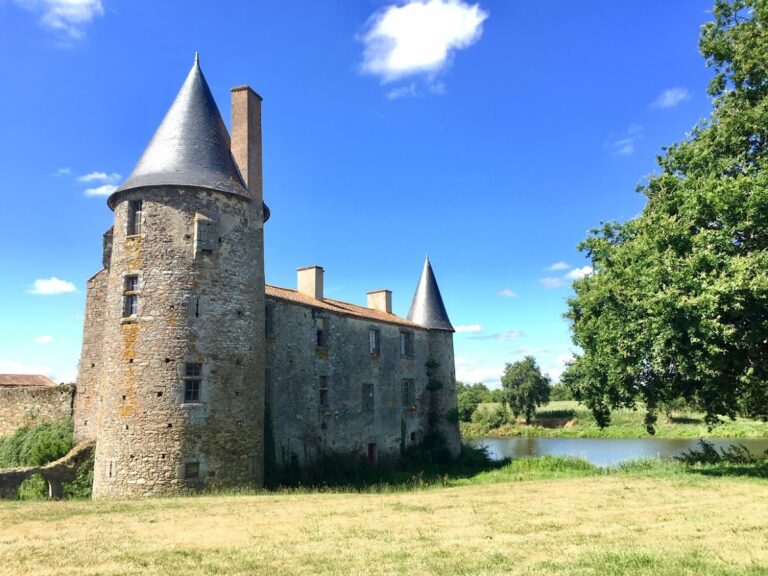
In the early seventeenth century, Jacques des Nouhes and Anne de Mornay rebuilt the château over the medieval fortress. Mathurin Bernard, an architect from Fontenay, carried out the work during the reign of Louis XIII, who ruled from 1610 to 1643. The new residence had a restrained, sober character associated with its Protestant patrons, while retaining the earlier defensive foundation. Louis XIII inaugurated the château during a visit from 19 to 22 April 1622.
The royal visit occurred during Louis XIII’s campaign against the Huguenot revolt in western France. The Huguenots were French Protestants, many of them associated with the Reformed or Calvinist tradition, whose conflicts with the monarchy and Catholic forces had shaped the political life of the region. The king’s presence at Sainte-Hermine was intended to impress the rebels and help prevent wider bloodshed. Henri IV also visited the château several times, including in January 1589 and again after François des Nouhes acquired it in 1598.
Later owners, revolution, and protection
The barony later passed through the Courcillon family. Members of the family were buried in the château chapel, and their son Philippe de Courcillon, Baron of Sainte-Hermine and Marquis de Dangeau, held a varied career during the reign of Louis XIV. He was a military officer, royal aide-de-camp, governor of Touraine, royal historian, member of the French Academy, and holder of senior religious and military offices.
The château subsequently passed to the d’Albert family. Charles d’Albert, Duke of Luynes, sold it to Louis-Constantin Joussaume, Marquis de La Bretesche and Vicomte de Tiffauges. After the French Revolution, inheritance transferred the property to the La Ville de Férolles and La Poëze families. Olivier de La Poëze became mayor and general councillor of Sainte-Hermine, deputy for Vendée, and chamberlain to Napoleon III.
During the Revolution, the château was abandoned and its window and door frames were removed. Sainte-Hermine was also affected by the conflict between Republican and royalist forces. On 13 August 1793, Vendéan generals led by Maurice d’Elbée, meeting in the presence of François Athanase Charette de La Contrie, gathered at a local inn to prepare an attack on Luçon.
The former Saint-Hermand church was sold as national property during the Revolution and returned to worship in the early nineteenth century. It was abandoned in 1808 after Saint-Hermand was merged with Sainte-Hermine, and the municipality of Saint-Hermand was legally abolished on 24 August 1800. The château was sold in 1877 to the Michelon-Landois-Buet family. Armand Landois, mayor of Sainte-Hermine, altered the building. François Buet sold it in 1976 to Claude and Jeanne de La Tour de Saint Lupicin, and their son-in-law Laurent Poultier du Mesnil took it over in 1998.
The château and the former feudal motte were entered in full on the supplementary inventory of historic monuments by decree of 17 February 2005. This French heritage register protects buildings and sites recognized for historical or architectural value. The property remains privately owned. In 2004, the owners discovered a concealed Louis XIII-period fireplace and painted decoration in the room above the entrance porch. Regional cultural authorities supervised the exposure and consolidation of the paintings in 2008, when the paintings and the site were entered on the supplementary inventory.
Remains
Fortress site and medieval tower
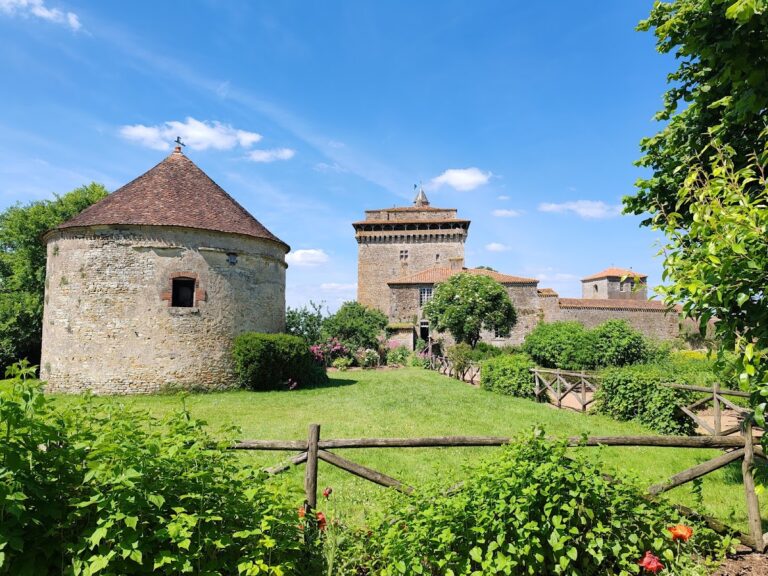
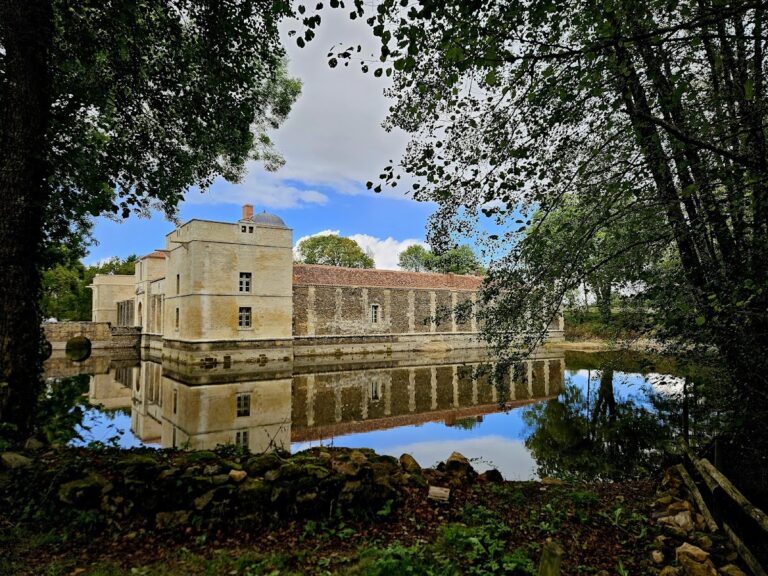
The château occupies the central part of an early defensive site that used the river and a surrounding trench as elements of its protection. The earliest tower stood here by the tenth century, and the complex also includes the former feudal motte, a raised fortified mound associated with an early medieval castle and defensive enclosure. As the seat of a barony, Sainte-Hermine was probably enclosed by walls. Street names referring to a moat, drawbridge, old moats, and a gate are associated with the former fortifications.
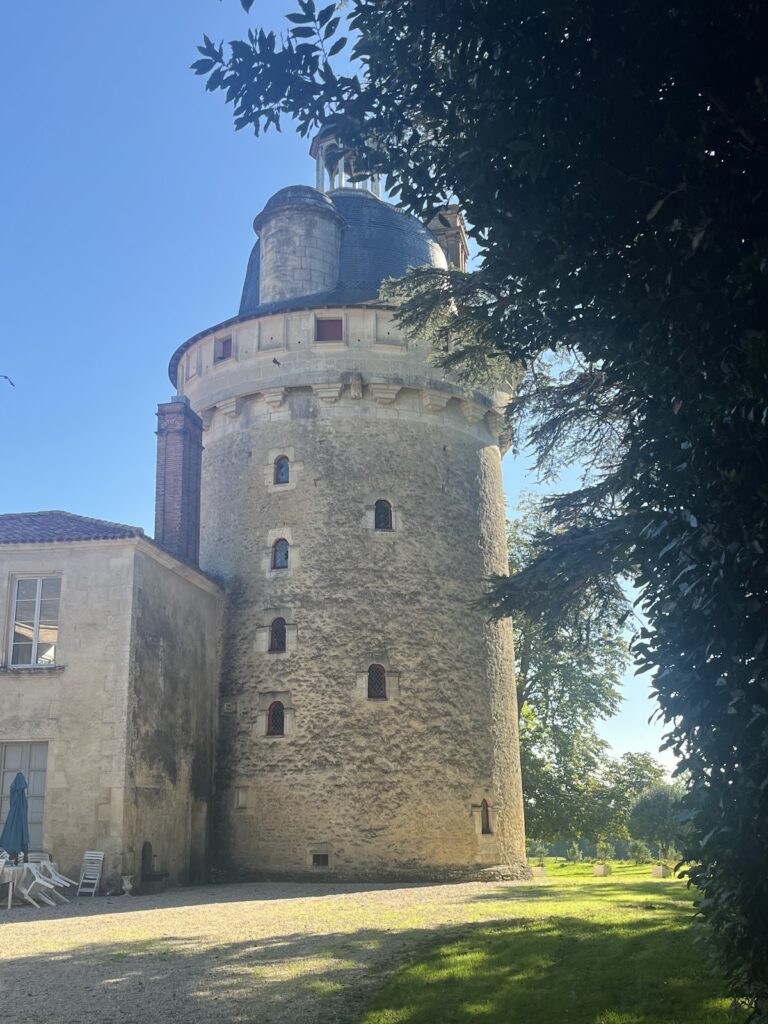
The medieval castle was rebuilt in the early seventeenth century, but the surviving Tour à Bernard preserves a projecting, spur-shaped tower from the end of the thirteenth century. Its form belongs to the castle’s medieval defensive phase and remains physically connected with the later residence. The present château stands over this earlier fortress, allowing the building to retain both its defensive origins and the character of its Louis XIII-period reconstruction.
The seventeenth-century château
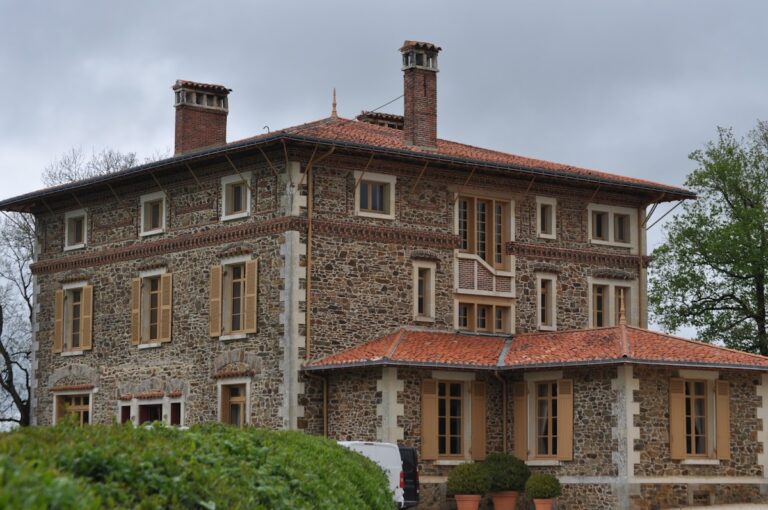
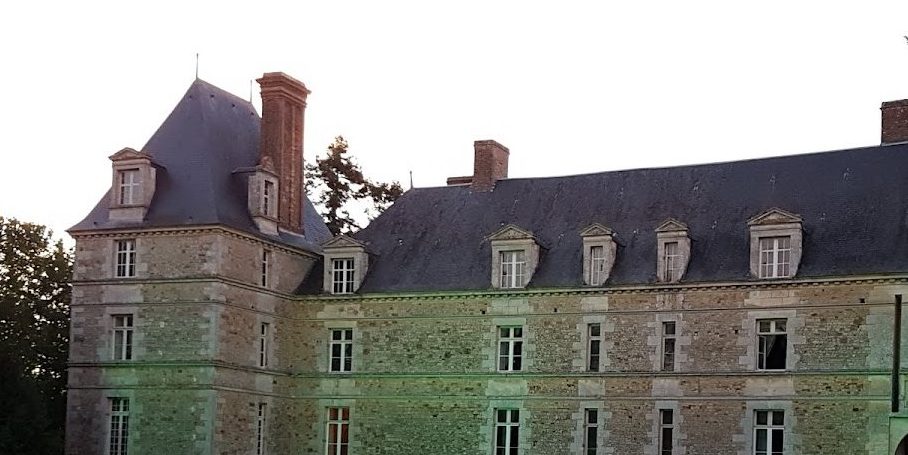
The present residence was built in a restrained style during the early seventeenth century. A carved stone on the north façade identifies Mathurin Bernard, includes his symbols, and gives the construction date. Nineteenth-century alterations changed parts of the building, while early seventeenth-century interior features survived within it, including fireplaces and painted decoration.
The room above the entrance porch contains a Louis XIII-period fireplace that had been concealed behind a wall. The exposed remains include blue wall painting, fleur-de-lis decoration, and royal attributes such as a crown, scepter, hands of justice, and sword. The fleur-de-lis was a principal emblem of the French monarchy, while the hands of justice represented the monarch’s judicial authority. Tradition identifies this painted room as the chamber that received Louis XIII. Its decoration indicates a blue interior covered with fleur-de-lis motifs, and the surviving paintings were fixed and conserved after their discovery.
Chapel and Saint-Hermand remains
From the fourteenth century, the château chapel served as the parish church of Sainte-Hermine. It also contained the burials of members of the Courcillon family, linking the chapel’s religious function with the burial practices of one of the château’s noble owners.
The former Saint-Hermand priory and church stood opposite what is now Clemenceau Square, outside the château complex. Fragments of the church survive. Restoration work carried out around 2010 to 2013 demolished some walls and restored the surviving springings of the vaults, preserving visible evidence of the former church’s construction.
Nearby sites