Manorhamilton Castle: A Seventeenth-Century Castle in County Leitrim


Site at a Glance
- Rating
- 4.1
- Popularity
- Very Low
- Country
- Ireland
- Primary era
- Early Modern
- Eras represented
- Early Modern
- Civilizations
- Irish
- Site type
- Military
- Remains
- Castle
On this page5 sections
History
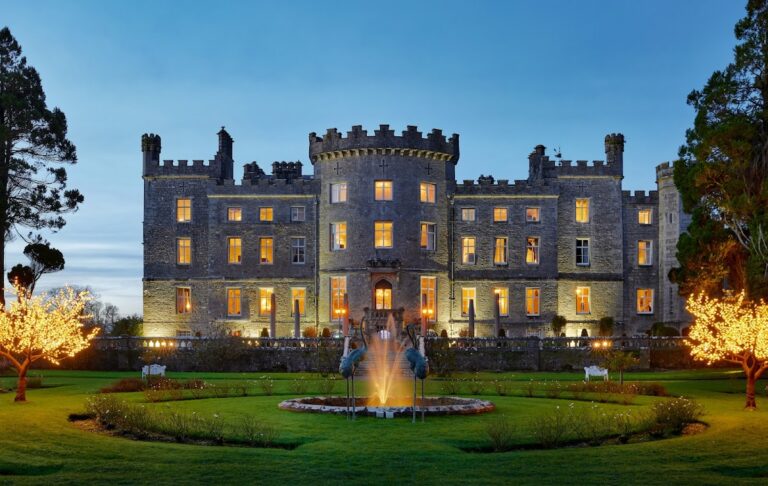
Manorhamilton Castle is a castle in Ireland, built by the Scottish aristocrat and military figure Sir Frederick Hamilton in 1634 during the seventeenth-century Plantations of Ulster. These settlement programs transferred land from Irish owners to English and Scottish settlers. Hamilton’s estate became the centre around which the town of Manorhamilton developed, but his arrival brought him into conflict with the local Irish population and the O’Rourke clan, a Gaelic ruling family associated with the medieval kingdom of Breifne.
Hamilton’s Estate and Military Career
Hamilton received land in County Leitrim from the king of England and Scotland in 1622. Over the next two decades, he expanded his estate to about 18,000 acres and established the castle. He was the youngest son of Claude Hamilton, 1st Lord Paisley, and Margaret Seton, daughter of George Seton, 5th Lord Seton. On 20 May 1620, he married Sidney Vaughan, daughter of Sir John Vaughan, governor of Londonderry.
His career extended beyond Leitrim. In November 1631, Hamilton entered the service of the king of Sweden as colonel of a Scottish-Irish regiment. The regiment fought in Germany for 15 months, including engagements in the Elbe basin, near the Weser, and in the Rhineland. Hamilton returned to his estate and made an unsuccessful attempt to re-enter Swedish service in September 1637.
Conflict in County Leitrim
Hamilton’s settlement provoked widespread hostility among local Irish people. On 5 December 1640, the Committee of Irish Affairs of the Long Parliament, the English Parliament that began sitting in 1640 and considered Irish petitions, supported a complaint by Turlough Mac Raghnaill, also known as Reynolds, of Kiltubrid. He alleged that Hamilton had unlawfully taken his lands in County Leitrim.
During the Irish Rebellion of 1641, a major uprising by Irish Catholics against English and Scottish Protestant settlers and the administration of Ireland, Manorhamilton Castle remained under continual siege but withstood the attacks. In 1642, Hamilton began a war against the O’Rourke clan. He captured Sligo, burned several houses, and burned Sligo Abbey before returning to Manorhamilton Castle.
Local tradition tells that some of Hamilton’s men became lost and died in dense fog while crossing the mountains toward the castle. According to the story, a rider on a white horse offered to guide them but deliberately led them to a precipice. The Irish poet and playwright William Butler Yeats later retold the legend in The Curse of Flame and Shadow.
Defeat, Destruction, and Later Use
In 1643, Hamilton became colonel of a cavalry regiment serving the army associated with the Solemn League and Covenant, a Scottish religious and political alliance whose forces operated in Scotland and northern England during the civil-war period. He retained his infantry regiment in western Ulster. In 1647, he abandoned the defeated Scottish army and returned to Edinburgh, where he died in poverty. He lost his Irish estates and received only minimal compensation or financial support from the English Parliament for his military service. His younger son Gustav later received an Irish peerage and the title Viscount Boyne.
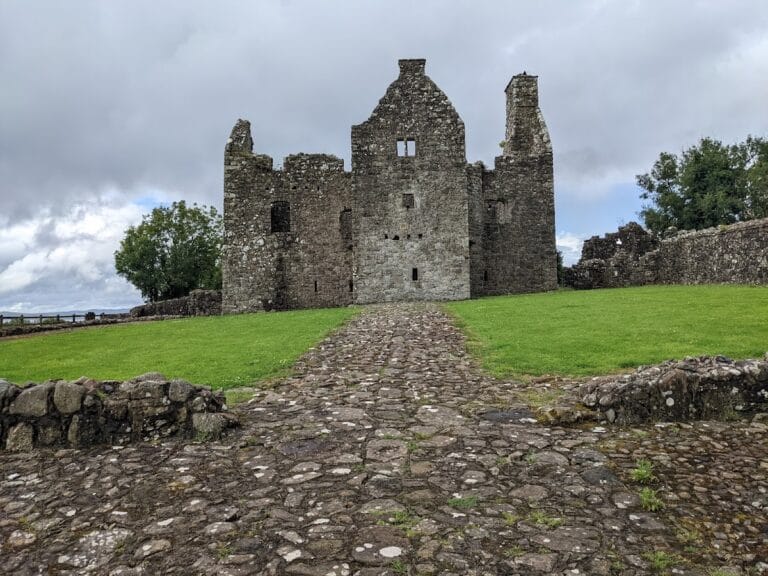
Royalist forces commanded by the Earl of Clanricarde burned Manorhamilton Castle completely in 1652. Clanricarde was an Irish earldom and the title held by its bearer. The castle was subsequently partly rebuilt and used as barracks. After that use ended, it was abandoned and became a ruin. Later restoration altered its condition and enabled the castle to house a museum exhibition.
Remains
The surviving physical history of Manorhamilton Castle is defined by destruction, partial rebuilding, abandonment, and restoration. The castle was completely burned in 1652, then partly reconstructed for use as barracks. Its later abandonment left it in ruin, while modern restoration changed the condition of the remaining structure and prepared it for use as a museum exhibition.
Nearby sites