Castle of Torremormojón: A Medieval Frontier Fortress in Spain


Site at a Glance
- Rating
- 4.7
- Popularity
- Very Low
- Country
- Spain
- Primary era
- Early Modern
- Eras represented
- Medieval, Early Modern
- Civilizations
- Crown of Castile, Spanish
- Site type
- Military
- Remains
- Castle
On this page9 sections
History
Castle of Torremormojón is a ruined fortress in Spain, beside the town of Torremormojón in Palencia. It originated in the twelfth century as part of the defensive system along the frontier between León and Castile and against attacks from Muslim territories. The castle formed part of a medieval line of towers and strongholds that included Monzón de Campos. Its position above the Tierra de Campos, a historic agricultural plain in northwestern Spain, later earned it the provincial nickname “Star of the Fields.”
Royal governors and frontier administration
For centuries, Torremormojón and its fortress were administered by successive royal appointees known as tenentes. A tenente governed a town or fortress for the monarch in an administrative and military capacity, rather than through an originally hereditary office. Count Pedro Ansúrez, a vassal of Queen Urraca of León and Castile, was the first known holder in the early twelfth century. Tello Fernández held the office in 1116, followed in 1124 by Pedro Martínez and Pedro González de Lara, who also served as governor of the castle.
The Girón family held the tenure during parts of the twelfth and thirteenth centuries. Rodrigo Gutiérrez Girón governed from 1162 to 1193, and his son Gonzalo Rodríguez Girón, also known as Gonzalo Ruiz Girón, held the office from 1195 to 1215 by order of King Alfonso VIII of Castile. After the family came into conflict with Álvaro Núñez de Lara, the Giróns lost royal favor and control returned to the Crown. The Téllez de Meneses family later administered the castle until the reign of King Pedro I of Castile.
From royal tenure to aristocratic lordship
After Pedro I, his successor Henry II of Trastámara granted Torremormojón and its castle to his brother, Count Sancho of Alburquerque. The tenure then passed to Garci González de Herrera, Marshal of Castile, a senior military official. Henry II gave him the title “Lord of the Town of the Tower,” which remained with the Herrera family until the late fifteenth century.
The title subsequently passed through female inheritance to Blanca de Herrera y Niño de Portugal. She was the widow of Alfonso Téllez Girón de las Casas and later married Bernardino Fernández de Velasco, Constable of Castile, the kingdom’s senior military officer. In 1484 Blanca granted her husband the towns of Pedraza de Campos and Torremormojón, and the town later passed by inheritance to the counts of Benavente.
Rebuilding and the Comunero conflict
Bernardino Fernández de Velasco, who was Constable of Castile in 1502, had a daughter, Ana de Velasco y Herrera, who married Alonso Pimentel y Pacheco, fifth Count of Benavente. Bernardino’s second marriage, to Juana of Aragon, produced Juliana de Velasco, also called Juliana Ángela Velasco Aragón, Countess of Castilnovo. Bernardino established an entail, a legally restricted inheritance intended to preserve property within a designated family line, in Juliana’s favor. The arrangement led to litigation between the two half-sisters and conflict between the Benavente and Velasco families, the latter led by the new constable Íñigo Fernández de Velasco.
Queen Joanna of Castile ordered the precautionary confiscation of the castle during the dispute. A later judgment restored the fortresses of Torremormojón and Cigales to Ana de Velasco y Herrera. The present fortress was built between 1502 and 1512 around the earlier twelfth-century tower, and the Count of Benavente financed additional reinforcement works in 1523.
The castle became involved in the Revolt of the Comuneros, the Castilian uprising of 1520–1521 against the imperial government of Charles I, who was also Holy Roman Emperor Charles V. On 15 January 1521 imperial troops captured the Comunero-held town of Ampudia, but withdrew to Torremormojón when the Comunero leaders Padilla and Acuña came to Ampudia’s aid. The royal troops soon abandoned the town as the rebels advanced and besieged it. The inhabitants left in procession to ask that the town be spared, eventually paying a ransom of 1,500 ducats and 2,000 cántaras of wine.
Decline and heritage protection
The castle’s deterioration continued after its military importance had passed. During the second half of the nineteenth century, it was used as a quarry for other construction projects, which removed part of its fabric. A royal order from the Ministry of Development declared it a National Historic Monument in 1878. Since 2008, the ruins have also appeared on Hispania Nostra’s Red List of heritage in danger. The castle is protected in Spain as a Cultural Heritage monument under the category of monument, with reference RI-51-0000023.
Remains
Hilltop fortress and outer defenses
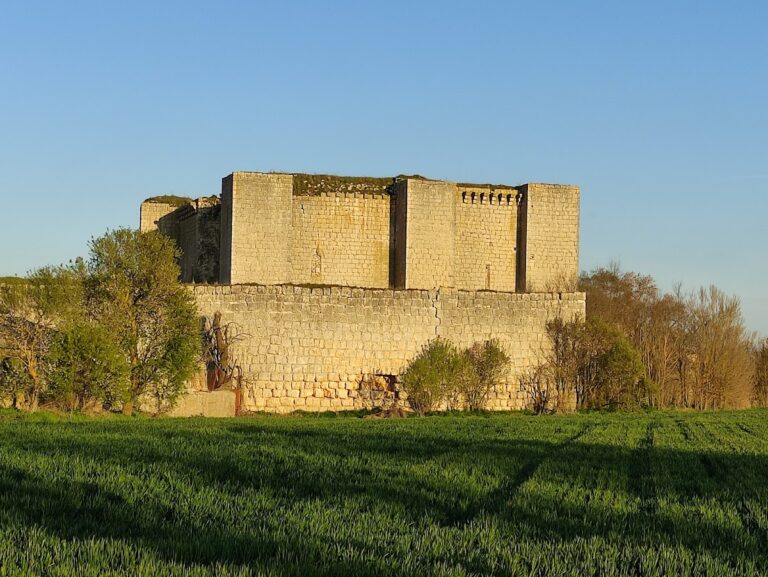
The castle occupies the summit of an isolated hill, one of the foothills of the Torozos Mountains near Torremormojón. The fortress built between 1502 and 1512 enclosed the earlier tower. Only one vaulted room of that primitive tower survives, while the remainder has been reduced to rubble. The later castle had a square plan with large towers at its corners. Its front was built of dressed stone, and its walls were approximately four metres thick. Numerous masons’ marks remain visible across the stonework.
A ditch surrounded the fortress and was defended by numerous firing chambers, fortified rooms from which weapons could be discharged through wall openings. These chambers were linked by an internal gallery within the walls, comparable to the gallery formerly found at La Mota Castle. Beyond the ditch stood a wall with two circular corner towers, each containing firing chambers. A central pentagonal tower protected the principal entrance.
Entrance and artillery defenses
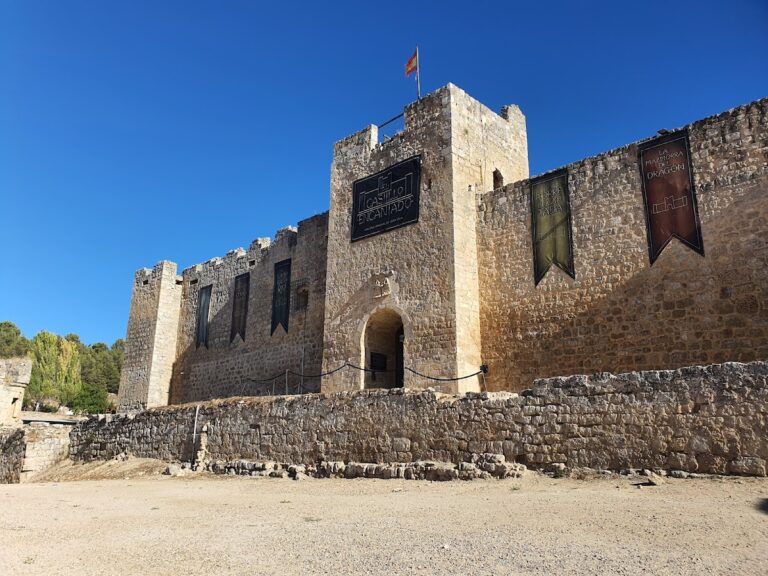
The main entrance was a pointed doorway reached across the ditch by a drawbridge and a footbridge or passageway. The difficulty of crossing the ditch strengthened the protection of the gateway. During the Comunero conflict, the entrance was altered into a firing chamber with an external opening intended for artillery, adapting the medieval approach to early modern warfare.
Later reuse and surviving fabric
Most of the remaining walls and towers now survive as ruins. At one stage, the surviving walls were reused to create a very large dovecote, which was later abandoned and became ruinous itself. This reuse and the nineteenth-century quarrying altered the physical fabric of the fortress, leaving the hilltop remains of the medieval tower and the later square artillery castle as the principal evidence of its development.
Nearby sites