Helfenberg Castle Ruins: A Medieval Castle and Baroque Palace in Germany


Site at a Glance
- Rating
- 4.6
- Popularity
- Very Low
- Country
- Germany
- Primary era
- Medieval
- Eras represented
- Medieval, Early Modern
- Civilizations
- Holy Roman Empire
- Site type
- Military
- Remains
- Castle
On this page11 sections
History
Helfenberg Castle Ruins are the remains of a medieval castle and later Baroque palace in Germany, near Velburg in the Upper Palatinate. The hilltop complex stands on Helfenberg, a 613-metre-high mountain east of Lengenfeld. Its history reaches from possible prehistoric fortification through episcopal administration, noble ownership, early-modern rebuilding, abandonment, and stone reuse.
Possible prehistoric and medieval beginnings
Bronze Age burial sites around the mountain point to early activity in the surrounding landscape. A wall on the plateau approximately 25 metres below the castle may represent an older ring wall, possibly dating from the tenth or eleventh century. This feature has been interpreted as a possible predecessor to the medieval stronghold.
An undated charter from 1198 to 1217 records Count Ulrich of Velburg transferring the castle to the Prince-Bishopric of Regensburg. This was an ecclesiastical principality in which the bishop exercised both religious and territorial authority. The first recorded administrator was Wirnt of Plankenstein, a ministerial, meaning a medieval service noble who held office and land from a higher lord, rather than belonging to the highest hereditary aristocracy. Wirnt served the bishops of Regensburg and is documented from about 1196 to 1224.
In 1232, Helfenberg became a fief of the Hohenfels family, a ministerial lineage in the service of the Regensburg bishops. After Konrad of Hohenfels unsuccessfully attempted to assassinate Conrad IV, the family adopted the name Ehrenfels, taken from one of its castles. Conrad IV was a member of the Hohenstaufen dynasty and held the title King of the Romans, the designation for the elected German king before imperial coronation.
Palatine and Bavarian ownership
After 1370, Count Palatine Rupert I of the Palatinate acquired the castle. Rupert was a fourteenth-century member of the Wittelsbach dynasty and Count Palatine of the Rhine. The castle was later burned during the War of the Landshut Succession, an early-sixteenth-century conflict over the inheritance of the Duchy of Bavaria-Landshut.
During the Thirty Years’ War, a major European conflict from 1618 to 1648 involving religious, dynastic, and territorial struggles, the castle and the other Palatine possessions in the Upper Palatinate passed to Bavarian Duke Maximilian in 1628. In 1632, Maximilian granted Helfenberg and its lordship to his field commander Johann t’Serclaes, Count of Tilly, a prominent military leader.
Baroque transformation and abandonment
Between 1699 and 1707, Count Ferdinand Lorenz Xaver Tilly converted the medieval castle into a Baroque palace. The Munich painter Hans Georg Asam took part in decorating its interiors. The representative residence remained in use for roughly a century.
After the Tilly family died out, the palace passed to the Bavarian elector, who appointed an administrator. French Revolutionary troops plundered it in 1796, after which the complex remained abandoned. In 1807, the palace was sold for demolition for 200 gulden. Its parts were dismantled over time, and the stone was reused in buildings around the surrounding area.
Helfenberg is protected as an archaeological monument under a designation covering an earthwork of prehistoric, early historical, or medieval date, with archaeological remains in the area of the medieval castle and early-modern palace ruins. It is also listed as a protected architectural monument associated with Schwaighof. The surviving ruins have not been secured through structural conservation measures.
Remains
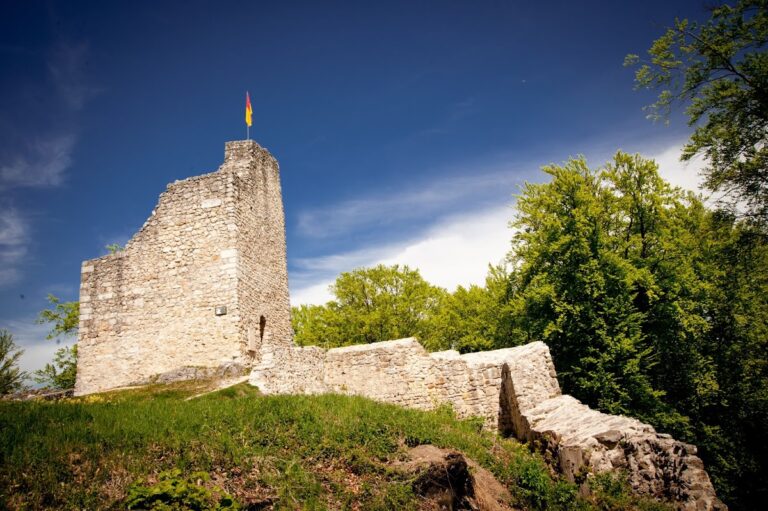
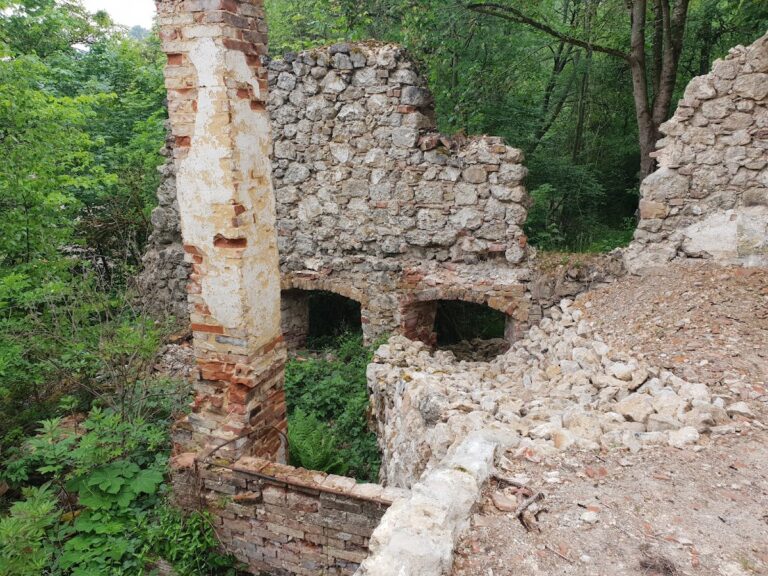
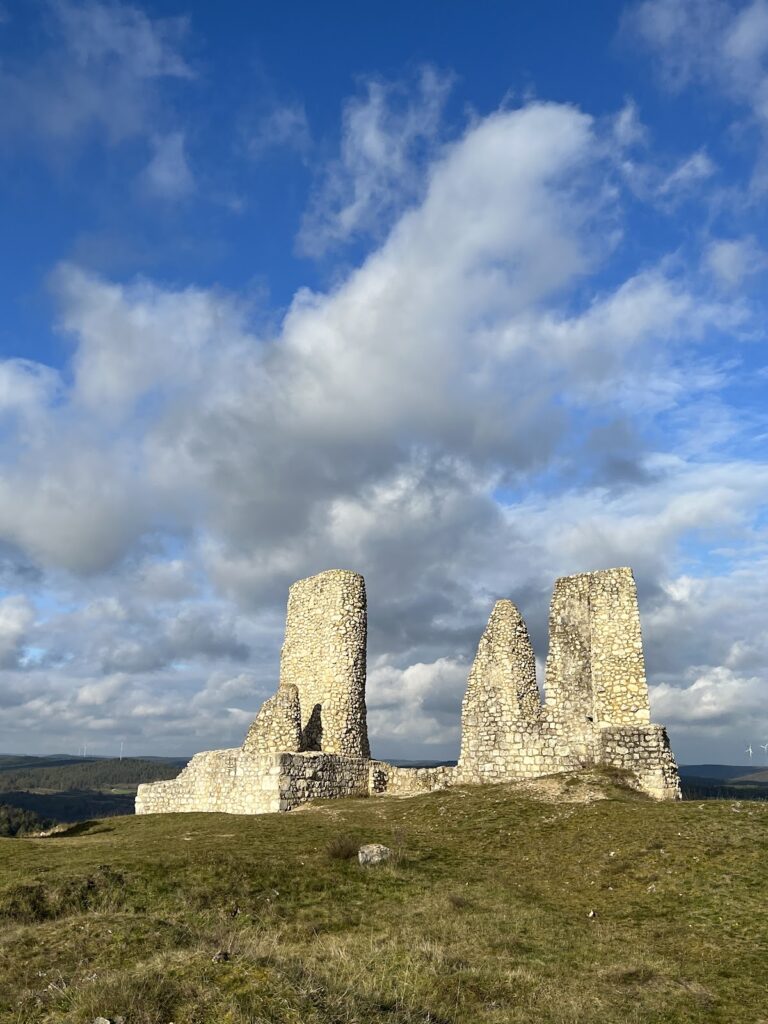
The site occupies the summit of Helfenberg in the Upper Palatinate Jura, east of Lengenfeld and beside the A3 motorway. Woodland has grown over the hilltop remains. The former complex is represented by foundations and fragments of its exterior walls, while the lower plateau contains a wall that may belong to an earlier ring enclosure.
Hilltop fortification and palace remains
Earlier ring wall
Approximately 25 metres below the castle ruin, a wall crosses the plateau. It may be the surviving trace of a ring wall from the tenth or eleventh century, providing a possible physical link to the site’s earlier phase of fortification.
Castle and Baroque palace
The medieval castle was transformed into a Baroque palace between 1699 and 1707. Foundations and remnants of exterior walls now define the surviving architectural fabric. These remains are overgrown by woodland and preserve the outline of the complex after its conversion and subsequent dismantling.
Surviving furnishings and artwork
Palace furniture
A small amount of furniture from the former palace survives and is displayed at the Winkler inn in Lengenfeld. The objects provide a material connection to the residence’s later domestic and representative use.
Altarpiece
The altarpiece from the former palace church, painted by Georg Asam, is preserved in the church at Lengenfeld. Georg Asam was a Baroque painter from the artistic family that also included Hans Georg Asam.
Nearby sites