Castle of Guardasone: A Medieval Hilltop Fortress in Italy


Site at a Glance
- Rating
- 3.7
- Popularity
- Very Low
- Country
- Italy
- Primary era
- Medieval
- Eras represented
- Medieval, Modern
- Civilizations
- Holy Roman Empire
- Site type
- Military
- Remains
- Castle
On this page11 sections
History
Castle of Guardasone is a medieval hilltop fortress in Italy, above Ariana di Guardasone in the municipality of Traversetolo. Probably established by the tenth century on the eastern slope of Mount Lugolo, it protected a ford of the Enza stream and served as an important defensive outpost of Canossa Castle, controlling movement through the Enza Valley.
Origins and the wars of the communes
The first surviving reference to the fortress, or to the court of Guardasioni, dates to 21 March 1165. Its medieval name, Guardaxonis, may have meant “Guard of the Attoni.” The castle belonged to the Baratti branch of the Counts of Canossa, a family related to the Attoni.
In 1248, when Guardasone was subject to the commune of Parma, Frederick II’s imperial army occupied the castle during the Battle of Parma. Guelph forces from Parma, led by Rolando Rossi and sent by the podestà, the commune’s chief civic magistrate, Filippo Visdomini, recaptured the fortress and drove away King Enzo, Frederick’s son. The conflict reflected the wider rivalry between Guelphs, who generally supported the papacy, and Ghibellines, who generally supported imperial authority.
In 1296, Ghibelline exiles backed by the Ferrarese marquis Azzo d’Este took the castle of the Baratti Neri. Guelph forces recovered it, but Azzo returned several months later and destroyed the building completely in retaliation. Parma then decreed that no further fortifications should be rebuilt at Guardasone.
Refortification and repeated attacks
Despite the decree, the stronghold again became involved in regional warfare. Between 1307 and 1310, Giberto III da Correggio imprisoned numerous enemies there, including members of the Rossi, Baratti, and Aldighieri families. Emperor Henry VII ordered their release in 1312. After Giberto was expelled from Parma in 1316, he allied with the da Palù, reorganized his forces in his territories, including Guardasone, and fortified the castle before making an unsuccessful attack on Parma.
In 1334, Ghibelline authorities in Parma sent troops under Marsilio de Rossi to destroy Traversetolo and plunder Guardasone. In 1341, Giberto’s son Azzo da Correggio strengthened the castle with two circuits of walls and built the watchtower of Montelugolo, known as Guardiola, on the mountain summit. The poet and scholar Francesco Petrarch stayed at Guardasone for several days in 1346 and composed the Latin poem La torre di Guardasone in connection with his visit. That same year, troops commanded by the Ferrarese marquis Francesco d’Este attacked the fortification. In 1391, forces from Bologna and Florence, allied against the Milanese lord Gian Galeazzo Visconti, burned both the village and the castle.
The Terzi succession
Giberto da Correggio died without children at Guardasone on 19 April 1402. Gian Galeazzo Visconti then granted the castle and Giberto’s other territories to the brothers Ottobuono, Giacomo, and Giovanni de’ Terzi, heirs of Niccolò Terzi the Elder. The grant was confirmed on 18 November 1402 by Caterina Visconti, acting as regent, and the young Duke Giovanni Maria Visconti.
The conflict between the Terzi and Rossi families brought further violence. The village and castle were plundered in 1403, and in 1405 Ottobuono had Gherardo degli Aldighieri imprisoned there. In 1408, following an alleged conspiracy involving men from Guardasone and Borgo San Donnino, the Terzi captured 65 people and had them beheaded in the fortress courtyard.
After Ottobuono was killed in an ambush at Rubiera in 1409 by Muzio Attendolo Sforza, with the complicity of Niccolò III d’Este, his brother Giacomo sheltered Ottobuono’s widow, Francesca da Fogliano, and their three children at Guardasone. Giacomo sent 300 knights under Giovanni Malvicino to reinforce the garrison, but Este forces intercepted and defeated them at Traversetolo. Residents of Cazzola, Sivizzano, and Rivalta then besieged the castle. Its castellan, Pietro del Borgo, the officer responsible for commanding and administering a castle, defeated the besiegers in a sortie.
In September, Este troops under Uguccione dei Contrari bombarded the fortress and forced the Terzi to surrender. Uguccione became lord of Guardasone and Montelugolo. In early 1410, Francesca and her children left the Parma area under the protection of the Republic of Venice. Giacomo Terzi was killed in October while attempting to aid his brother Giovanni.
Milanese and Rossi control
Uguccione arrested Azzo Baratti in 1417 and imprisoned him at the castle, fearing an alliance between Azzo and Orlando Pallavicino. He then seized Castione de’ Baratti. In 1421, Niccolò III d’Este exchanged Parma for Reggio Emilia with Filippo Maria Visconti, Duke of Milan. Guardasone and the territories dependent on it were confiscated by the duke and entrusted to the castellan Masino di Facino di Santo Alosio. Ammunition was supplied to the castle in 1422.
In 1431, Filippo Maria Visconti granted Guardasone and Colorno to his condottiero, adviser, and diplomat Niccolò de’ Terzi, known as the Warrior. He was an illegitimate son of Ottobuono de’ Terzi. Pier Maria II de’ Rossi, supported by the da Correggio, attacked and plundered Guardasone in 1447. Fearing further attacks by Ercole I d’Este, Niccolò urged his sons Ottobuono and Gaspare to strengthen the castle and the other defenses on their lands in 1448.
In 1449, Guardasone served among the fortified bases protecting Parma and supporting the Ambrosian Republic, the republican government established in Milan after the death of Filippo Maria Visconti in 1447. Alfonso V of Naples sent 800 infantrymen to the area, while Astorre II Manfredi was expected to provide 1,500 cavalry and 500 infantry. Alessandro Sforza, brother of Francesco Sforza, besieged Guardasone with help from Giberto VI, Manfredo I, and Niccolò II da Correggio. The garrison, which included the poet Basinio Basini, surrendered after several days. Custody passed first to Manfredo and Giberto da Correggio and, in 1452, to Pier Maria II de’ Rossi.
From Renaissance warfare to destruction
In 1466, Duke Galeazzo Maria Sforza assigned the castle to Giovanni and Vitaliano II Borromeo. In 1483, Guido de’ Rossi tried to capture it through a ruse involving his wife, Ambrosina Borromeo, but the castellan was not deceived. The Rossi faction retaliated by burning houses in the village. In 1526, Landsknecht troops, German-speaking mercenary infantrymen widely used in European warfare, entered and plundered the castle.
During the War of Parma, a conflict involving control of Parma and its surrounding territories, French forces allied with Duke Ottavio Farnese captured Guardasone in January 1551 because of its strategic value for supplying Parma. The occupants strengthened the fortifications before Ferrante I Gonzaga and Gian Giacomo Medici could intervene, and the castle was not recaptured at that time.
In 1558, Ercole II d’Este unexpectedly seized the poorly garrisoned castle after taking several nearby strongholds. He also captured Guardiola. Ottavio Farnese bombarded the watchtower, almost destroying it, and then shelled Guardasone, where the Ferrarese garrison under Alessandro Rangoni had taken refuge. The garrison escaped during the night. The bombardment destroyed the castle almost completely, leaving only the keep.
Later ownership and restoration
In 1652, Renato II Borromeo married Giulia Arese, inherited half of her father’s estate, and adopted the surname Borromeo Arese, establishing the Borromeo Arese family. In the early nineteenth century, the Medici family purchased the ruined castle. Only part of the enclosing walls and the keep survived. A few years later, the property was sold to the priest Gian Battista Rondani, whose brother, the entomologist Camillo Rondani, established his study there.
By 1903, Alberto Rondani had restored the keep, altering its windows and roof. A large adjoining wing was added a few years later. The castle remains in the possession of the Rondani family. A local tradition holds that Ottobuono de’ Terzi was not killed through treachery at Rubiera but was ambushed by women of Guardasone in revenge for the execution of the 65 villagers. According to the legend, his unburied body was left in the woods and his ghost has since wandered near Guardiola.
Remains
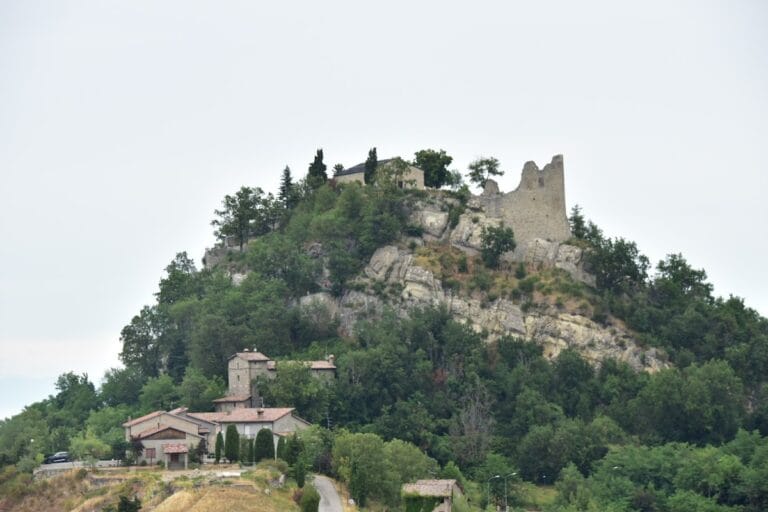
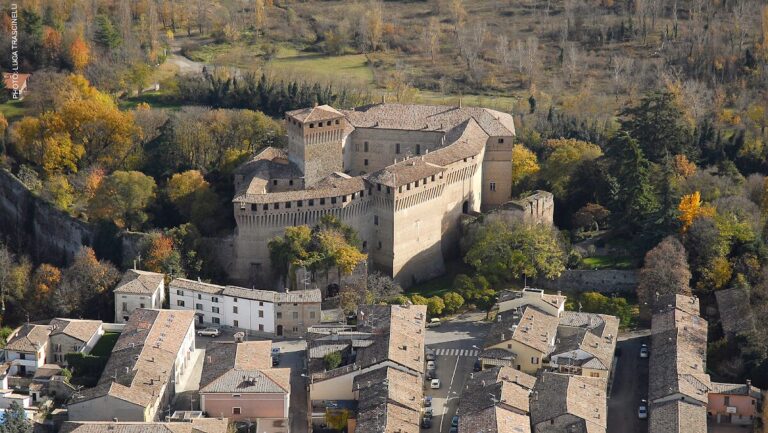
Castle of Guardasone stands at approximately 304 metres above sea level on a hilltop along the eastern slope of Mount Lugolo. Its surviving medieval fabric consists principally of a broad, massive keep on an unusual rectangular plan, together with sections of stone walls rising along the slope around it. The walls retain the outline of the former fortified complex but no longer have their battlements.
The keep
The keep, the principal fortified tower of the castle, rises through four main levels above ground. On its western side, a pointed-arch portal originally opened toward the parade ground. The first three floors contain broad mullioned windows, each divided into separate openings by a central vertical column. These windows were installed by 1903 during the restoration carried out by Alberto Rondani.
The upper floor has several narrow single-lancet windows arranged around the perimeter. Their crowning and round-arched treatment were altered around 1900. The tower’s present form therefore combines the surviving medieval structure with changes made during its early twentieth-century restoration.
Walls and adjoining building
Sections of the medieval walls extend along the slope around the keep. They represent part of the double wall circuit built in 1341, when Azzo da Correggio strengthened the castle. The later destruction of the complex left these wall ruins together with the keep as the principal remains of the hilltop fortress.
An L-shaped stone building was added directly beside the keep in the early twentieth century and extends toward the east. It forms part of the later architectural group associated with the restored tower and has no notable architectural details.
Guardiola
Guardiola stands several hundred metres west of the castle on the summit of Mount Lugolo. Built as a stone watchtower in 1341, it originally had three levels. Only the ruins of its outer walls survive. The tower was almost destroyed by Ottavio Farnese’s bombardment in 1558, when Este forces had captured it during the fighting around Guardasone.
Nearby sites