Château de Novel: A Former Fortified Residence in Annecy, France


Site at a Glance
- Rating
- 3.9
- Popularity
- Very Low
- Country
- France
- Primary era
- Medieval
- External website
- Open
- Eras represented
- Medieval, Modern
- Civilizations
- Duchy of Savoy, French
- Site type
- Domestic
- Remains
- Castle
On this page10 sections
History
Château de Novel is a former fortified residence in Annecy, France, dating from the twelfth century. It stands in the plain at the foot of the hill of Annecy-le-Vieux, in the modern Novel district. The place may have been occupied earlier by a Gallo-Roman villa, while the name Novel refers to recently cleared land. In the Middle Ages, the residence served the Counts of Geneva, the ruling dynasty of the County of Geneva, a territory centered on the Lake Geneva and Annecy region before its incorporation into wider Savoyard political structures.
The Counts of Geneva
During the twelfth century, the Counts of Geneva used Novel as a residence during visits to the Annecy basin. They moved to Annecy Castle in 1219. The manor nevertheless remained associated with important events in the dynasty’s history. In 1174, Count Amadeus I of Geneva and the abbot of Saint-Maurice of Agaune concluded an agreement at Novel, under the arbitration of Saint Anthelme of Chignin, bishop of Belley. William I of Geneva died at Novel on 25 July 1195.
Letters issued by the Count of Geneva in 1205 refer to the place as “Novellas, apud Nansicum” while protecting the priory of Chamonix. During the fourteenth century, the family holding Novel in feudal tenure adopted the site’s name. In the fifteenth century, ownership passed first to the Renguis family and then to the Chenex family. Marriage transferred the manor to the de Sales family in 1512, and the father of Saint Francis de Sales held the title Lord of Novel. Saint Francis de Sales was a seventeenth-century Catholic bishop, theologian, and spiritual writer who was later recognized as a saint.
From Private Manor to Agricultural Estate
Novel belonged to Amadeus Viollon in 1556. At the beginning of the seventeenth century, five of the twelve children of Michel Viollon de Novel, all daughters, entered the Visitation and brought the manor as their dowry. The Visitation, or Order of the Visitation of Holy Mary, was a Catholic religious order founded by Francis de Sales and Jeanne de Chantal in the early seventeenth century.
The Visitation community retained Novel until the French Revolution and made it the center of an agricultural estate. After the manor was confiscated and sold as national property, it continued to function as a farm until the 1960s. The municipality of Annecy purchased it from the Gay family in 1972 and restored the building. Its façades and roof received partial listing as historic monuments through an order dated 31 October 1975.
Remains
Manor and Defensive Enclosure
Quadrangular Manor
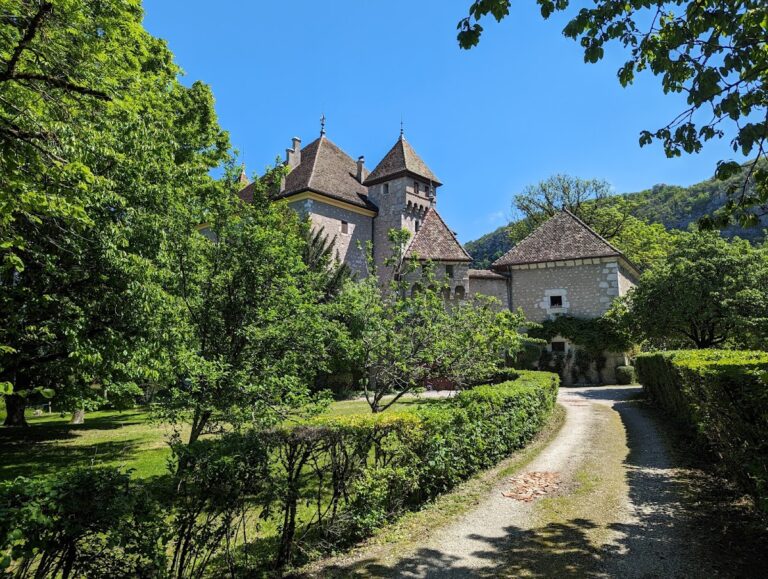
The surviving manor is a quadrangular building whose overall form dates from the fifteenth century. A round tower occupies its southwest corner, preserving part of the fortified character of the residence. The building’s façades and roof were partly restored after the municipality acquired the property in 1972.
Moat and Drawbridge
The fortified complex was formerly enclosed by a perimeter wall and a moat crossed by a drawbridge. An inventory from 1612 described the bridge as resting at its center on three oak supports set within the moat, while also noting that the structure had completely deteriorated.
Agricultural Buildings
Pigeon Tower
A pigeon tower, a structure for keeping domestic pigeons, formed part of the agricultural group beside the manor. A description found the pigeon loft in very poor condition and called for masonry repairs, replastering, and whitewashing.
Courtyard and Farm Structures
A large agricultural building was erected in the courtyard in 1803. During the nineteenth century, another building was constructed between the manor’s round tower and the pigeon tower, creating the complex’s present appearance. The farm that had formerly adjoined the pigeon tower was replaced by a shed.