Saint Stephen’s Church in Dingy-Saint-Clair: A Catholic Parish Church in France
Site at a Glance
- Popularity
- Very Low
- Country
- France
- Primary era
- Modern
- Eras represented
- Medieval, Modern
- Civilizations
- Duchy of Savoy, French, Kingdom of Sardinia
- Site type
- Religious
- Remains
- Church
On this page14 sections
History
Saint Stephen’s Church in Dingy-Saint-Clair is a Catholic parish church in France, dedicated to Saint Stephen. Its construction is generally dated to the fifth century, and it belongs to the Diocese of Annecy and the Parish of Saint-Pierre-Favre.
Early church and medieval rebuilding
Tombs found near the church have informed its proposed fifth-century date. Early written references identify Saint Stephen as the dedication of the first church. A burial tradition also reaches back several centuries: in his will of 3 November 1384, the lord of Menthon wished to be buried there, as his ancestors had been.
During a pastoral visit in 1411, Jean V de Bertrand, bishop of Geneva, ordered parishioners to repair the porch by 25 December. In 1470, another bishop’s visitor directed them to rebuild the church. In 1480, Catherine de Cordon, wife of Jean II de Menthon, founded a chapel with a Gothic choir, a medieval style characterized by pointed arches and rib vaults. The church was reconstructed that year under Georges de Menthon and Marie de Coligny. Their family emblems appear on the choir’s vault keystones.
Revolution and nineteenth-century rebuilding
The French Revolution brought damage and destruction, leading to a further rebuilding. The municipal council approved the project in 1833, and construction began in 1837 under Louis Ruphy, an architect from Annecy. The exterior was admired, but the interior received criticism. Art historian Raymond Oursel described it as lacking a coherent style and judged the bell tower ordinary.
A confraternity was a voluntary religious association of laypeople. Members of the Saint Sebastian confraternity, a men’s association, volunteered to care for the sick and bury the dead during plague outbreaks; the group later took on a devotional role. Its altar was rebuilt in the nineteenth century. The women’s Rosary confraternity used its altar to recite the rosary.
The village had seven bells, which were requisitioned during the Revolution to be melted down for cannon. The municipal council managed to retain one. After peace returned, the council voted in 1802 to purchase a bell for 5,000 francs. It was cast outside the church, then replaced after it cracked by a bell from the Paccard foundry. Another bell was added in 1870 and named Mary, Mother of God.
Stained glass and later care
The church’s Renaissance (a later European cultural and artistic period) stained-glass windows, donated by the Menthon family, were removed and sold to the Annecy museum in 1880 because they were deteriorating. They returned in 1951 following negotiations involving antiquities and art conservator André Jacques, parish priest Abbé Compois, and the mayor of Annecy. That year, stained-glass artist Jacques Bony, from Jean Hébert-Stevens’s Paris workshop, was commissioned to restore the windows and make additional panels. The church has undergone several renovations, most recently in 2017.
Remains
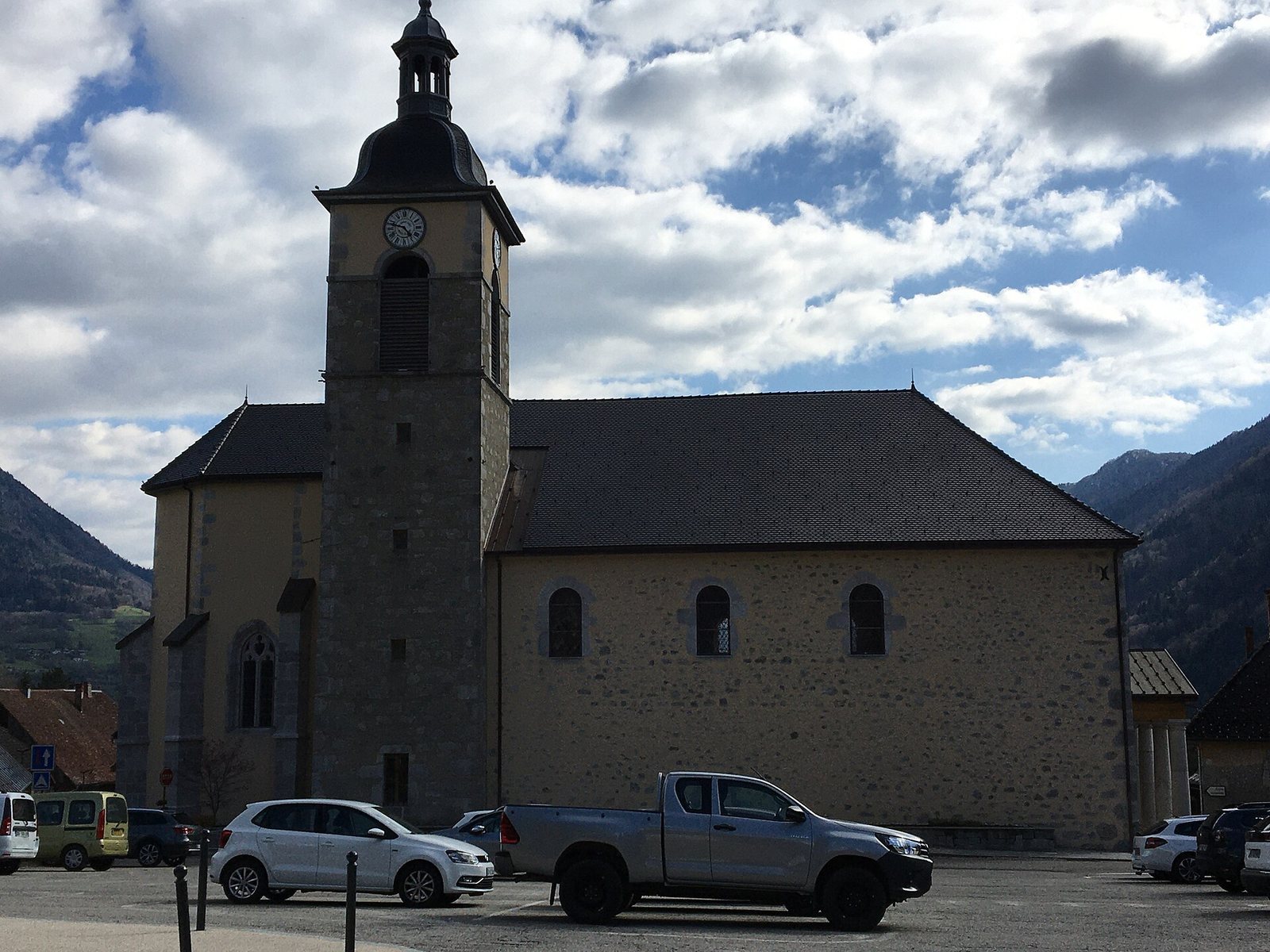
The surviving church combines a nineteenth-century main body with an earlier, two-bay choir retained during rebuilding. The choir ends at its eastern side in a three-sided wall, where the stained glass is set. The church stands on Dingy-Saint-Clair’s central square.
Façade
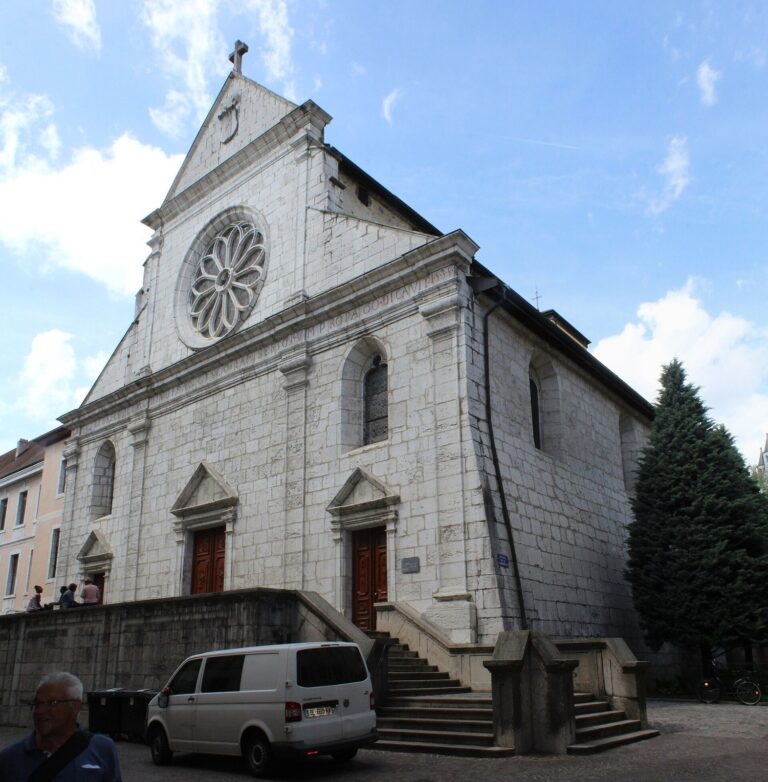
The façade has four Doric columns, a classical column design, and a canopy decorated with a triangular pediment. Its composition is thought to reproduce the façade of the Basilica of Superga in Turin.
Choir and stained glass
Choir
The choir has two bays. The western bay is nearly square, while the eastern bay ends in a three-sided wall. Each has a rib vault, a ceiling supported by intersecting ribs, and the bays are divided by a crosswise arch. Their moldings combine concave profiles, narrow rounded rolls, and flat bands. The vaults end in exposed stone keystones bearing family emblems. The eastern keystone shows a lion crossed by a blue diagonal band, the arms of the Menthons. The western keystone displays the combined arms of Menthon and Coligny, an eagle with a crown, blue beak, and blue feet.
Two recesses are built into the walls at the choir’s eastern end. One received the consecrated host, while the other drained blessed water. The host receptacle has a Renaissance form; a Gothic, three-lobed pointed arch rises over the water-draining recess.
Stained-glass windows
The principal eastern window depicts the Holy Trinity, the Christian belief in one God as Father, Son, and Holy Spirit. God holds the universe in his left hand and blesses with his right. Above him, a pelican feeds its young with its own flesh, an image associated with Christ and the Eucharist, the sacrament centered on consecrated bread and wine. Angels, the Sun, the Moon, and two star-shaped diamonds surround the scene.
Below the Trinity is a Calvary scene. Christ hangs on the cross, with two angels collecting his blood; Mary stands to his left and John, dressed in red, to his right. The Virgin’s facial features and the folds of her clothing recall the Sainte-Chapelle at Chambéry, a chapel associated with the Savoy court.
Two side windows also illuminate the choir. Each combines an older panel with a later panel made by Jacques Bony. The north window depicts Saint Maurice, a martyr associated with the House of Savoy, and Francis de Sales, a Catholic bishop and religious writer. The south window shows Saint Sebastian, an early Christian martyr, and Saint Clair. The Saint Sebastian panel differs in style and technique from the others and is considered one of the church’s finest stained-glass works.
Altars
Main altar
Donated in 1867, the main altar has a gilded wooden canopy supporting a statue of the Sacred Heart between two angels. Reliefs at its base show Saint Clair healing two blind men on the left and the stoning of the deacon Stephen on the right.
Saint Sebastian altar
This altar has a statue of Saint Sebastian and a painting probably dating to the nineteenth century. The painting, the Return from Egypt of the Holy Family, shows Jesus, Mary, and Joseph walking with their backs to the pyramids of Egypt.
Rosary altar
The Rosary altar has a gilded wooden statue of the Madonna and Child and a painting showing the presentation of the rosary to Saint Dominic and Saint Catherine of Siena. The Christ Child, seated on Mary’s lap, offers a rosary to Dominic, who founded the Dominican Order; Mary gives one to Catherine, a fourteenth-century Dominican mystic. The statue is hollow, and its gold color represents divine light.
Baptismal font
The wax-finished wooden font is decorated with three carved reliefs separated by columns, above a stone basin. On the right, Ezekiel, an Israelite prophet, stands beside a spring of living water. The central scene shows John the Baptist baptizing Jesus in the Jordan. On the left, the high priest Zechariah blesses his son John the Baptist. A royal crown of Savoy topped by a dove representing the Holy Spirit stands above the scenes.