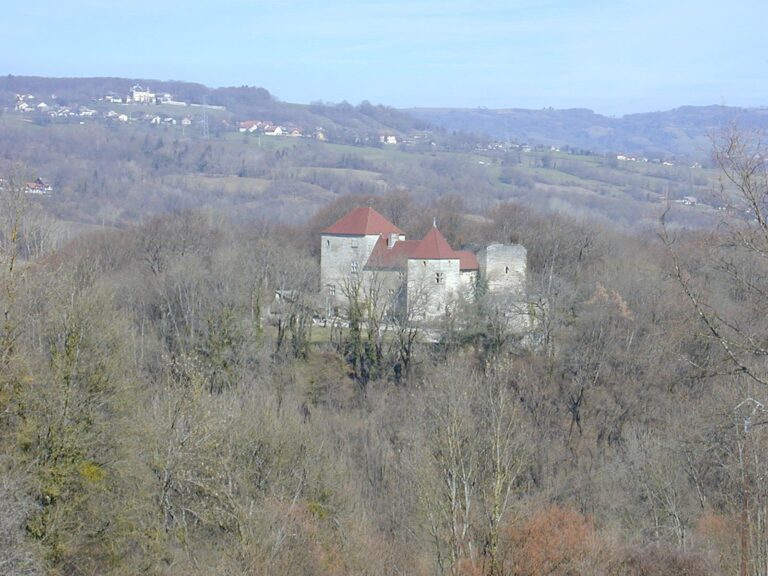
Promery Castle: A Fortified Residence in France
Site at a Glance
- Popularity
- Medium
- Country
- France
- Primary era
- Medieval
- Eras represented
- Medieval, Early Modern
- Civilizations
- Duchy of Savoy
- Site type
- Domestic
- Remains
- Castle
On this page10 sections
History
Promery Castle is a fortified manor in Pringy, France, whose origins remain uncertain but may predate the 14th century. It stood in Genevois, a historic province of the Duchy of Savoy, and later served chiefly as a country residence for the Favre family.
Origins and Monthoux ownership
The Trombert family may have been the first owners; its members were regarded as descendants of the marquises of Cruseilles and the lords of Vongy. The property is first known to have belonged to the Monthoux family in the early 14th century. On 14 November 1316, Pierre de Monthoux made a deed at the house. It remained in a junior branch of his family until 1578.
The estate then passed to the Menthon-Lonay family, although the circumstances are unclear. The transfer may have come through marriage or through a gift from Claude de Monthouz to his grandson Humbert, made on condition that the property could not be alienated. Humbert, lord of Promery, Bastie-Milliens, Villaret and Groyer, sold it to René Favre, lord of La Valbonne. The estate comprised the fortified house and other buildings, courtyards, a lower courtyard, orchard and garden, as well as authority over dependent lands held under feudal obligations.
The Favre family residence
René Favre de la Valbonne, the eldest son of Antoine Favre, acquired the house and estate on 22 November 1618 for 20,000 florins, with 30 écus as an additional customary payment. On 3 August 1622, a further transfer gave him jurisdiction over Villaret, principally its feudal rights. The Savoy Senate, the Duchy’s high court and governing institution, settled a jurisdictional dispute in 1627 in Monthoux’s favor, placing Promery under its authority. A further Senate decision confirmed that arrangement in 1707.
The Favres lived in Annecy and used Promery chiefly as a country house. René made major improvements to the property. When he died on 28 September 1656, he left it to his son Gabriel Philibert on condition that 2,500 livres be given to the chapel of Promery. The donation was made in 1658.
Inheritance disputes
Gabriel Philibert Favre died without a will on 12 September 1693, leaving four daughters and three sons. A dispute arose over the estate between his daughter Marie-Françoise, who had received use of the castle’s assets and income as her dowry when she married Claude-Gaspard de Cornillon in 1687, and his two eldest sons, Marc-Antoine and Joseph Victor. In 1712, the Savoy Senate ruled in Marie-Françoise’s favor.
In 1737, Marc-Antoine bequeathed the property, which he considered his, to Anne-Marie de Villaret, a daughter of Joseph Victor’s first marriage. Yet Pringy land registers from 1738 and 1741 assigned the estate to Madame de Cornillon, reflecting the competing claims. Anne-Marie married Claude-Gabriel de la Place in 1740, and he continued the case against Madame de Cornillon, who died in 1754, and her son Sigismond, who died without an heir in 1764.
In 1772, the Savoy Senate finally decided in favor of Marie de Villaret. She died in 1783, leaving two children, Marie Antoine and Hyéronime. Hyéronime had received the Preméry estate as a dowry when she married Joseph Dufour in 1764, before the final judgment. After Hyéronime died in 1789, her daughter Adeline inherited the castle and married the marquis Jacques-Abraham de La Grange in 1790.
Revolution and later ownership
The La Grange family held the property until the French Revolutionary invasion of Savoy in 1792. The marquis emigrated, leaving his wife at the castle, and the property was confiscated and sold as national property on 14 July 1796. The sale deeds named Marie Antoine de La Place, Hyéronime’s brother, as owner. M. Delatte of Annecy bought the castle and land for 16,662 livres, then sold them on 23 May 1813 to Madame de Lagrange, a daughter of Hyéronime Dufour, for 10,000 francs.
The estate remained in the family until its sale in 1854 to Adèle Ruphy, wife of Dr. Albert-Eugène Lachenal. Lachenal’s mother descended from the Menthon-Lornay family. The property passed again on 23 February 1875, when it was sold to Frédéric-Raymond de La Grange. A later fire reduced the castle to a ruin, after which a new family acquired and fully restored it. An order dated 20 July 1951 listed its façades, roofs and two gatehouses as historic monuments.
The name appears in several spellings: Promery, Proméry, Premery and Preméry. Its spelling remains unsettled. Public documents, including René de la Valbonne’s purchase contract, generally use Proméry, while private correspondence more often uses Preméry.
Remains
Setting and enclosure
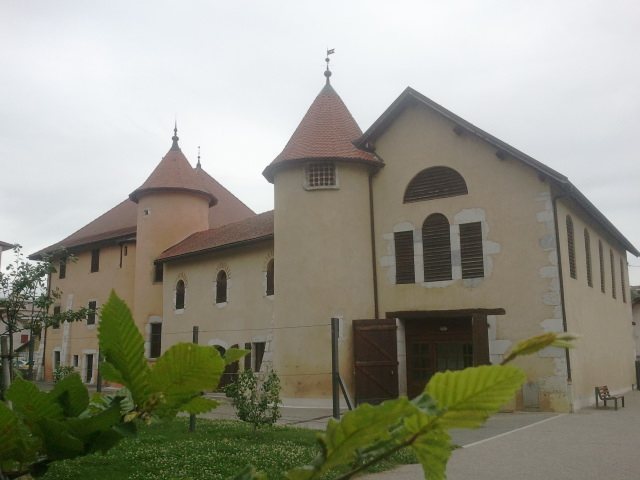
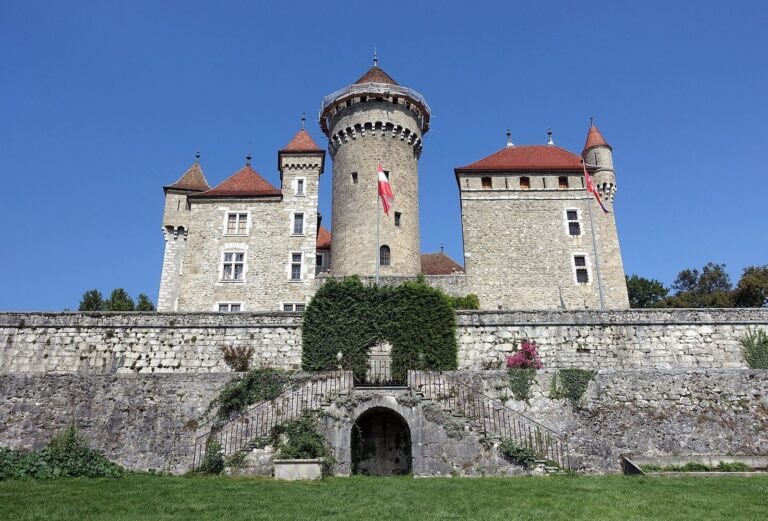
The castle stands in the foothills on the south-facing slope of Cuvat hill, on the right bank of the Viéran and opposite Monthoux Castle. It lies about 1.5 kilometres north-northeast of Pringy and 7 kilometres from Annecy. A quadrangular enclosure surrounds the residential block, whose foundations consist of pebbles set in mortar. This foundation construction is characteristic of fortified houses in the region.
Residential block and towers
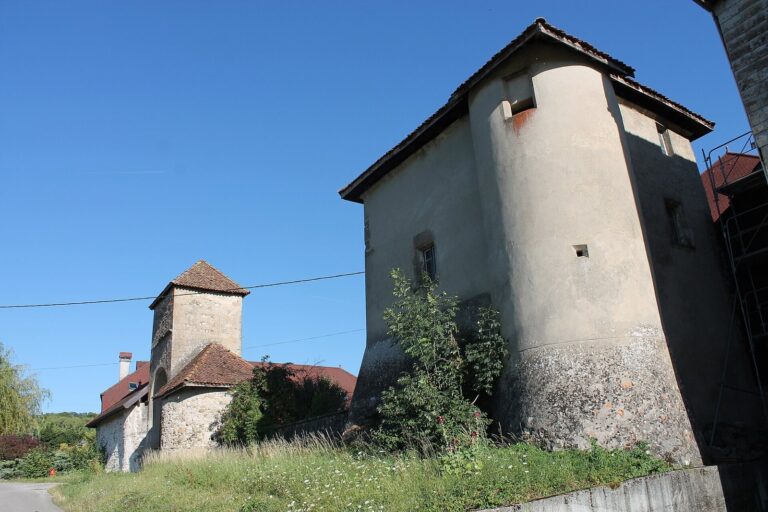
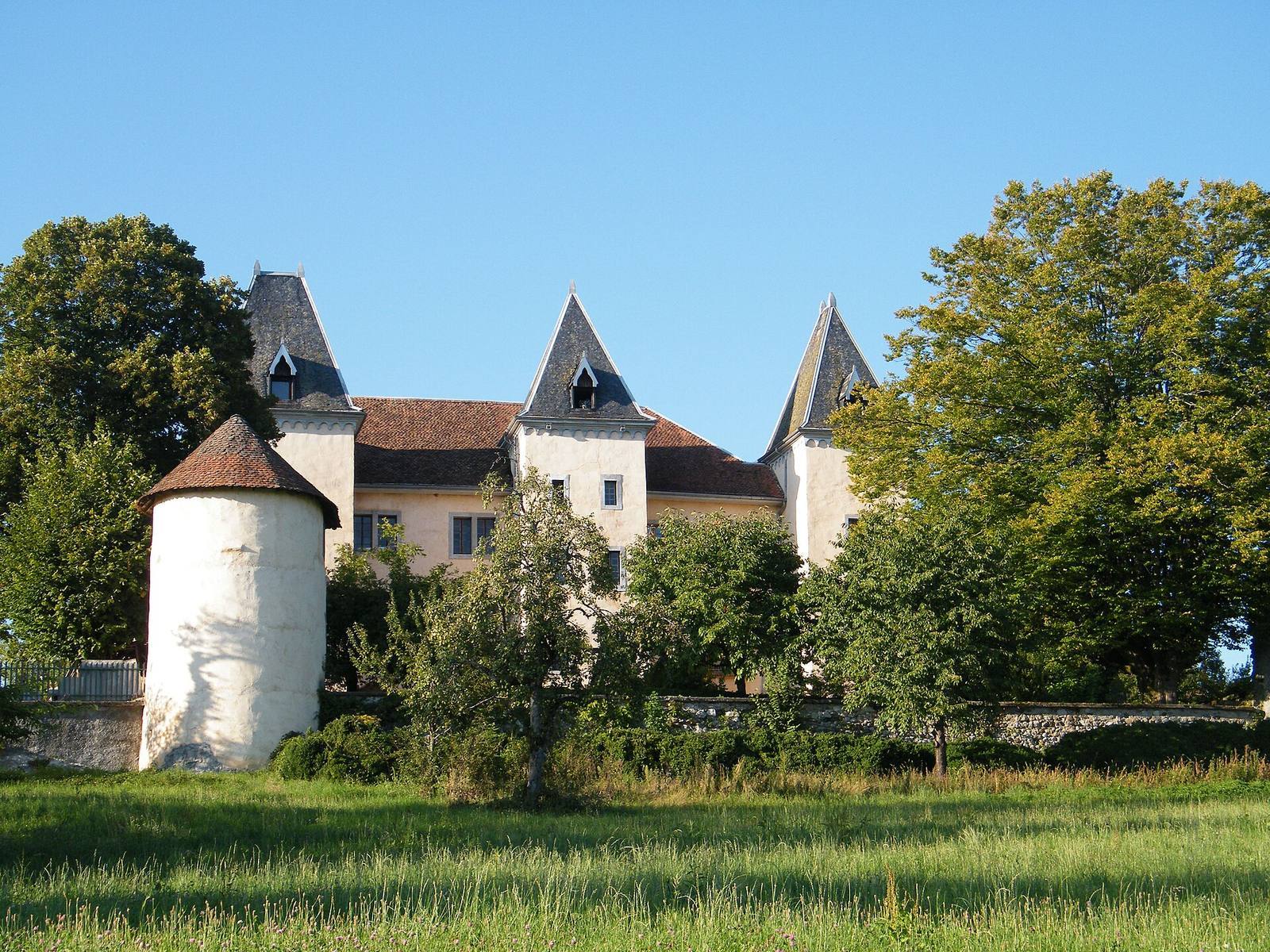
The residential block has a ground floor and three upper storeys beneath a high roof with clipped sides. Three projecting sections are shaped to resemble towers, while three round towers also surround the building.
Entrances and terrace
A courtyard doorway framed by two towers bears the date 1626. The southern terrace, built in the early 17th century, is flanked by two small towers. One of the garden portals also carries the date 1626 and the Favre family arms: a silver field with a blue chevron and three Moor’s heads, stylized heads used in heraldry, each banded in silver. An inscription on the portal welcomes anyone recognized as a true friend of the master.
Inscriptions and paintings
Twenty-four decorated inscriptions appear on the château’s exterior and interior walls. Their themes and literary quality vary considerably.
The west tower contains several paintings. Portraits inside the castle depict President Favre, René Favre, Marie de Villaret, Hyéronime de Laplace and Claude Favre de Vaugelas, a 17th-century French grammarian and member of the Académie française.