Athcarne Castle: A Ruined Elizabethan Castle in County Meath


Site at a Glance
- Rating
- 3.8
- Popularity
- Very Low
- Country
- Ireland
- Primary era
- Medieval
- Eras represented
- Medieval, Modern
- Civilizations
- British, Norman
- Site type
- Military
- Remains
- Castle
On this page12 sections
History
Athcarne Castle is a ruined Elizabethan castle in Ireland, with origins in an Anglo-Norman defensive structure that developed into a tower house over several centuries. Its major late-sixteenth-century expansion took place in 1590, and the castle is now a national monument of Ireland, listed as Athcarne Castle under reference number 240.
Earlier Traditions and Anglo-Norman Origins
The name Athcarne may derive from Áth Cairn, meaning “ford at the cairn” or “ford at the burial mound,” or from Ard Cairn, meaning “high cairn.” A burial mound stands southeast of the castle, across the Hurley River. Historian Beryl Moore proposed that the castle itself may have been built over an earlier cairn, although that interpretation remains uncertain. The cairns are attributed to approximately 4,000 years ago, and Moore also suggested that they were raided during the Viking attack on Newgrange in 861.
In the early historic period, the townlands of Carnes, east of the ford at Athcarne, were associated with Cerne, Cernae, or Cerna. This place was described as the principal burial ground of the men of east Midhe and Brega. It included a burial mound and the Hill of Cerna, where tradition said the bodies of the sons and grandsons of Áed Slaine, an early medieval king associated with Brega, were kept. These places lay at the western end of the Crockafotha ridge, south of Duleek.
The name Cerna also appears in early Irish literary traditions describing a route south from Brú na Bóinne, the prehistoric ceremonial and funerary landscape in the Boyne valley. Another Cerna, linked with the legend of Conaire Mór and the “crooked beasts of Cerne,” was probably farther along the Boyne at Kilcarn near Navan.
In 1172, the lands at Athcarne were granted to Hugo De Bathe, an Anglo-Norman knight from Bath in England. He may have arrived in Ireland with Richard “Strongbow,” Earl of Pembroke, in 1170, or with Hugh de Lacy, Lord of Meath, in 1171. A defensive structure was probably established on the site after the grant, gradually becoming a tower house.
Elizabethan Expansion and the Bathe Family
Sir William Bathe, a High Court judge, and his wife, Janet Dowdall, greatly enlarged the castle in 1590. This work created an Elizabethan residence, combining fortified traditions with the more comfortable domestic arrangements associated with late-sixteenth-century architecture. After William Bathe died in 1597, Athcarne passed to his brother James Bathe and later to James Bathe’s heirs. A James Bathe owned the property in the 1640s.
Cromwellian Capture and Later Ownership
Athcarne became involved in Oliver Cromwell’s campaign against the Royalists in 1649. Cromwell, the English military and political leader whose forces conquered much of Ireland during the campaigns of 1649 to 1653, marched north from Dublin with 12,000 men to capture Drogheda. After Ballygarth Castle at Julianstown fell on 31 August, his forces captured Athcarne, Bellewstown, and Dardistown on 1 and 2 September, before the Royalists could secure them. These actions gave Cromwell control of the River Nanny, which ran parallel to and south of the Boyne.
Following its capture, Athcarne was granted to Colonel Grace, one of Cromwell’s officers. James Bathe and his family moved to Ashbourne, where James died before 1660. His son Luke Bathe petitioned the Crown for the return of the family estates, but the Second Act of Settlement of 1662, which redistributed or confirmed ownership of Irish estates after the Cromwellian confiscations and the restoration of the English monarchy, transferred Athcarne and other confiscated properties to the Duke of York, the future King James II of England.
The Bathe family did not regain legal ownership, although the Duke of York granted Sir Luke Bathe a 99-year lease in 1668. The lease covered the castle and 1,200 acres for a total payment of £430, and expired in 1767. A local tradition holds that James II slept at Athcarne while travelling to the Battle of the Boyne in 1690. James II, king of England, Scotland, and Ireland from 1685 until 1688, was defeated by William III at that battle. The tradition is considered plausible because the castle stood about six miles from the battlefield, James II owned it at the time, and the Bathe family occupied it as tenants.
Remodelling and Ruin
The Bathe family left Athcarne around 1700. The Garnett family then owned the castle for approximately a century, after which the Gernon family acquired it around 1830 and substantially remodelled it. The Gernons retained the original tower house but demolished the Elizabethan mansion and replaced it with a more modern extension.
Financial decline led the Gernon family to sell Athcarne at auction in 1939. The building was gutted, and its parts were sold as architectural salvage. A proposal to demolish the remaining structure and use its rubble for local road extensions was abandoned. The surviving remains eventually passed into the care of the Irish State.
Remains
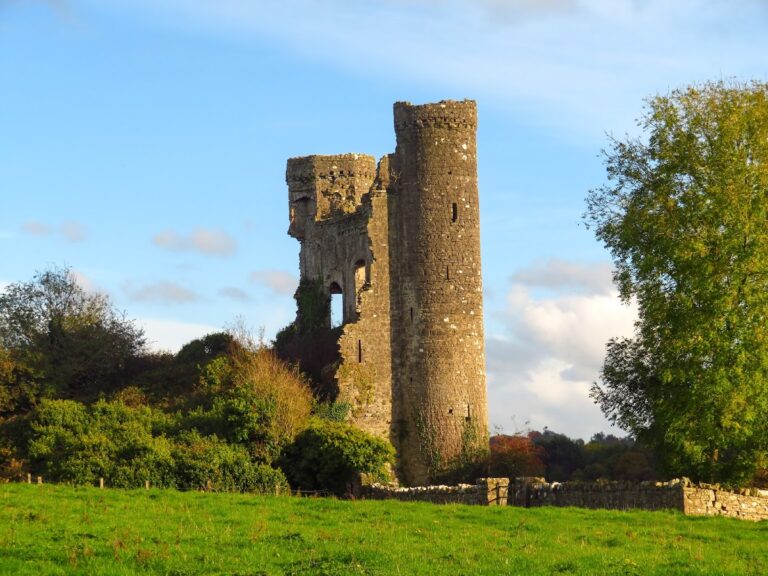
Athcarne survives as a combination of the original tower house and the nineteenth-century extension built during the Gernon remodelling. The Elizabethan mansion added by William Bathe in 1590 was demolished during that later transformation. The Gernons also changed the orientation of the house so that its front faced south, giving the surviving complex a different arrangement from the Elizabethan residence.
Castle Buildings
Original Tower House
The original tower house forms the older core of the ruin. A tower house was a fortified stone residence centred on a tall tower, a common form in medieval and early-modern Ireland. At Athcarne, this structure represents the building tradition that developed from the earlier defensive establishment associated with the Anglo-Norman grant of 1172. It was retained when the Gernon family remodelled the property and remains part of the surviving ruin.
Nineteenth-Century Extension
The Gernon family replaced the Elizabethan mansion with a nineteenth-century extension containing larger windows. These openings reflected the architectural fashion of the period and gave the remodelled house a more modern character. The extension survives alongside the tower house, while the wider building was gutted after the 1939 auction and its architectural parts were dispersed as salvage.
River and Burial Landscape
Burial Mound
A burial mound lies southeast of the castle on the opposite side of the Hurley River. It forms part of the landscape associated with the possible origins of the name Athcarne. The mound, and the uncertain suggestion that the castle may have occupied an earlier cairn, connect the later castle site with funerary features attributed to approximately 4,000 years ago.
Boating Lake
A boating lake was created in the field in front of the castle during the Gernon period. It was formed each winter by damming the Hurley River, and the dam remained visible. The feature belonged to the nineteenth-century landscape created around the remodelled house.
Nearby sites