Millmount Fort: A Historic Fortified Complex in Drogheda, Ireland


Site at a Glance
- Rating
- 4.5
- Popularity
- Low
- Country
- Ireland
- Primary era
- Medieval
- External website
- Open
- Eras represented
- Medieval, Early Modern, Modern
- Civilizations
- British, Norman
- Site type
- Military
- Remains
- Fort
On this page12 sections
History
Millmount Fort is a fortified complex in Ireland, overlooking Drogheda from the south bank of the River Boyne. The site was fortified by the Normans from the early twelfth century and became an important part of the town’s history through the medieval period, the Cromwellian conquest, and the Irish Civil War.
Norman origins and medieval development
The earliest fortification was a Norman motte-and-bailey, a raised mound supporting a fortified position beside an enclosed defensive area. It was probably built on an earlier Neolithic passage grave, a prehistoric burial monument organized around a passage leading to a burial chamber, although this identification remains uncertain.
Hugh de Lacy, a Norman lord who became a leading figure in the Anglo-Norman expansion in Ireland under Henry II, built the original fort around 1172 after Henry granted him the Kingdom of Meath. A stone castle was later erected on the same site, extending the military importance of the mound within Drogheda’s defences.
Irish mythological tradition associates the mound with the burial place of Amhairgin mac Míled. His name and the poem known as The Song of Amhairgin were traditionally linked with the origins of song, poetry, music, and Irish poetry.
The siege of 1649
The castle formed part of Drogheda’s defences during the siege of 1649, one of the major actions in Oliver Cromwell’s conquest of Ireland. Cromwell was the English Parliamentarian leader whose forces sought to bring much of Ireland under Parliamentarian control. On 11 September 1649, the English defenders attempted to surrender to the Parliamentarian army, but they were massacred after giving themselves up.
Later military phases
The complex later became known as Richmond Barracks. Buildings in its courtyard were constructed around 1714. After the unrest and rebellions of the 1790s, and following the Act of Union of 1800, which united the Kingdoms of Great Britain and Ireland, the site was re-fortified and its present tower was built.
During the Irish Civil War, Anti-Treaty forces occupied Millmount. These republican forces opposed the 1921 Anglo-Irish Treaty. On 4 July 1922, troops of the Irish Free State, the state established under the Treaty settlement, shelled the fort for several hours with an 18-pounder artillery piece. The republican garrison retreated, while the bombardment caused considerable damage and almost completely destroyed the tower.
Restoration and museum use
The fort was restored in 2000 and now houses Millmount Museum. The Old Drogheda Society is identified as the owner. The entire fort is a national monument and has also been designated Drogheda’s Cultural Quarter. The museum’s collections have local and national importance, including guild and trade banners recognised by Ireland’s National Museum as specially significant. They include the only remaining guild banners in Ireland.
Remains
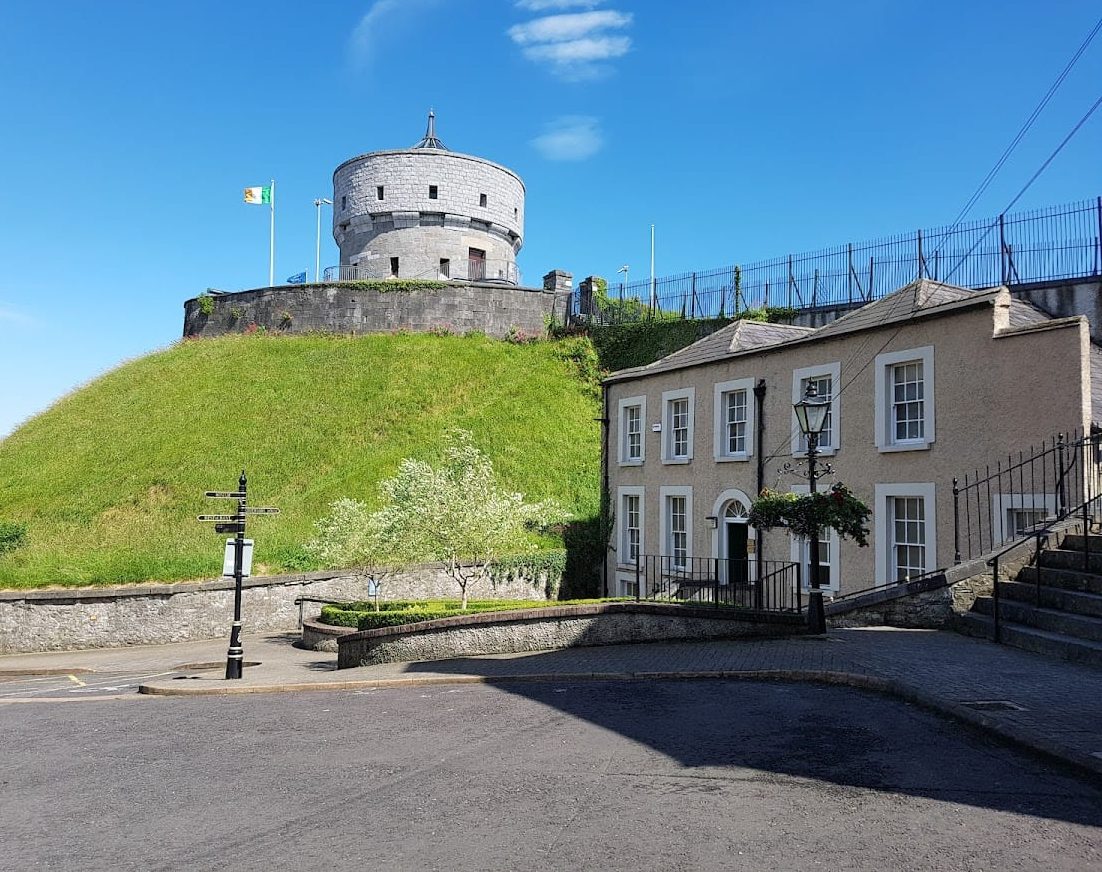
Millmount Fort occupies a large mound on the south bank of the River Boyne and forms a dominant feature of Drogheda. Its surviving complex combines the elevated medieval fortification site, later courtyard buildings, and the defensive tower constructed during the re-fortification after 1800. The restored buildings now contain the museum and its exhibition spaces.
Fortified mound and defensive tower
Norman mound
The mound preserves the physical setting of the early Norman motte-and-bailey fortification. The motte was the raised defensive mound, while the adjoining bailey formed the enclosed area of the medieval complex. A stone castle was later constructed on the same site, continuing the use of the mound as a fortified position.
Martello tower
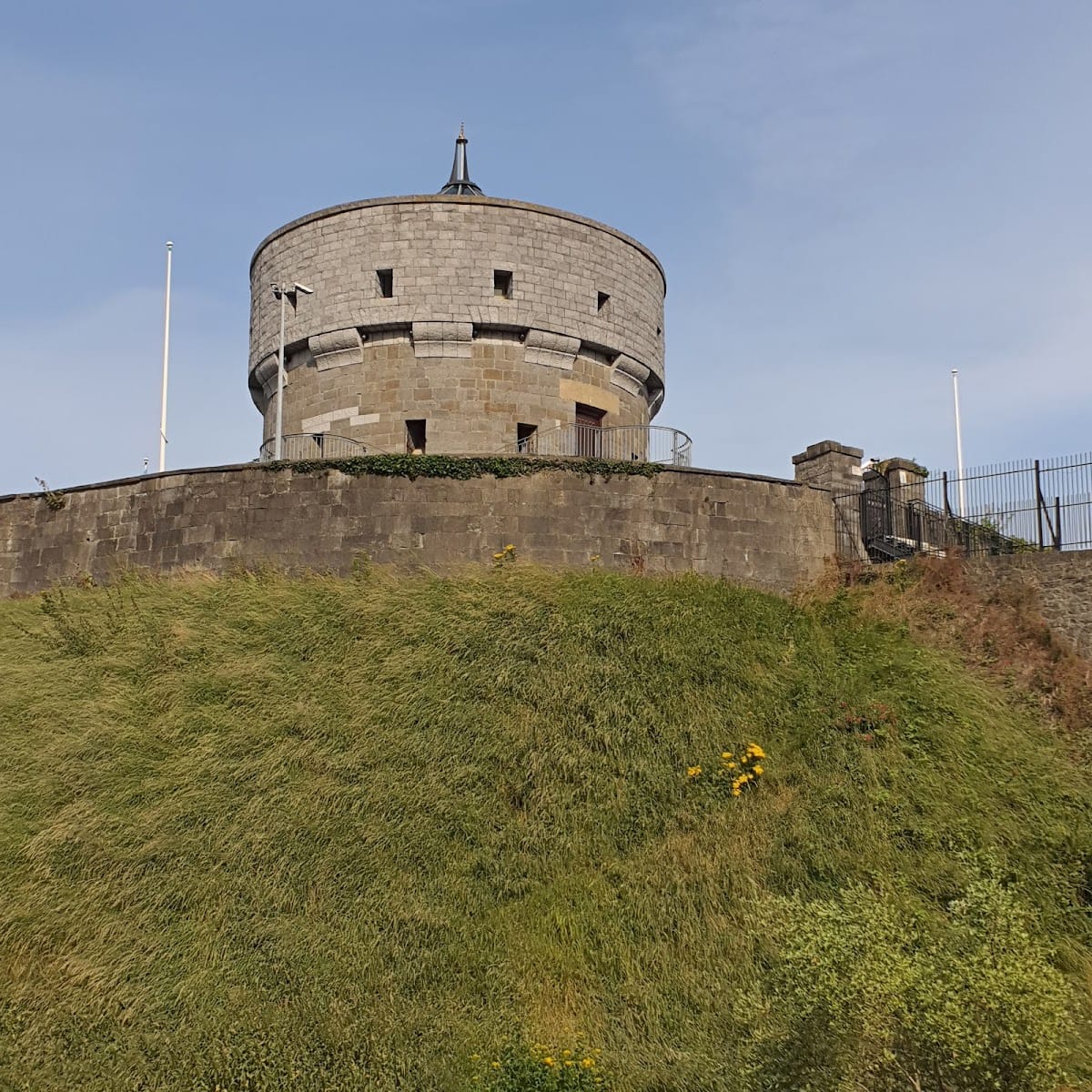
The present tower is a Martello tower, a compact defensive structure built to withstand artillery attack and provide a platform for defensive guns. Locally known as “The Cup and Saucer,” it was almost completely destroyed by shelling during the Irish Civil War. The tower and the wider complex were restored in 2000.
Courtyard buildings and museum collections
Richmond Barracks courtyard
The courtyard contains buildings constructed around 1714, reflecting the complex’s later use as Richmond Barracks. These buildings now accommodate parts of Millmount Museum, including an eighteenth-century Irish folk kitchen, a dairy, a laundry, and an Irish History Room presenting major events in Irish history.
Guild and trade banners
The museum displays a distinctive surviving group of Irish civic and occupational banners. Its guild and trade banners are recognised by Ireland’s National Museum as specially significant and include the only remaining guild banners in Ireland.
Nearby sites