Skryne Castle: A Norman Feudal Castle in County Meath, Ireland


Site at a Glance
- Rating
- 4.6
- Popularity
- Very Low
- Country
- Ireland
- Primary era
- Medieval
- Eras represented
- Medieval
- Civilizations
- English, Norman
- Site type
- Military
- Remains
- Castle
On this page9 sections
History
Skryne Castle is a late twelfth-century Norman fortress in Skreen, County Meath, Ireland, established by the feudal lord Adam de Feypo after the Anglo-Norman conquest of Ireland began in 1171. Its first form was a timber motte-and-bailey, a fortified mound paired with an enclosed defensive courtyard, built by 1175. The castle formed part of the network of lordships and fortifications created to secure Norman control in Meath.
The Norman foundation
Henry II of England visited Ireland in October 1171 to organize the territories conquered by the Anglo-Normans, departing in April 1172. He granted Meath to Hugh de Lacy, who began building castles to defend the territory against Irish clans resisting the conquest. Hugh de Lacy granted Skryne to Adam de Feypo, who distributed land among twenty vassals.
Skryne Castle is mentioned in the twelfth-century poem The Song of Dermot and the Earl, which records Adam de Feypo receiving the castle. The Skryne estate later remained with a direct descendant of those knights. By 1300, the de Feypo family held the title of Baron of Skryne.
Religious foundations and later history
The de Feypo family also shaped the religious landscape around the castle. Richard de Feypo rebuilt the old church of Saint Colm Cille on the hill. Colm Cille, also known as Columba of Iona, was an Irish Christian saint associated with early medieval monasticism. In 1341, the de Feypo feudal lords built a church dedicated to Saint Lawrence, while a nearby monastery was constructed in the fifteenth century. The castle itself served as a chapel for a long period, and an old cemetery beside it was traditionally associated with the burials of Adam de Feypo and his son Richard.
The barony continued until about 1600, when its holders died out. The castle was then abandoned and gradually fell into ruin. It was repeatedly destroyed, rebuilt, and altered before undergoing partial restoration in 1800. The estate had covered 1,266 acres and included mills and ponds, while a royal road ran beside the castle. Skryne also lay near the Hill of Tara, a sacred Irish site traditionally associated with the residence of Ireland’s high kings. The place-name is derived from a word meaning “the shrine,” reportedly referring to a shrine of Colm Cille once kept in a monastery at the settlement.
Remains
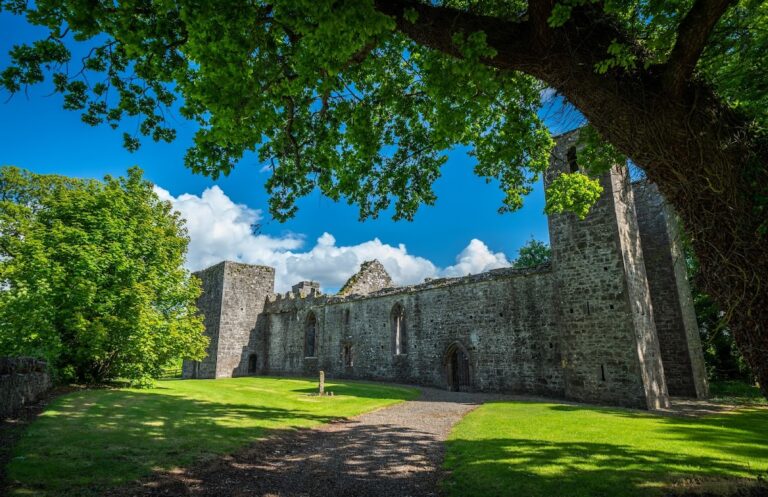
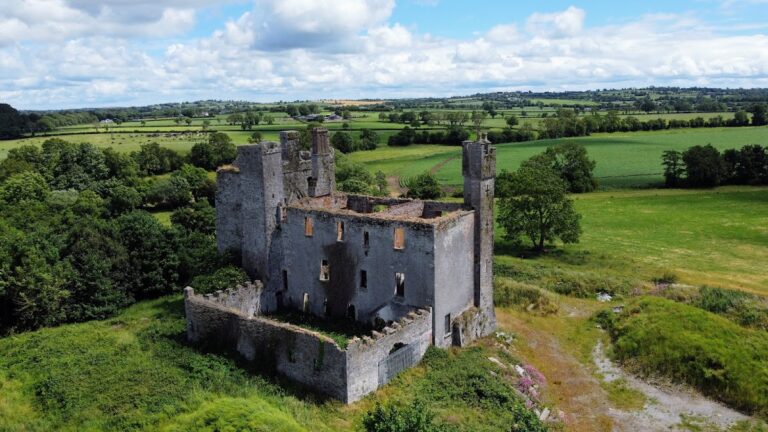
Skryne Castle occupies the summit of a high hill approximately 500 feet above sea level. Its surviving ruins represent successive stages in the development of the site, from an early timber fortification to a stone castle and a larger manor complex.
Early fortification
Motte-and-bailey
The earliest castle consisted of a motte-and-bailey. The motte was an artificially constructed mound, while the bailey formed the enclosed defensive courtyard beside it. This timber-built arrangement was an early Norman form of castle construction in Ireland and provided the first fortified centre of the Skryne estate.
Castle and manor complex
Enlarged tower house
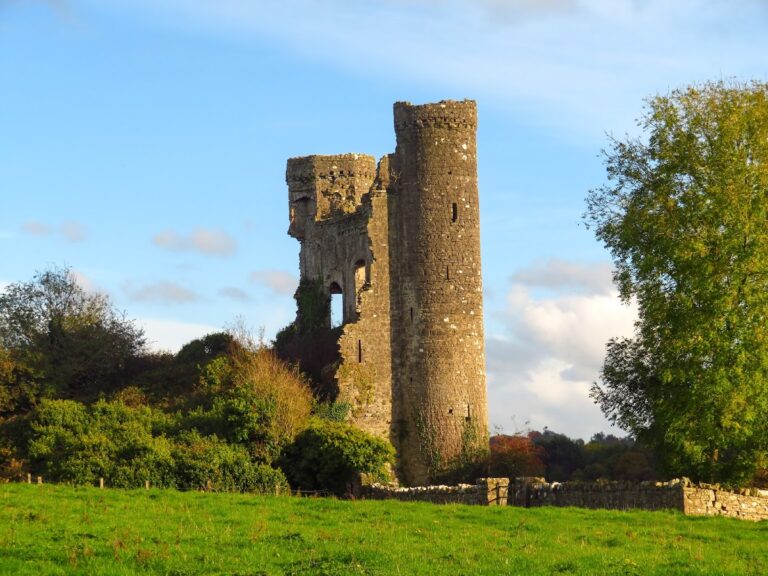
The original motte was later replaced by a small castle described as an enlarged tower house. A tower house was a compact fortified residence organized around a tall stone tower. At Skryne, this later form combined residential and defensive purposes and became part of the successive castle remains.
L-shaped manor
The complex was subsequently expanded into a larger manor. This stage incorporated an L-shaped building and an adjoining square extension measuring approximately 30 by 30 metres. The surviving structure is now ruinous, preserving the changing form of the castle and manor complex rather than a single building from one period.
Nearby sites