Habichtsburg: A Medieval Castle in Germany


Site at a Glance
- Rating
- 4.3
- Popularity
- Very Low
- Country
- Germany
- Primary era
- Medieval
- Eras represented
- Medieval
- Civilizations
- Holy Roman Empire
- Site type
- Military
- Remains
- Castle
On this page10 sections
History
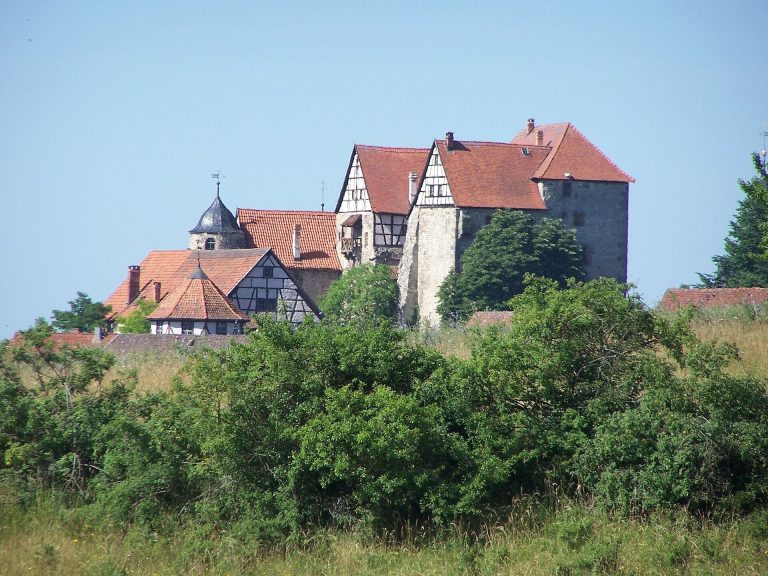
Habichtsburg is a medieval castle in Germany, near Meiningen, established around 1100 in the eastern Rhön. Formerly called Habesburg, it helped protect the Würzburg bishopric’s exclave and monitor trade routes leading from Gotha toward Würzburg, Fulda, and Frankfurt am Main.
The Würzburg Exclave
The castle’s origins were connected with a territorial transfer made in 1008. King and Emperor Henry II gave the royal estates of Meiningen and Walldorf to the Würzburg bishopric in connection with the re-establishment of the Bamberg bishopric in 1007. The Würzburg bishopric was an important ecclesiastical authority, and its temporal territory, known as a Hochstift, was governed as a prince-bishopric. Together with Meiningen and Walldorf, Habichtsburg later formed part of this Würzburg exclave, a separated area of territory, which lasted until 1542.
Habichtsburg was built partly to secure this outlying territory. Its position also allowed it to oversee routes passing through the Haßfurt Gorge. The road below, later known as the Old Frankfurt Road, belonged to the Hohe Straße, an important medieval trade route. The castle therefore combined territorial protection with control of movement through a strategically useful landscape.
Changes of Ownership and Decline
During the twelfth century, Count Goswin of Stahleck acquired Habichtsburg from the bishop of Würzburg. His son Hermann of Stahleck, Count Palatine of the Rhine, sold it in 1156 to Poppo III of Henneberg-Irmelshausen, a member of the Henneberg noble house. The sale helped finance Bildhausen Abbey.
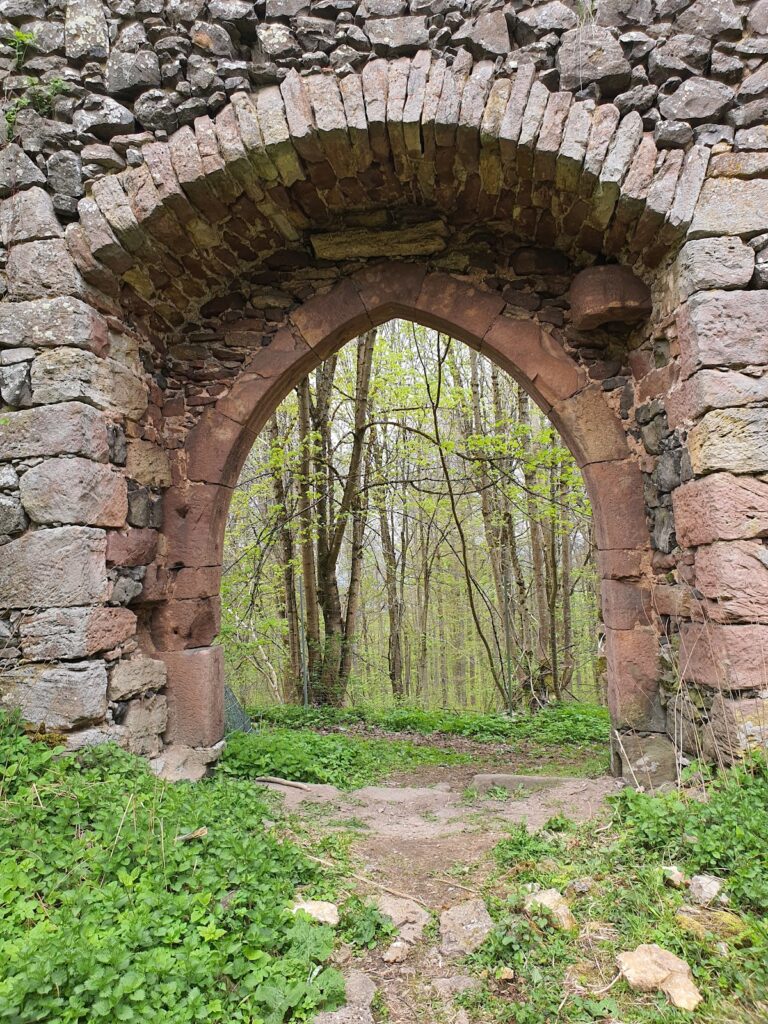
Later changes to the traffic routes reduced the castle’s strategic value, and Habichtsburg fell into decay. Würzburg authorities did not allow it to be rebuilt. In the nineteenth century, parts of the medieval ruins were incorporated into an artificial ruin. Much of the material used for that construction came from the medieval castle itself, making the surviving masonry difficult to interpret and date. During the same period, a circular shaft was excavated to its bottom, probably in the hope of finding valuables, destroying archaeological evidence within it.
Habichtsburg is legally protected both as a monument and as a protected archaeological ground monument.
Remains
Setting and Defensive Layout
The ruins occupy a rocky spur on the eastern edge of the Rhön, on the western slope of the 415.8-metre Kallberg, at about 370 metres above sea level. The castle stands approximately 40 metres above the floor of the Haßfurt Gorge. Its enclosure measures about 70 by 40 metres, while steep rock faces protected three sides of the site.
Approach Ditches
Access from the east crossed a neck ditch, a defensive ditch cut across the narrow connection between a castle spur and the surrounding ground. This ditch was up to 7 metres wide and 10 metres deep. A second blocking ditch lay about 30 metres farther out and survives in fragmentary form. Standing remains of the eastern section of the enclosure wall rise immediately behind the neck ditch.
Keep and Eastern Enclosure
A building in the eastern section was especially exposed during an attack, so the former keep stood directly beside it. A keep was the main defensive tower of a medieval castle, usually serving as a strongpoint rather than a permanent residence. Habichtsburg’s keep was a round tower built with double-shell masonry and had an internal diameter of 5.2 metres. The tower was replaced by a pavilion in the nineteenth century. The surviving castle remains include remnants of the keep, the neck ditch, and a rock chamber.
Terraces and Water Supply
Western Buildings
Buildings and courtyard areas occupied the western part of the enclosure, where the rocky ground was arranged in three terraces linked by stairs. The size and appearance of these structures remain uncertain because little wall fabric is recognizable. Stairs also form part of the nineteenth-century artificial ruin.
Rock-Cut Shaft
On the steep northern slope, a staircase leads to a circular shaft cut into the rock. It measures 3.1 metres in diameter and may have served as a tank or cistern rather than a well. A narrow footpath descends from the shaft toward the gorge, possibly indicating that additional water was brought up by donkey.
The Old Frankfurt Road passes through the Haßfurt Gorge below Habichtsburg. About 2 kilometres north stood the Würzburg castle of Landeswehre, whose site has been built over by Landsberg Palace since 1840. The terrain prevented a direct line of sight between the two castle sites, although Habichtsburg provided views toward Walldorf and the Wasungen area.