Hünenburg bei Bielefeld: Iron Age Refuge Fortress and Telecommunications Site
Site at a Glance
- Rating
- 4.8
- Popularity
- Very Low
- Country
- Germany
- Primary era
- Iron Age
- Eras represented
- Iron Age, Modern
- Civilizations
- German
- Site type
- Military
- Remains
- Fort
On this page8 sections
History
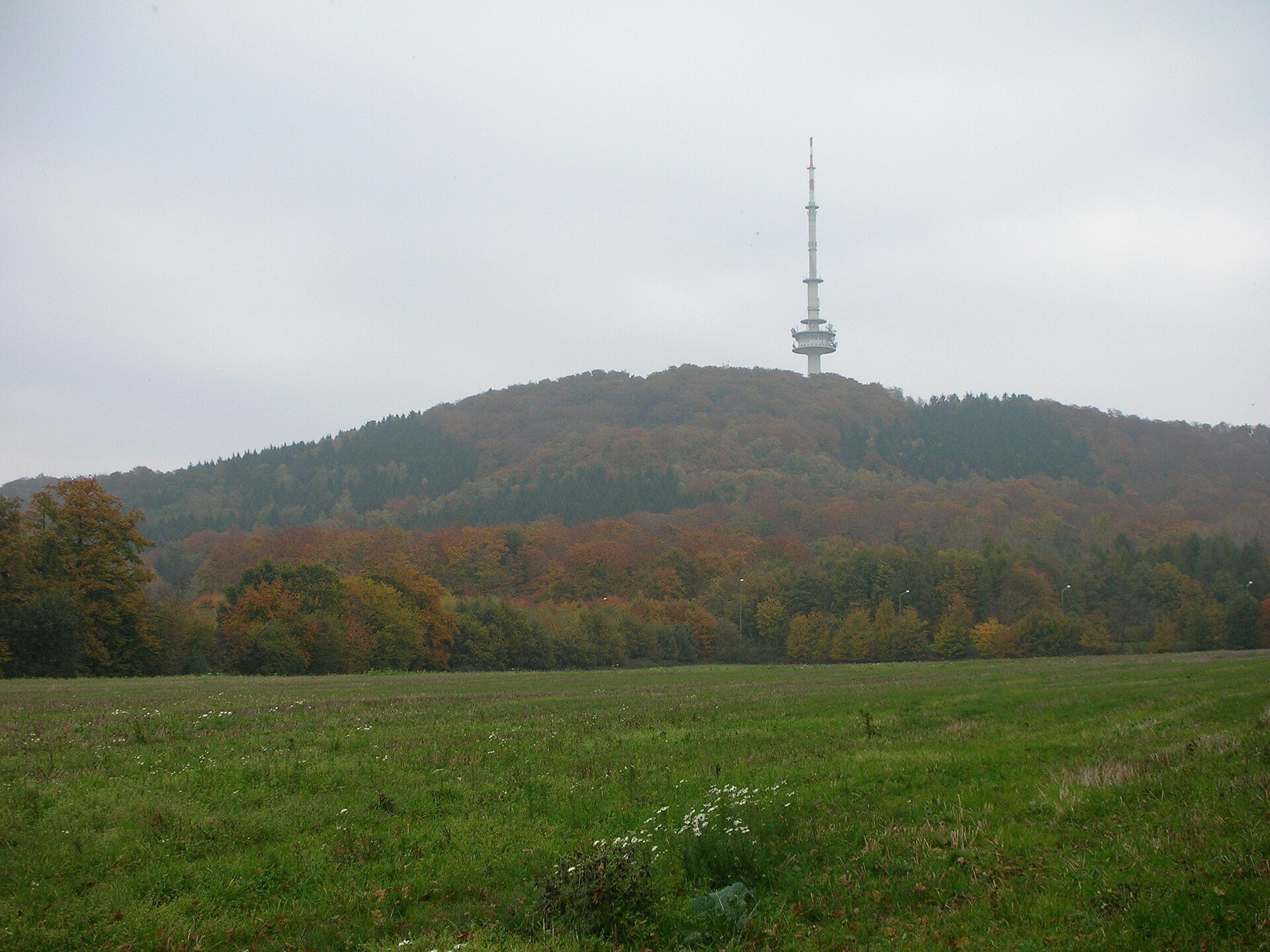
Hünenburg bei Bielefeld is a 312.2-metre mountain in Germany’s Teutoburg Forest, about 4 kilometres west-southwest of central Bielefeld, and the site of a refuge fortress dating to 340–200 BC in the pre-Roman Iron Age. The fortress, which covered about 2.8 hectares, gave the mountain its name. A refuge fortress was built chiefly to shelter a population during danger rather than to serve as a permanent residence. Evidence also indicates that its interior served as a meeting place or cult site.
The Iron Age Fortress
The fortification occupied the summit and the upper part of the southwestern slope. Radiocarbon dating, which estimates the age of organic material through its remaining radioactive carbon, places its beginnings at approximately 200 ± 71 BC. Its early traces were later affected by a medieval quarry on the southern slope and by construction on the summit.
Modern Towers
The summit’s nineteenth-century observation tower, the Drei-Kaiser-Turm, was begun in 1888, the “Year of the Three Emperors,” and completed in 1894. It was demolished in 1952. In the early 1950s, the NWDR was establishing television broadcasting while the Deutsche Bundespost developed the Hamburg–Cologne transmission route. A relay station, which receives and retransmits signals to maintain a long-distance communications route, was needed between the telecommunications tower at Beckum and the old tower at Jakobsberg. The Drei-Kaiser-Turm could not accommodate the newly developed FREDA directional-radio equipment and horn antennas, so a Deutsche Bundespost telecommunications tower replaced it.
The older telecommunications tower was later partly dismantled, while a second tower was built beside it. Transmission operations at the older tower ended in 1972, when the newer Fernmeldeturm Hünenburg was completed. These successive structures, together with the quarry, caused the loss of many early traces from the mountain.
Remains
Fortress Earthworks
The refuge fortress forms a roughly trapezoidal, ring-shaped earthen terrace enclosing approximately 400 by 300 metres. Its surviving defenses consist of earthworks with ramparts and remnants of walls. Excavation exposed a short stretch of dry-stone masonry, a wall built from stones laid without mortar, which formed facing in front of a timber construction about 2 metres wide.
Telecommunications Structures
Older Tower
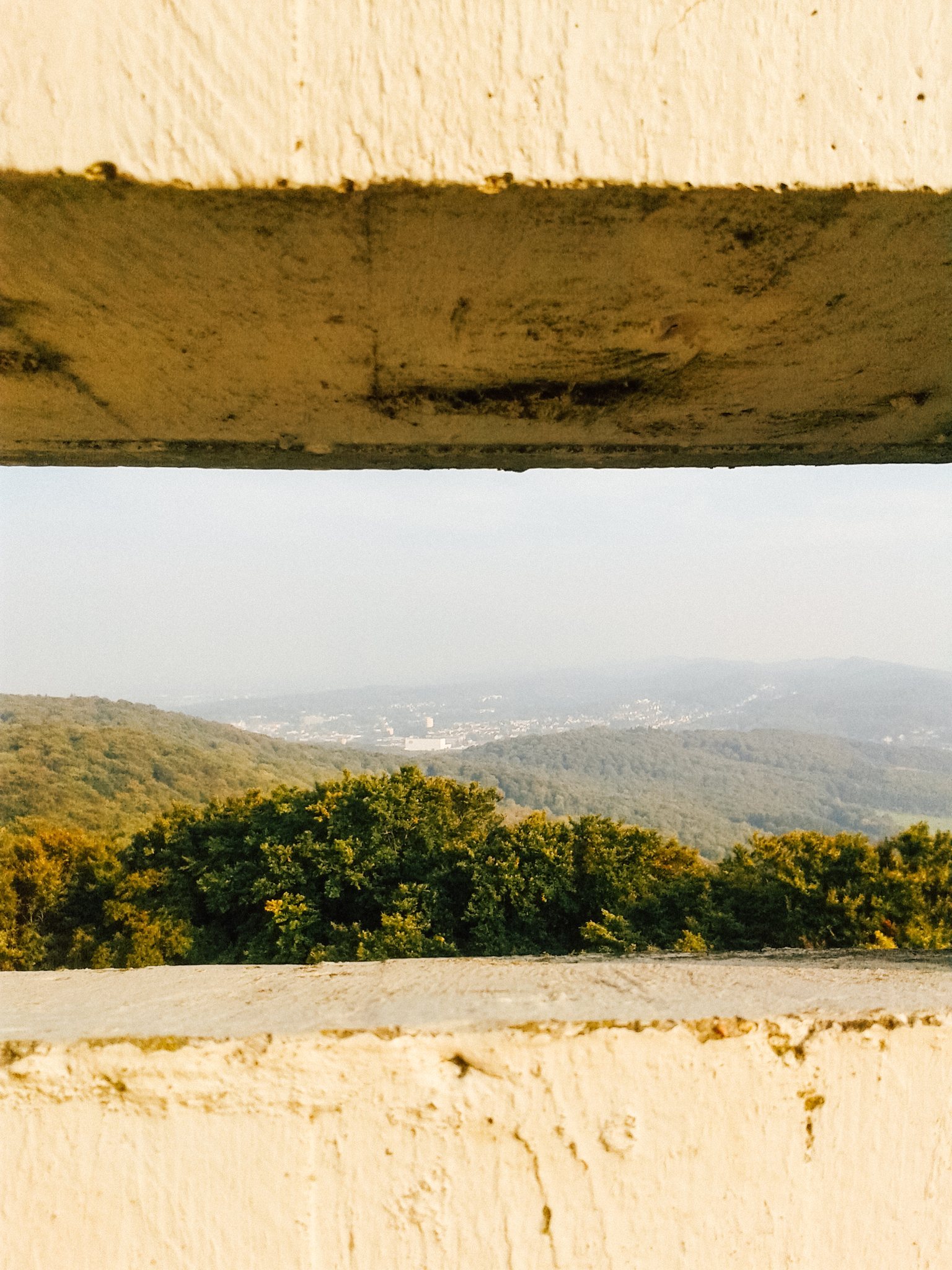
The older telecommunications tower stands within the former fortress grounds. After partial dismantling, it was adapted as an observation tower with a museum and a small kiosk. Its observation platform is about 30 metres above ground. An amateur-radio repeater identified by the call sign DB0BI is installed beneath the platform for FM radio in the 70 centimetre band.
Fernmeldeturm Hünenburg
The newer Fernmeldeturm Hünenburg is a standardized telecommunications tower more than 165 metres high, designated type FMT 3/72. It stands beside the older tower on the former fortification grounds, within the summit area of the mountain.