Fort du Hâ: A Royal Fortress and Prison in Bordeaux

Site at a Glance
- Rating
- 3.8
- Popularity
- Very Low
- Country
- France
- Primary era
- Modern
- Eras represented
- Medieval, Early Modern, Modern
- Civilizations
- French
- Site type
- Civic
On this page16 sections
History
Fort du Hâ, also called Château du Hâ, is a former royal fortress in Bordeaux, France, built by the French monarchy after the reconquest of the city at the end of the Hundred Years’ War. Following the French victory at Castillon on 17 July 1453, Charles VII ordered the construction of the Château Trompette and the Château du Far, which later became known as Fort du Hâ. The fort was intended to control Bordeaux, guard against a renewed English offensive, and secure the city’s political allegiance.
Royal fortress and princely residence
The first stone was probably laid on 24 January 1456. Bordeaux and other towns in Guyenne, the historical province around Bordeaux and the lower Garonne, were required to pay for the work because Bordeaux had supported the English even after surrendering to the French commander Dunois in 1451.
Jean des Vignes is widely regarded as the fortress’s architect, although its resemblance to the Château-Neuf of Bayonne has also led to an attribution to Mathieu de Fortune. Jean des Vignes may instead have been involved financially. Jean and Gaspard Bureau supervised the construction, assisted by the Count of Clermont, Jean Poton de Xaintrailles, and Théodore de Valpergue.
The fortress initially accommodated part of Bordeaux’s royal garrison. In 1470, Louis XI appointed his brother Charles de Valois Duke of Guyenne, and Charles made the Hâ his residence. The fortress consequently became the setting for a brilliant court as well as a military establishment. Charles de Valois died there on 24 May 1472.
Religious conflict and royal control
The Hâ was drawn into the disturbances caused by the gabelle in August 1548. This major salt tax was deeply unpopular because its administration varied between regions. Tax collectors took refuge in the fortress, which was then seized during the uprising. Tristan de Monenh, lieutenant general of Guyenne, was killed when the garrison intervened against the insurgents. Anne de Montmorency subsequently directed the royal repression.
Charles de Coucy, Lord of Burie and lieutenant general of Guyenne, requested the fortress as his residence in December 1562. He received it in 1563, after the death of Antoine de Noailles, who had occupied it as captain of Fort du Hâ while also serving as mayor of Bordeaux.
After the Saint Bartholomew’s Day massacre, a wave of anti-Protestant killings that began in Paris in August 1572 and spread elsewhere in France, the fortress sheltered Protestant refugees. Jacques d’Escars, Baron of Merville, was governor of the Hâ and seneschal of Guyenne. He also protected Benoist de Lagebaston, the Catholic first president of the Parlement of Bordeaux, and the lawyer Guillaume Leblanc.
On 1 December 1593, Marshal Jacques II de Goyon de Matignon seized the fortress to prevent the Catholic League, a Catholic political and military alliance active during the French Wars of Religion, from handing Bordeaux over to Spain. Henri IV had already ordered measures to secure the Hâ because of its strategic value. In August 1604 he ordered its fortifications demolished, but letters patent issued on 31 October suspended the demolition.
Defence, prison, and revolutionary repression
During the Fronde, a series of rebellions against royal authority between 1648 and 1653, the fortress helped defend Bordeaux when royal forces besieged the city in September 1650. Louis XIV ordered repairs and additions in 1654. In 1680, Vauban, France’s leading military engineer under Louis XIV, prepared a memorandum on the defences of the Hâ, the Château Trompette, and Fort Sainte-Croix. Some transformations followed.
A civil prison was established at the Hâ in 1731. In August 1785, Louis XVI ordered the Château Trompette demolished and proposed new barracks at Fort du Hâ. Victor Louis was commissioned to design them in 1786, and the plans and estimates were approved in March 1788. The project was abandoned, however, after the French Revolution began. The prison sometimes held more than 200 civilian and military prisoners, including both men and women.
In September 1790, the Tower of the English was transferred to the city because Bordeaux’s prisons were overcrowded. A decree of 10 July 1791 proposed suppressing and selling the Hâ, Fort Louis, and the Château Trompette, but the departmental authorities retained the Hâ as a prison.
During the Reign of Terror, the period of revolutionary repression and executions chiefly associated with 1793 and 1794, the fortress became national property and a state prison. The Military Commission of Gironde, which issued death sentences for many detainees, met in the former Minimes chapel beside the prison. Its president, Jean-Baptiste Lacombe, was imprisoned at the Hâ after the fall of Robespierre and guillotined on 14 August 1794.
Among the revolutionary prisoners were François-Armand de Saige, mayor of Bordeaux, who was executed on 25 October 1793, and Antoine Duranthon, a lawyer and former Minister of Justice under Louis XVI, executed on 20 December 1793. Other detainees included the journalist Romain Dupérier de Larsan, the chronicler Pierre Bernadau, and Thérèse Cabarrus, who was later released through the intervention of Jean-Lambert Tallien. The architect Pierre-Jean-Baptiste Thiac was arrested in December 1793, tried in March 1794, and acquitted.
Nineteenth-century rebuilding and the prison system
Demolition began in 1835 to make way for a new courthouse and the future Hâ prison. The old fortress was largely destroyed by 1837, although two medieval towers were retained. The replacement buildings, designed by Joseph-Adolphe Thiac, were inaugurated on 19 November 1846. The prison followed the Pennsylvania penitentiary system, a model based on separate-cell confinement and intended to encourage penitence through isolation.
At the end of the nineteenth century, women from across the region who had been sentenced by the courts were held at the Hâ before being transported to New Caledonia. There they were intended to marry former convicts who had become settlers.
From 1918, capital executions in Bordeaux took place in the courtyard shared by the Hâ and the neighbouring courthouse. Six men were executed publicly there between 1918 and 1933. Between 1941 and 1960, one woman and five men were executed at the same location. René Pons, executed on 21 June 1960, was the last person condemned to death at the fort.
Occupation, postwar imprisonment, and transformation
During the German Occupation in the Second World War, the Hâ served as a political prison for opponents, resistance members, and other detainees. Those held there included Édouard Daladier, Georges Mandel, the Bonapartist claimant Louis Napoléon Bonaparte, Renée Darriet, Louis de Jabrun, and Andrée De Jongh. Resistance members detained at the Hâ included Lucien Nouaux, Robert Darniche, Max Coyne, Raoul Batany, Serge Duhourquet, Paul Cazaux, Laure Gatet, Aurore Pica, and Paulette Sauboua. Some were deported to concentration camps, while others were executed at the Souge camp near Bordeaux.
Jewish prisoners were held at the Hâ before being transferred to Drancy, a transit camp near Paris, and deported to extermination camps in Poland. During and after the Occupation, the prison also held people who had crossed the Pyrenees toward the Atlantic coast and been arrested in Spain. After liberation, the fortress was used for collaborators and other prisoners, including Friedrich-Wilhelm Dohse, who had helped direct the Gestapo in Bordeaux.
After the war, the Hâ resumed its role as a departmental prison. Marie Besnard was imprisoned in Bordeaux during her second trial before her later exoneration. The prison also held the sixteen defendants known as the “Sixteen of Basse-Pointe,” who were tried there in 1951. The last inmates were transferred to the new Gradignan prison on 12 June 1967, and demolition began at the end of 1969.
The École nationale de la magistrature, France’s national institution for training judges and public prosecutors, was built on the site from March 1971 to designs by Guillaume Gillet. It was inaugurated on 12 December 1972. A competition for a new judicial courthouse was held in 1990. After the winning project by Jacques Hondelatte was cancelled, Richard Rogers designed the modern building that entered service in 1998.
The surviving towers were placed under the protection of France’s historic-monument system in 1965. The present complex is owned by the French state and the Gironde departmental council and accommodates Bordeaux’s judicial courts and the École nationale de la magistrature.
Remains
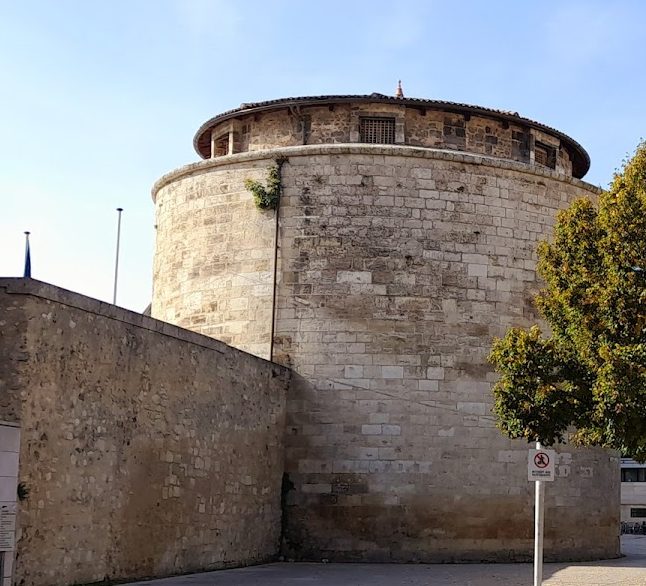
The present site combines the two surviving towers of the medieval fortress with nineteenth-century courthouse and prison buildings and the modern judicial and educational complex. The original defensive character is especially clear in the Minimes Tower, whose walls are 4.40 metres thick. The two medieval towers remain the principal visible remnants of the Hâ, while the Minimes Tower has been incorporated into the École nationale de la magistrature.
Medieval towers
Minimes Tower
The Minimes Tower, also called the Powder Tower, is one of the two surviving structures from the medieval fortress. Its defensive construction includes walls 4.40 metres thick. The tower now forms part of the École nationale de la magistrature and has been converted into a conference room, linking the medieval remains with the site’s present institutional use.
Tower of the English
The Tower of the English is the second surviving medieval tower. It is also known as the Peugue Tower or the Witches’ Tower. In 1790, it was transferred to the city because Bordeaux’s prisons were overcrowded. It remains part of the historic fabric of the former fortress complex.
Courthouse, prison, and chapel remains
Nineteenth-century courthouse and prison
Most of the medieval fortress was replaced by the courthouse and prison buildings designed by Joseph-Adolphe Thiac. The courthouse was completed in 1846, while the prison was arranged according to the Pennsylvania penitentiary model, which used individual confinement in separate cells to promote penitence through isolation. These buildings were later joined by the modern judicial facilities, including the judicial tribunal and the Court of Appeal.
Former Minimes chapel
The former Minimes chapel stood beside the prison. During the Reign of Terror, it served as the meeting place of the Military Commission of Gironde, the revolutionary body that issued death sentences for many detainees. Its association with the prison preserves the physical setting of one of the most repressive phases in the site’s history.
Memorials and modern integration
Memorials to deportees and resistance members
A commemorative plaque in the courtyard honours deportees, internees, and members of the Gironde resistance who died in the Nazi concentration-camp system between 1940 and 1945. A grey granite memorial erected in 1985 against the Minimes Tower commemorates Jewish prisoners deported during the Second World War and contains ashes collected from concentration camps. The courtyard between the surviving towers and the courthouse also contains a Jewish memorial.
Present judicial complex
The former fortress site is physically integrated with the École nationale de la magistrature and the judicial courthouse. The modern complex contains Bordeaux’s judicial tribunal and Court of Appeal, while the Minimes Tower continues as a part of the national judicial training institution. Together, the surviving towers, memorials, historic buildings, and contemporary structures show the successive military, penal, commemorative, judicial, and educational uses of the site.
Nearby sites