Weisswasserstelz: A Medieval Hill Castle on the High Rhine


Site at a Glance
- Rating
- 4.4
- Popularity
- Very Low
- Country
- Germany
- Primary era
- Medieval
- Eras represented
- Medieval, Early Modern
- Civilizations
- Holy Roman Empire
- Site type
- Military
- Remains
- Castle
On this page9 sections
History
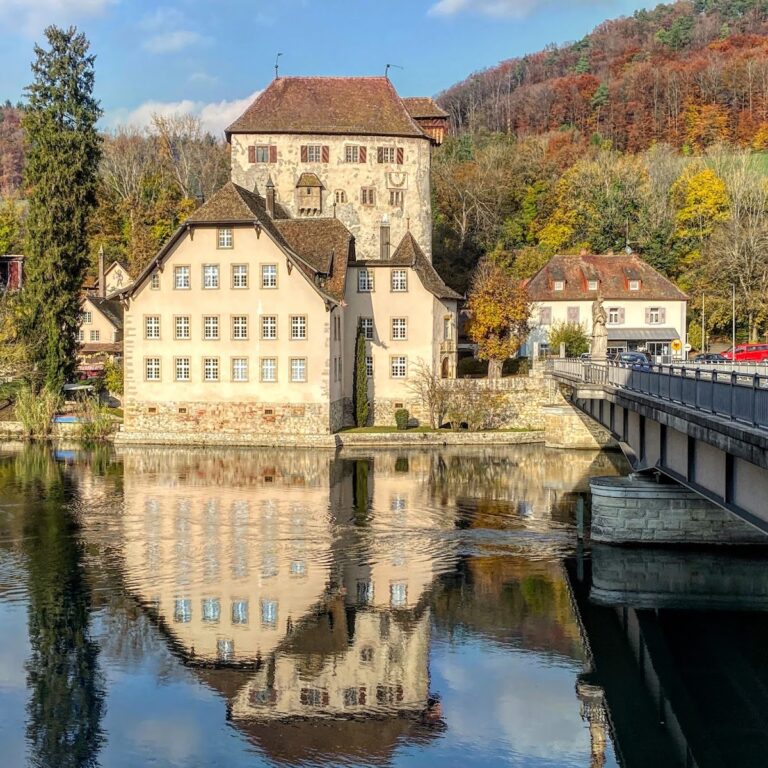
Weisswasserstelz is a medieval hill castle in Germany, above the Rhine near Hohentengen am Hochrhein. Built between 1100 and 1200, it belonged to the local nobility and formed part of a strategic chain of fortifications along the High Rhine, the upper section of the river between the Lake Constance region and Basel.
Origins and the Wasserstelz family
The castle’s beginnings may reach further back than the twelfth century. Foundations beneath the nearby farm estate have been dated to around the year 1000, and the complex may have developed from an earlier Alamannic settlement or estate. The Alamanni were a Germanic population associated with this region during late antiquity and the early Middle Ages. In a wider pattern found elsewhere, an elite family may have established a castle outside an older settlement while keeping the original residence as an economic farm.
The name Wasserstelz first appears in connection with local noblemen in 1165. Heinrich von Wasserstelz, together with Friedrich and Werner von Wasserstelz, is recorded that year, with the latter two serving as ministeriales of Reichenau Abbey. A ministerialis was a dependent member of the medieval service nobility who could hold substantial property and military responsibilities. Wernherus de Wasserstelce appears in a record from 1170. The name may refer to the white Jurassic limestone used in prominent parts of the castle, although this explanation remains uncertain.
Weisswasserstelz was held as a fief of Reichenau Abbey. The grant included church patronage, meaning the right to present or appoint a church’s cleric, as well as the bailiwick of Lienheim, an administrative and judicial territory. From the thirteenth century, such fiefs could be inherited, pledged, or sold, and Weisswasserstelz consequently passed through numerous hands.
Changing feudal holders
Rudolf von Wasserstelz held the property in 1231, followed by Konrad von Wasserstelz. In 1239, Rudolf sold revenues connected with it to Wettingen Abbey. Kunigunde von Wasserstelz appears in 1265 and was abbess of the Fraumünster in Zurich by 1299. Margarete von Wasserstelz was last mentioned in 1330, when Lüthold von Krenkingen acquired property belonging to the Wasserstelz family.
Further transfers followed under the authority of Reichenau’s abbots. In 1343, Abbot Eberhard approved the transfer of the castle, its associated estate, and the Lienheim church patronage to Adelheid von Usenberg. Four years later, he granted the castle and its properties to Ulrich Winkelshain, who had purchased them for 260 marks in Schaffhausen currency.
Hermann von Griessen appears at Wasserstelz in 1366, married to a member of the Heggenzer family of Schaffhausen. The castle may have passed to the Heggenzers through this marriage, although a record from 1373 presents a different sequence. It states that Hermann von Grießheim received Wasserstelz as a Reichenau fief for his son, who was under the guardianship of Johann von Krenkingen. The ownership during these intervening years therefore remains uncertain.
Hans Heggenzer was lord of Wasserstelz in 1451. In 1465, Reichenau’s Abbot Johann enfeoffed Wilhelm Heggenzer with Weisswasserstelz, the Lienheim bailiwick, and the church patronage. An enfeoffment was the formal granting of land or rights by a feudal lord to a holder in return for obligations. Abbot Martin granted the property to Konrad Heggenzer in 1495. Wilhelm Heggenzer of Schwarzwasserstelz sold Weisswasserstelz to Konrad in 1511, and Konrad received it again as a fief in 1518 and 1524.
From Reichenau to Baden
In 1540, Reichenau Abbey was incorporated into the Diocese of Constance, a major Catholic ecclesiastical jurisdiction in the medieval and early modern southwest German region. The bishops of Constance then became the lords of Weisswasserstelz, while the Heggenzers continued to hold the castle as feudal tenants.
Melchior Heggenzer is associated with the property in 1560, the same year carved on the gateway keystone of the estate building in front of the castle. Later investigation showed that the date probably marked the renewal of an older structure rather than its original construction. In 1571, Hans Melchior von Wasserstelz and Rebekka von Schellenberg-Randegg were connected with the property. The inheritance then passed to the Landsberg family, with Georg von Landsberg holding it in 1577 and Friedrich von Landsberg in 1592. Through marriage, the inheritance passed in 1614 to Hans Heinrich Holzapfel von Herxheim.
During the Thirty Years’ War, the major European conflict fought from 1618 to 1648 amid religious, dynastic, and political struggles, Swedish forces reportedly besieged, captured, and burned the castle. In 1639, the Swiss Confederates complained to Duke Bernhard of Weimar, the Swedish commander, that soldiers were mistreating their “open house” at Weisswasserstelz. The keep was certainly blown up. Other major parts may have survived comparatively intact and remained inhabited until shortly before the property passed to the state of Baden in 1803.
Later feudal holders included Johann Melchior Würmer in 1649, Franz Jakob von Andlau in 1665, Franz Ernst Zweyer von Evibach in 1686, and Ägidius von Kreuth of Jestetten in 1694. Records also name Georg Brumsk as holder for Countess Marie Magdalena von Crotti in 1707, Count Ernst August von Falkenhayn in 1715, and Johann Josef von Remscheid from 1731. A pledge arrangement involving the Bishop of Constance followed in 1753 and 1754.
Destruction and conservation
The ruin deteriorated over the eighteenth century. Its southern walls beside the Rhine collapsed in 1729. By 1753 and 1754 it was described as decaying, and in 1779 it was roofless and partly collapsed. The outer walls may have slid toward the Rhine that year, while the rear part of the castle may have lacked a roof from 1781. Judicial rights passed to the Swiss Confederation in 1798, ending the lordship. When the ruin became part of Baden in 1803, it was no longer habitable and continued to decay. Building materials were probably reused in nearby farms and villages.
Repairs took place in 1891 and 1901. In 1989, the state building authority carried out extensive conservation of the surviving masonry. Weisswasserstelz has also been described at times as resembling a robber-knight castle and has been linked in local tradition with black magic and alchemists seeking to make gold or discover the philosopher’s stone. These associations are traditions rather than established historical facts.
Remains
Castle masonry and defensive structures
Weisswasserstelz is a Höhenburg, or hilltop castle, situated on the northern bank of the Rhine at about 340 metres above sea level. Only masonry survives. The former complex included a round tower, a semicircular tower on the eastern side, a curtain wall enclosing the castle, a kitchen building, and a keep, the principal fortified tower of a medieval castle.
The enclosing walls were still preserved in places to a height of two storeys in the late nineteenth century. Their masonry was roughly laid in irregular courses, with dressed facing stones used in some areas. Small sections of plastered walkways remained visible within the complex. Further excavation exposed additional wall lines and profiled base stones from the principal entrance gate. A mason’s mark, a distinctive sign cut by a stoneworker into a finished building stone, survives on the right-hand base stone.
The castle was relatively small and had not been designed to withstand firearms. Its keep was later destroyed by blasting, while the southern outer walls collapsed or may have slid toward the Rhine. The surviving fabric therefore consists chiefly of fragmentary wall remains and preserved masonry from the former defensive complex.
Schlosshof and farm estate
Immediately in front of the castle stood the Schlosshof, an associated estate later used as a tithe barn, together with a farm estate and the Guggenmühle. The estate building has a gateway with a keystone dated 1560. Its conversion into a hotel between 1989 and 1997 revealed that the dated gateway belonged to the renewal of an older building, beneath which foundations had been dated to around the year 1000.
Walls near the present parking area may belong to a chapel. The former farm buildings and the mill formed part of the group of structures associated with the castle, while the old Rhine Valley road passed directly beside the Schlosshof and Guggenmühle.
River setting and related castles
Weisswasserstelz occupied a narrow section of the High Rhine opposite Schwarzwasserstelz, a castle on a small island in the river. Rotwasserstelz lay several kilometres to the east. Together, these fortifications enabled control of the roads along both banks, the bridge site at Kaiserstuhl, and the regional movement of goods.
A riverside transport route may have existed as early as prehistoric times and was probably improved during the centuries of Roman settlement, although the date of the former bridge is unknown. The narrowing of the Rhine at Weisswasserstelz placed the castle and its island counterpart in a closely connected physical and strategic position.