Burgruine Herrenbröl: A Medieval Castle Ruin in Germany


Site at a Glance
- Rating
- 3.9
- Popularity
- Very Low
- Country
- Germany
- Primary era
- Medieval
- Eras represented
- Medieval
- Civilizations
- Holy Roman Empire
- Site type
- Military
- Remains
- Castle
On this page10 sections
History
Burgruine Herrenbröl is the ruin of a small lowland castle in Germany, near Ruppichteroth in North Rhine-Westphalia. It was probably built as a knightly residence during the thirteenth century, although its early history remains obscure. The castle was never a centre of political or strategic importance, but its later ownership records reveal the changing fortunes of the local nobility.
Medieval origins and expansion
Herrenbröl was first mentioned on 8 October 1417, in connection with properties and rights in the parish of Eitorf. The tower and additional parts of the complex were probably built during the fifteenth century by the von Scheidt family. Only limited remains are linked to the earlier thirteenth-century phase, including the castle well.
The von Martial inheritance
In the middle of the eighteenth century, the castle passed by marriage from the imperial baroness Maria Caroline von Neukirchen, known as Nievenheim, to Baron Carl Georg von Martial zu Birlinghoven. Carl Georg was the grandson of Maximilian Carl von Martial zu Veynau, a field marshal and general adjutant to Johann Wilhelm, Elector Palatine. A field marshal was a senior military commander, while a general adjutant served as a ruler’s high-ranking personal military aide.
Franz Ferdinand Clemens von Martial later inherited half of Herrenbröl. Born at Birlinghoven on 6 October 1780, he died at Herrenbröl on 14 May 1831. Eight weeks after the death of his first wife, Anna Catharina, née Stahl, he married Anna Gertrud Happ. Their daughter was Johanna Magdalena.
After Franz Ferdinand’s death, his widow and daughter inherited shares in half of the estate. Johanna Magdalena died at the age of eight. Her mother then received three parts of her daughter’s inheritance, while the remaining nine parts passed to the surviving children of Franz Ferdinand’s deceased brother, Franz Adolph von Martial.
Sale and family disputes
The estate included the residence, ancillary buildings, and 40 Morgen of land. A Morgen was a traditional land measure whose size varied by region. The property was sold on 2 May 1833 to Carl Hundhausen of Ruppichteroth-Oeleroth for 750 thalers, a thaler being a major silver coin used in the German lands before the modern mark. Of the purchase price, 510 thalers went directly to creditors. The notary objected because shares belonging to two minor children had also been sold.
Rather than receiving cash, the widow was given, subject to reservation, the property of Wilhelm Heimann in Ruppichteroth-Kammerich so that the part ownership of Herrenbröl Castle could be released. On 30 November 1837, she transferred that property and her remaining assets to her brother-in-law Anton Hemmerle, who was to provide for her.
On 23 November 1833, Carl Hundhausen had resold the estate to Conrad Becker, a farmer from Breitscheidt, for 1,070 thalers. Becker’s children later sold their inherited shares. The children of Franz Adolph von Martial did likewise, having inherited only 10 thalers each and already being in debt.
Gertrud von Martial, one of those children and a seamstress, brought a court action with legal aid after reaching adulthood. She sought compensation for the forced sale, maintaining that the buildings had been worth more and that the property contained limestone worth 3,000 thalers for quarrying. The dispute ended in a settlement with Carl Hundhausen. Gertrud sold her recovered share to her brother Josef von Martial for 30 thalers. Josef was also unable to retain the property during the wider decline of the lower nobility.
Religious connections and destruction
A small chapel once stood within the castle grounds, and the last wedding of the Martial family held there took place in 1796. The lords of Herrenbröl also held the patronage of the collegiate church at Schönenberg until 1826. Church patronage was the legal right to participate in the appointment of a cleric and to exercise related privileges. A collegiate church was served by a community of clergy rather than monks.
French forces destroyed the castle by the time of the French occupation of the Rhineland, around 1807. In 1994, the municipality of Ruppichteroth acquired parts of the grounds, including the ruin. It demolished a house built by Carl Georg von Martial or his sons in the early nineteenth century. That house had stood over the cellar of the castle’s former manor house, which had itself been destroyed earlier.
Following the demolition, the North Rhine-Westphalian Office for Ground and Monument Preservation excavated and surveyed the old complex. The work showed that Herrenbröl had been considerably larger than previously understood and indicated that remains might also survive on adjoining privately owned plots. The ruin is legally protected as a monument.
Remains
Setting and construction
Herrenbröl was a lowland castle in the valley of the Waldbrölbach, at just over 150 metres above sea level, between Ruppichteroth and Schönenberg and north of the Nutscheid ridge. Unlike a hilltop fortress, a lowland castle stood on relatively level or valley ground, relying on walls, ditches, and water barriers for defence. The complex was built mainly of rubble stone, using irregular, roughly worked stones rather than carefully cut blocks.
Surviving castle structures
Castle tower and buildings
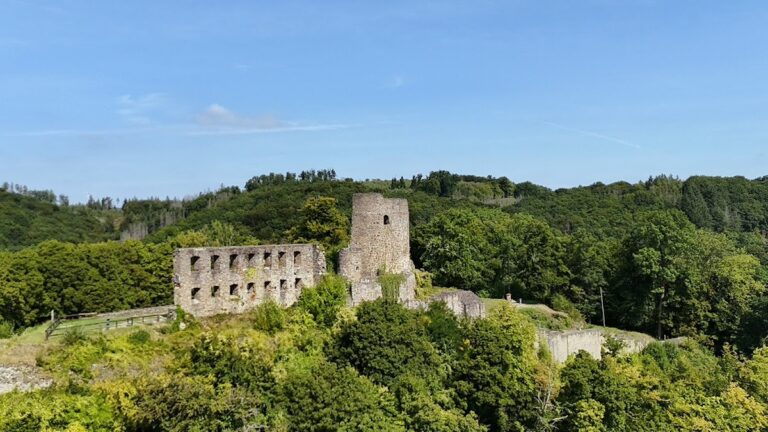
The dominant surviving feature is a section of the castle tower, which rises to approximately seven metres. The tower and other parts of the complex probably date from the fifteenth century. Modest ruins of the castle buildings, foundations, and a rubble-stone-vaulted cellar also survive. A vaulted cellar is a basement covered by a curved masonry vault.
Walls, moat, and excavated area
Approximately 23 metres of the enclosing wall remain. A moat ran along the southern side of the castle and still existed as a pond in the middle of the nineteenth century. Excavation and surveying also revealed that the historical complex extended beyond the area previously recognized, with possible remains on neighbouring privately owned properties.