Château de Stors: An Aristocratic Estate on the Oise


Site at a Glance
- Rating
- 3.6
- Popularity
- Very Low
- Country
- France
- Primary era
- Early Modern
- Eras represented
- Medieval, Early Modern, Modern
- Civilizations
- French
- Site type
- Domestic
- Remains
- Castle
On this page17 sections
History
Château de Stors is an eighteenth-century aristocratic residence in France, on the slopes of the Oise valley near L’Isle-Adam and Mériel. Built on the foundations of an earlier castle, it developed from a medieval seigneurial domain into a country estate shaped by royal officials, aristocratic families, and the Prince of Conti. The property was later damaged by a hurricane, war, neglect, and vandalism, but parts of the château and its grounds have since undergone restoration.
Medieval origins and the Duval residence
A domain at Stors is recorded in 1093. A chapel was built there in the twelfth century for the inhabitants of the hamlet, while a fortified castle on the hillside is documented from the fourteenth century. Jean de Saint-Benoit occupied the castle in 1435.
By the sixteenth century, the residence was described as a four-bay seigneurial house with ashlar walls and a tiled roof. Denis Duval, a notary and royal secretary, and his son Jean Duval, treasurer of the royal treasury under Francis I, rebuilt the residence lower on the hillside near the river. Their building occupied the site of the present château while retaining some elements of the earlier construction.
The Duvals were close to Charles IX and Catherine de Medici. Jean’s son René Duval served as a councillor to Henry III and married Madeleine de L’Aubespine de Verderonne. After René’s death, Madeleine remained childless and, following her own death in 1595, left Stors to her nephew Charles de L’Aubespine de Verderonne. He acquired the estate in 1624, enlarged it, and restored the chapel. Madeleine’s heart was deposited there that year, and a marble funerary plaque was preserved in the chapel.
The eighteenth-century château and the Conti estate
The present château was built on the foundations of the earlier castle at the beginning of the eighteenth century, possibly around 1718, in connection with the first marriage of Étienne Louis de L’Aubespine, Marquis of Verderonne, and Françoise de Grolée de Viriville. The architect is unknown. Its traditional attribution to Jules Hardouin-Mansart, a leading architect of Louis XIV’s reign, is chronologically improbable. Jean Aubert and Germain Boffrand have also been proposed, but without proof.
On 26 July 1746, Louis François de Bourbon-Conti, Prince of Conti, bought the lordships of Villiers-Adam, Stors, and Marangle to enlarge his L’Isle-Adam domain, where he was then settling permanently. The entire transaction cost 700,000 livres, with Stors and some surrounding land valued at 150,000 livres.
The Prince of Conti commissioned his appointed architect, Pierre Contant d’Ivry, to embellish the château and create a fashionable garden. He intended Stors as a country retreat for women favored by him. The residence first housed Madame Panneau d’Arty and, after her death in 1765, the Countess of Boufflers.
Revolutionary period and nineteenth-century owners
In 1783, the château and the other properties of the last Prince of Conti, Louis François Joseph de Bourbon-Conti, were sold to the future Louis XVIII subject to a retained usufruct. During the French Revolution, the property was confiscated as a national asset, but it was not vandalized.
The upper parts of the château were severely damaged by the hurricane of 27 January 1794. The building then deteriorated rapidly until Isaac Ardant, an advocate and wealthy military supplier associated with Masséna and the First Consul, bought it unfurnished in 1798. Ardant brought part of the furnishings from the Château de Louveciennes, while his botanically interested wife introduced rare American plant species.
During the 1830s, the Ardants’ daughter, the wife of Dr. Kapeler, sold the property to François Christophe Edmond Kellermann, third Duke of Valmy. He undertook major works, remodeling the north gable, renewing the attic level, and arranging the grand entrance stair facing the Oise.
Financial reverses led the Duke of Valmy to sell the estate in the mid-nineteenth century to Casimir Cheuvreux, a wealthy textile merchant and judge at the Seine Commercial Court. Cheuvreux received writers and statesmen at Stors, and his nephew Léon Say used the estate as a retreat while preparing speeches. The Cheuvreux family greatly enlarged the domain, which then covered 150 hectares.
Twentieth-century damage and conservation
By family inheritance, the estate passed to Lannes de Montebello in 1893. Members of the Romanov family, including Grand Duke Alexis, brother of Alexander III, were received at Stors. Louis de Montebello spent summers there and died at Mériel in 1912.
Allied bombardments in 1944 destroyed the château’s north wing and the agricultural operation on the estate. From 1983 onward, the property was pillaged and vandalized and progressively fell into ruin, becoming threatened with demolition in the 1990s.
The remains of the château and part of the park were bought by the Capdevielle couple in 1999. In 2001, the terraces, kiosks, and basin were entered on France’s supplementary inventory of historic monuments, a heritage register for places recognized for historical or architectural interest. A European restoration project began in summer 2002, and the estate lies within the classified site of the Chauvry Valley.
The chapel was restored through a patronage operation involving the Fondation du patrimoine, the Fondation Maxime Goury-Laffont, and the Sauvegarde de Stors association. In late 2019, a princess from the royal family of Qatar acquired the entire estate with the aim of restoring it to its appearance before the Second World War. Originally a country residence, the property is now used as a private dwelling.
Remains
Château de Stors occupies the left bank of the Oise on the valley slopes. The surviving complex is organized around the château, its terraces and gardens, the chapel, substantial estate buildings, and associated features extending across L’Isle-Adam and Mériel. In the nineteenth century, the estate also reached the opposite bank of the Oise, where its kitchen garden lay in what is now Butry-sur-Oise.
The château and principal estate buildings
The surviving château
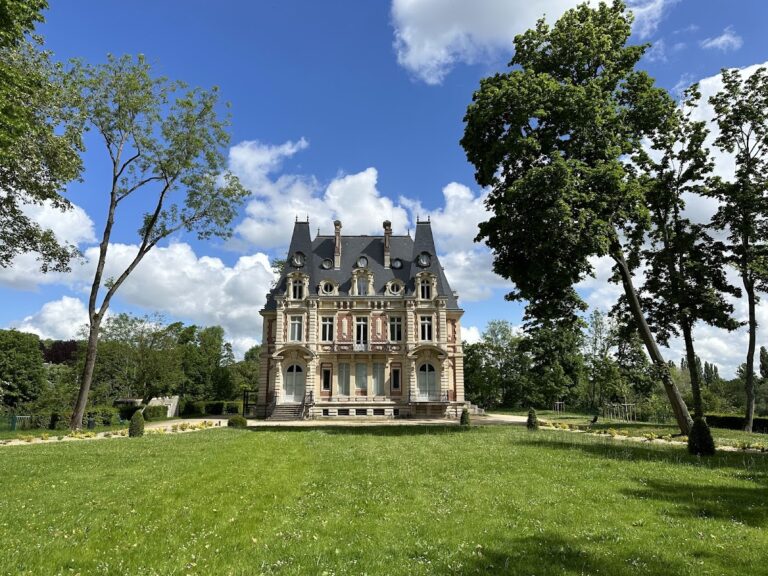
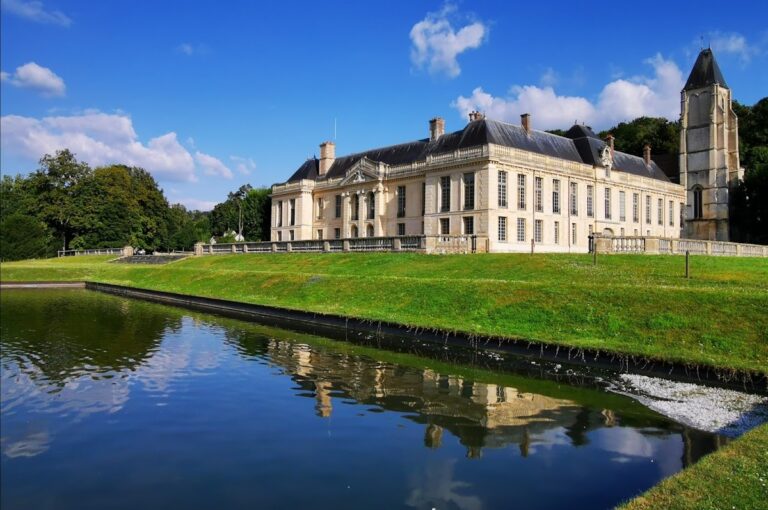
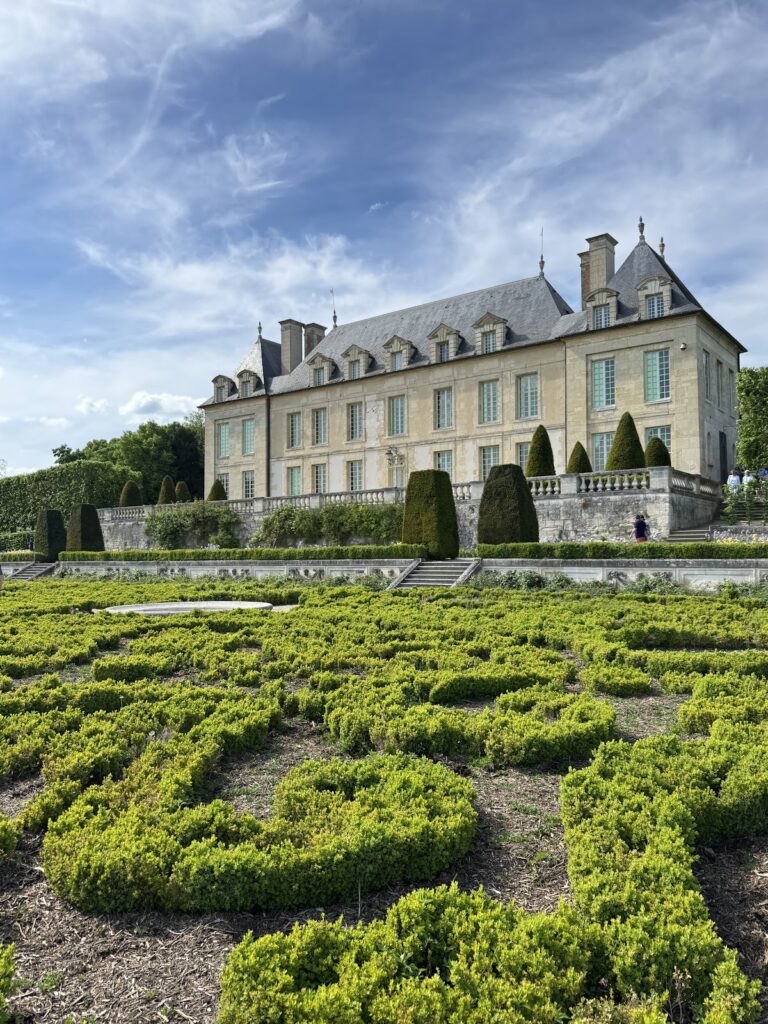
The surviving building consists principally of the south wing of the so-called château-Mansart, dating from the eighteenth to the nineteenth centuries. It stands on the site and foundations of the earlier castle and is built entirely of ashlar, carefully cut and dressed stone. The former château had two levels, lateral pavilions, and a high roof. Its central grand entrance stair faces the gardens, while a curved staircase leads toward the Oise.
Nineteenth-century work altered the north gable, renewed the attic level, and arranged the grand entrance stair. The château’s enfilade of salons was decorated with stucco, wood paneling, and Versailles-pattern parquet. During the Lannes de Montebello ownership, the rooms contained Beauvais tapestries, stamped furniture, silverware, sculptures, and paintings, including modern works by Paul Baudry and Jules Dupré, together with objects associated with Marshal Lannes. The north wing was destroyed in 1944.
Valmy Pavilion
The substantial outbuildings were constructed around 1840 and form the present Valmy Pavilion. They have been restored and remain part of the surviving estate complex.
Tournebride
The estate also contains Tournebride, the former seventeenth-century house of the river ferrymen. Its name refers to the turning of teams before they boarded the ferry, and the building also housed an inn. The roof and roof structure burned in December 2017.
Terraces, gardens, and park features
The monumental terraces
The gardens contain a monumental double terrace from the eighteenth century, attributed to Pierre Contant d’Ivry. Built as a stone-and-vegetation theater overlooking the château and the Oise, it includes underground rooms. The terraces, underground spaces, elliptical basin, and two small pavilions were entered on the supplementary inventory of historic monuments in 2001.
The pavilions and landscaped park
Louis-Charles Boileau restored the two small pavilions in the style of the Pagoda of Chanteloup. The landscaped park formerly contained several bodies of water and numerous garden structures, known in French as fabriques, which served as ornamental features within a designed landscape. Most of these structures have disappeared. The creation of the park is attributed to Louis-Sulpice Varé.
Sainte-Madeleine Chapel
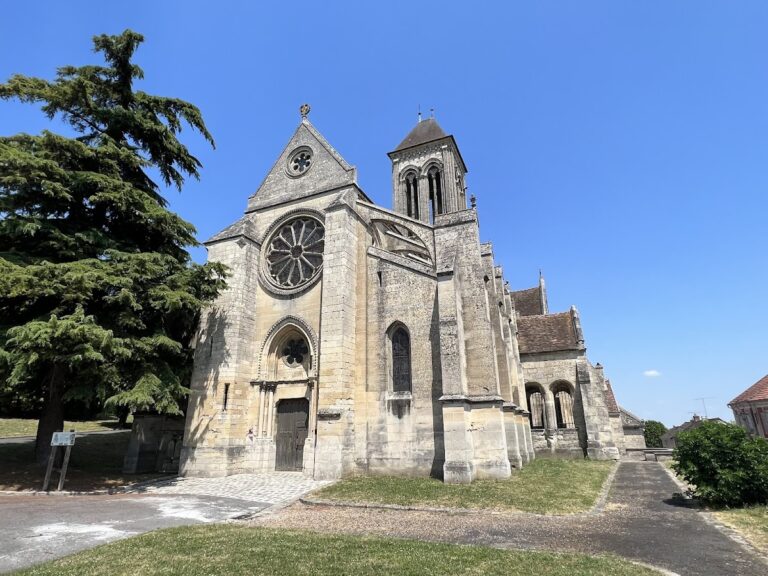
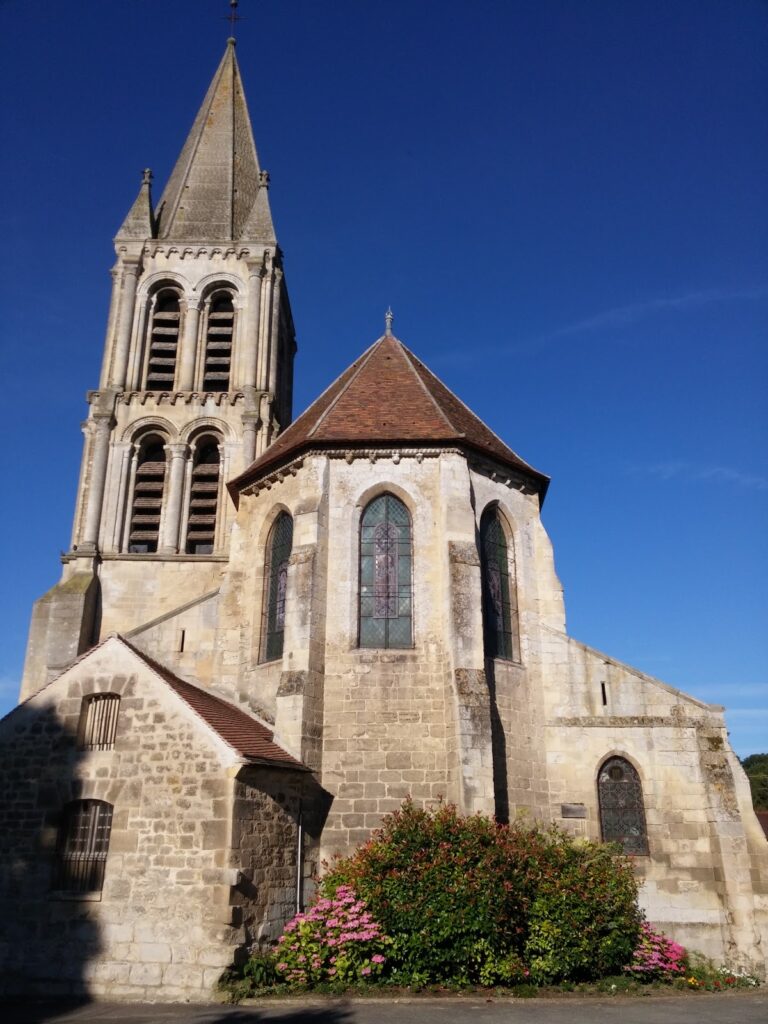
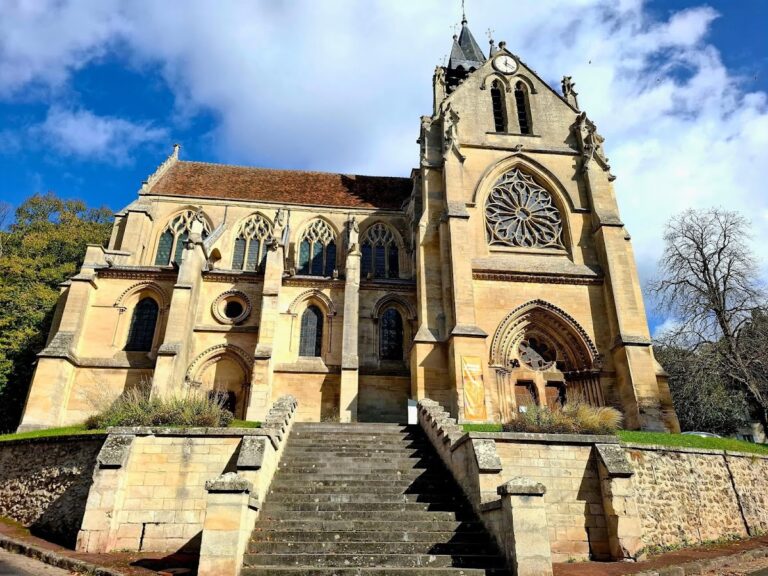
The parish chapel of Sainte-Madeleine was built in the twelfth century for the inhabitants of the hamlet. René Duval rebuilt it between 1564 and 1574, and it was later restored under Charles de L’Aubespine de Verderonne. During the Conti period, the Joséphites, a religious congregation providing clerical and educational services, provided its religious service.
The chapel has a notable eighteenth-century facade with an oculus, a circular window or opening, attributed to Pierre Contant d’Ivry. It was extensively remodeled at the beginning of the nineteenth century at the request of the third Duke of Valmy and fitted out internally during the Second Empire, the French imperial regime of Napoleon III from 1852 to 1870.
The chapel contained a replica of the mausoleum of Louise Cheuvreux, who was buried at the Church of Saint Louis of the French in Rome. The replica was already damaged during the Second World War, partly destroyed when a tree fell on it, and later fell into ruin before the chapel’s restoration.
Stors Mill and the river landscape
Stors Mill
About 800 meters from the château in Mériel, the sixteenth-century Stors Mill, also called Perrot Mill, was converted for the Cheuvreux and Lannes de Montebello families into a country manor in the troubadour style. Louis-Charles Boileau directed the work and drew on the interior decoration of Chenonceau. The manor is surrounded by an English-style park.
The mill pond
The mill pond disappeared during the twentieth century and was replaced by marshes described as an exceptional biotope in Île-de-France.
Nearby sites