Castle of Méry-sur-Oise: A Renaissance and Classicist Château in France


Site at a Glance
- Rating
- 4.5
- Popularity
- Low
- Country
- France
- Primary era
- Early Modern
- External website
- Open
- Eras represented
- Medieval, Early Modern
- Civilizations
- French
- Site type
- Domestic
- Remains
- Castle
On this page10 sections
History
The castle of Méry-sur-Oise is a historic château in Méry-sur-Oise, France, whose present form combines Renaissance and Classicist elements developed through rebuilding from the late sixteenth century to 1760. Its history began with a religious settlement beside the Oise and continued through medieval fortification, royal associations, aristocratic ownership, revolutionary change, and modern municipal stewardship.
Priory and Medieval Fortification
In the sixth century, monks from Saint-Denis Abbey established a priory at Méry. A priory was a religious house governed by a prior and usually subordinate to a larger abbey. The monks built a wooden bridge across the Oise, linking Méry with Auvers. Work on the first church began in 862, and King Charles II the Bald ordered the bridge to be rebuilt in 865. Viking incursions up the Oise devastated the area about two decades later, destroying the priory.
After this disruption, the lords of Buffé took control of Méry from the monks. They held the lordship, or seigneurie, until the end of the twelfth century. A fortified castle was established on the site of the former priory, but repeated attacks led to its destruction. Henry de Milly acquired the lordship in 1343, and the Hundred Years’ War, the long conflict between the English and French crowns from the fourteenth to the fifteenth century, brought further damage.
The d’Orgemont Castle
A judgment issued on 24 March 1375 dispossessed Henry de Milly and transferred Méry to Pierre I d’Orgemont, Chancellor of France and a major royal landholder. Between 1375 and 1389, d’Orgemont built a new castle. King Charles V, known as Charles the Wise, frequently stayed at Méry, where many royal letters patent were written. At the king’s request, d’Orgemont also continued work there on the Grandes Chroniques de France, a large medieval history of the kings of France compiled and extended by royal and court-associated writers.
After Pierre d’Orgemont died in 1389, Méry passed among members of his family. Nicolas d’Orgemont became involved in a failed conspiracy to hand Paris to John the Fearless, Duke of Burgundy. His property was confiscated, and he died in prison in 1417. When John the Fearless entered Paris in 1418, confiscations imposed on his allies were annulled, allowing the d’Orgemont family to recover its possessions. Guillaume d’Orgemont held Méry until his death in 1422, after which the lordship was divided among his sons.
Charles d’Orgemont reunited the lands of Méry in 1485 and had acquired the neighbouring lordship of Mériel in 1481. He rebuilt Méry’s church between 1485 and 1487. At this time the settlement was a small village of twenty-six households. His grandson, Méry d’Orgemont, inherited the estate as an orphan but lost most of it during his guardianship, retaining land along the Oise. He nevertheless served Francis I as a knight, ordinary royal cupbearer, and governor of Paris and the Île-de-France. His death is dated to either 1549 or 1551.
Rebuilding in the Sixteenth and Seventeenth Centuries
Claude d’Orgemont inherited Méry at fifteen and, like his predecessor, became an ordinary royal cupbearer. Despite serious financial difficulties, he almost entirely rebuilt the château. The date 1584, carved above a doorway, apparently marks the completion of this work. The Wars of Religion, conflicts between Catholics and Protestants that affected France mainly during the second half of the sixteenth century, brought about Claude’s financial ruin. After withdrawing to the château in 1596, he transferred the heavily mortgaged estate to his son-in-law, François II Juvénel des Ursins, Marquis of Trainel. The property was soon sold to Antoine I de Saint-Chamans, a count close to King Henry IV.
Henry IV stayed at Méry when visiting Angélique d’Estrées, abbess of Maubuisson and sister of Gabrielle d’Estrées, the king’s mistress. Under Antoine I de Saint-Chamans, the château recovered considerable splendour. He filled its interiors with paintings, tapestries, valuable furniture, silverware, and other decorative objects, and lodged artists there. Antoine died in 1628, leaving the estate to his grand-nephew François de Saint-Chamans.
François I de Saint-Chamans-Méry died in 1648 from wounds received during the siege of Ypres. His brother Antoine II then inherited Méry and married Marie Lioni in 1655. Their son François II was born in 1658. He served first as a royal page, then in the king’s bodyguard and the Noailles company. In 1679 he accompanied Marie Louise d’Orléans to Spain for her marriage to Charles II of Spain. Louis XIV later sent him to his lordship of Méry and ordered him to marry. His marriage to Bonne de Chastellux took place in 1687, and Louis XIV raised his lands to a marquisate in 1695. A marquisate was a territorial lordship whose holder bore the title of marquis.
François II restored and altered the château after more than a century of inadequate maintenance. The south façade was rebuilt in 1697. He died in 1714, and his unmarried son César-Arnaud died without issue in 1728. After the annulment of César-Arnaud’s will, the estate was placed on the market.
The Molé Family and the Revolutionary Era
The financier Samuel Bernard acquired Méry as a dowry for his daughter Bonne-Félicité Bernard. She married Mathieu-François Molé in 1735, bringing the estate into the Molé family. Molé was a president à mortier, a senior judicial magistrate of the Parlement of Paris named for the ceremonial cap associated with the office, and later became the Parlement’s First President. Bonne-Félicité generally remained at Méry, while her husband preferred Champlâtreux. The naturalist Georges-Louis Leclerc de Buffon advised her on choosing plants for the park, and she commissioned the reconstruction of the château’s west façade.
Pauline de Saint-Chamans-Méry, Samuel Bernard’s widow, later settled at Méry with her daughter and became known for visiting poor people in the village. Pauline died in 1763, and Bonne-Félicité died in 1784. Her son Édouard-François-Mathieu Molé inherited the estate and became president à mortier of the Paris Parlement in 1788. He was guillotined on 20 April 1794 during the French Revolution, but the château was not confiscated and passed to his daughter, Félicité Molé.
After a period of imprisonment, Félicité married her maternal uncle Pierre-Christian de Lamoignon in 1798. He repaired the château after damage during the Revolution and replaced the formal French gardens with an English garden, a landscape style using irregular lawns, trees, and paths to create a naturalistic appearance. Their daughter Marie-Louise de Lamoignon married her cousin Adolphe de Ségur in 1823. Before his death in 1827, Pierre-Christian secured for Adolphe the hereditary title of Peer of France, prompting him to adopt the name Ségur-Lamoignon.
The Ségur Estate and Modern Ownership
Félicité Molé continued to develop the park and in 1845 employed Louis-Sulpice Varé, a French landscape designer, to integrate its ancient trees and broad lawns into the English garden. After her death in 1852, the estate passed to Marie-Louise and Adolphe, who had no children. The Comtesse de Ségur, Adolphe’s sister-in-law, sometimes stayed at Méry and probably wrote part of Les Malheurs de Sophie there.
Edgar de Ségur-Lamoignon, a diplomat and deputy for the Meuse, inherited the property in 1876. It subsequently passed to his son Louis and grandson Philippe. Philippe’s brother, the actor Guillaume de Ségur-Lamoignon, who performed as Guillaume de Sax, frequently stayed at Méry with his wife, the actress Cécile Sorel.
A drinking-water treatment plant was established near the park in 1911, and a reservoir was later built within the park to hold a three-day reserve in case accidental pollution affected the Oise. The château and park were entered on the register of historic monuments by decree on 23 July 1937. The park received additional protection as a classified site by decree on 12 December 1946.
The Île-de-France Water Syndicate acquired the estate from the Ségur family in 1976, the first sale of the domain since 1597. The estate passed to the Compagnie générale des eaux in 1986, and the company became Vivendi in 1998. The château underwent complete renovation in 1999. Vivendi later stopped maintaining the experimental botanical garden because of financial difficulties. The municipality of Méry-sur-Oise acquired the entire estate in 2004 with support from regional and departmental authorities and the Île-de-France green-spaces agency. The municipality is the current owner, and the château now hosts receptions.
Remains
Château and Courtyard
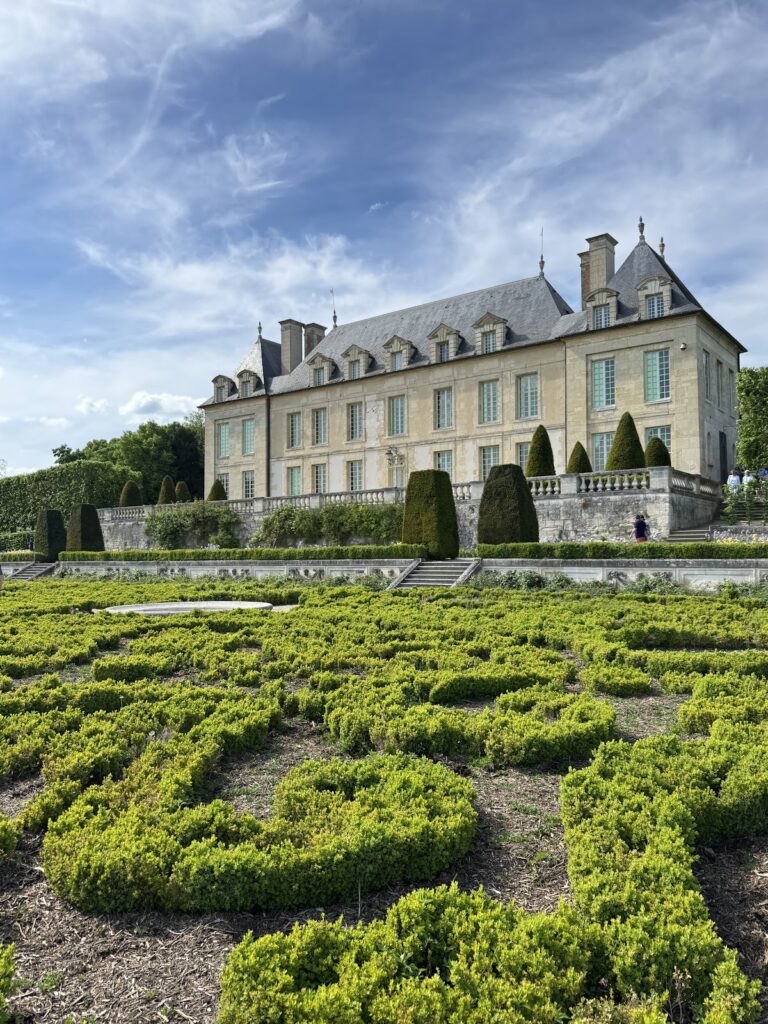
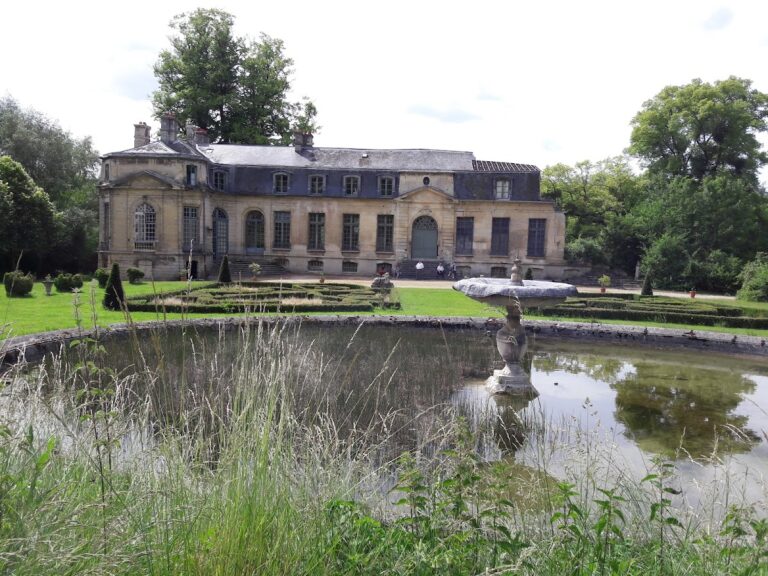
The château combines Renaissance and Classicist features. Its construction is described as extending from the late sixteenth century to 1760, with major phases including Claude d’Orgemont’s rebuilding, the reconstruction of the south façade in 1697, and the later alteration of the west façade. The principal façade faces north toward the park, which separates the château from the Oise. A central projecting section carries a triangular pediment, while a slightly projecting pavilion stands at either end.
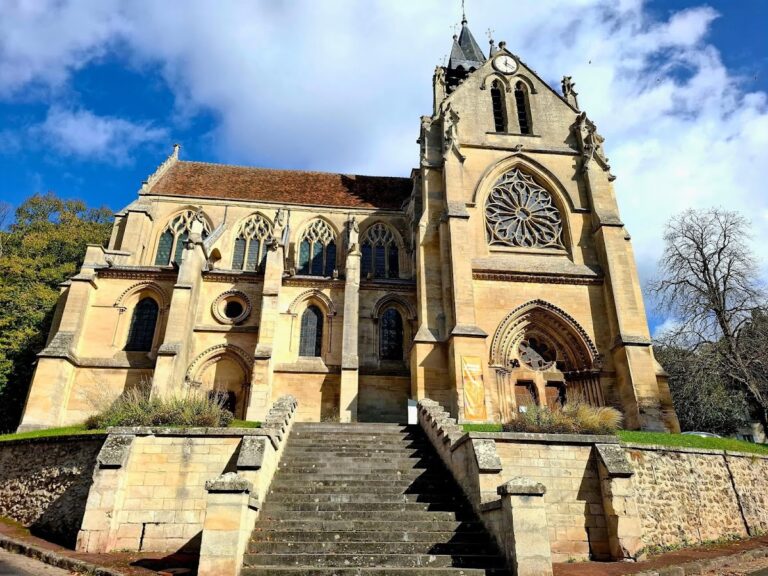
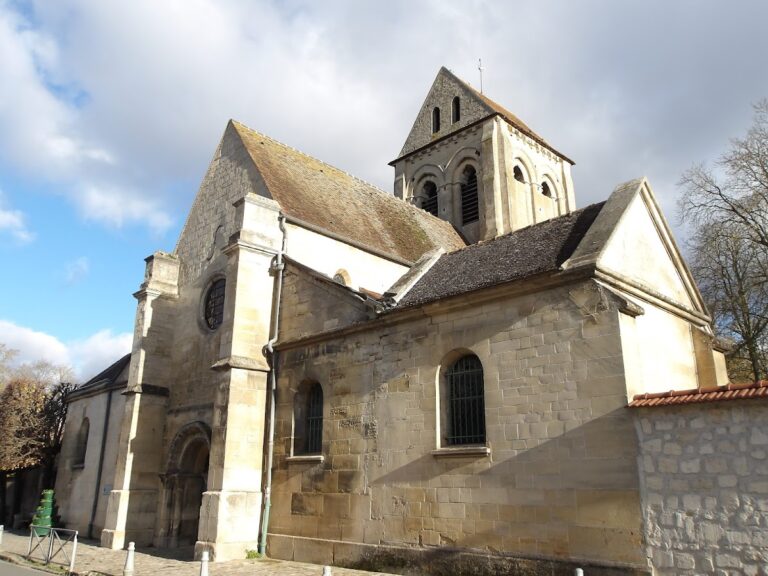
The opposite façade forms one side of a trapezoidal courtyard enclosed by buildings. At the southern end, the courtyard adjoins the parish church of Saint-Denis at Méry, which contains an old seigneurial chapel. Beneath the complex, an underground room survives from Pierre d’Orgemont’s castle of 1375–1389. It is arranged around a central pillar, preserving a physical element of the medieval rebuilding that preceded the present château.
Interiors
Antoine I de Saint-Chamans transformed the interior during the early seventeenth century through artistic patronage and decoration. Paintings, including portraits of kings and princes of Lorraine, were accompanied by tapestries, costly furniture, silverware, and other decorative objects. Artists were lodged at the château during this period, when the residence regained the splendour associated with its aristocratic owners.
Park and Waterworks
The formal French gardens were replaced after the Revolution by an English garden. In 1845, Louis-Sulpice Varé reshaped the park around its ancient trees and large lawns. A reservoir basin was later installed there to provide a three-day drinking-water reserve if the Oise became accidentally polluted, adding a practical water-supply function to the historic landscape.
During Vivendi’s ownership, Pascal Cribier, Patrick Blanc, and Lionel Guibert created an experimental botanical garden in the park. By 2017, the garden had fallen into ruins. The surviving park therefore reflects successive landscape phases, from formal French design to the naturalistic arrangement developed around older trees and broad lawns.
Nearby sites