Lienzer Klause: A Fortified Pass in Austria

Site at a Glance
- Rating
- 4.6
- Popularity
- Very Low
- Country
- Austria
- Primary era
- Early Modern
- External website
- Open
- Eras represented
- Medieval, Early Modern
- Civilizations
- Habsburg, Holy Roman Empire
- Site type
- Military
- Remains
- Fort
On this page11 sections
History
Lienzer Klause is a fortified pass in Austria, south of Lienz in East Tyrol. The Bishops of Brixen established it in the Middle Ages at the narrowest point of the Puster Valley, beside the old Post Road, to protect their possessions around Anras and Assling during conflicts with the Counts of Gorizia.
Medieval origins and Gorizian control
The fortification is first mentioned in 1241 and again in 1253, together with Neuenburg Castle near Lienz. Both defensive works belonged to the territorial interests of the Bishops of Brixen, the ecclesiastical rulers of the Diocese of Brixen. Their purpose was to prevent hostile seizure of the bishops’ lands in the surrounding valley.
The Counts of Gorizia later gained control of the two fortifications, although the date of the transfer is unknown. Neuenburg Castle declined, while Lienzer Klause continued to be maintained. It functioned as an inland fortress for Gorizian and later Tyrolean possessions rather than as a border fortress. From the fourteenth century, it also housed a court, which remained there until its transfer to Lienz in 1806.
Expansion and military administration
Threats from the Ottoman Empire brought repeated enlargement during the fifteenth and sixteenth centuries. These works substantially altered the complex, with much of its medieval fabric removed. A regulation issued in 1599 required peasants and townspeople to leave their families and homes when necessary and serve in the defense of the Klause. In return, they were exempt from Lienz’s compulsory market requirement and could sell their produce throughout the County of Tyrol.
After the truce between the Archduchy of Austria and the Ottoman Empire broke down in 1661, Christoph and Elias Gumpp modernized the fortification. The complex was extended eastward with projecting bastions in 1664 and 1665, and its masonry was reinforced again in 1670. Bastions are projecting parts of a fortification that allow defenders to fire along the faces of adjoining walls.
Decline, sale, and renewed military use
A new valley road constructed during the 1760s reduced the importance of the old Post Road and, in turn, the strategic value of Lienzer Klause. The state decommissioned the fortification in 1782 and offered it to private buyers. Two farmers from the nearby village of Burgfrieden purchased it in 1788.
Although the complex had already fallen into considerable decay, it regained military importance during the 1809 Tyrolean uprising and the Napoleonic Wars. After the Austrian army withdrew, the Tyrolean Landsturm used the Klause as a defensive and retreat line. The Landsturm was a territorial militia made up mainly of local civilian men called to defend their region during emergencies.
In early August 1809, French troops commanded by General Rusca entered East Tyrol from Carinthia and tried to advance inland. On 8 August, Tyrolean and Sexten Landsturm forces defended Lienzer Klause against a French and Italian force twenty times their size. They halted the advance and forced Rusca to withdraw. An inscribed commemorative monument at Burgfrieden recalls the engagement.
Preservation and private ownership
Franz Huber acquired the fortification in 1879 and initially planned to dismantle it and sell its stone. Monument protection prevented this, while initial renovation work had already begun during the 1870s. Lienzer Klause is now privately owned by Anton Huber. Private and public funds have supported measures to prevent the ruin’s complete decay, and monument authorities have recognized Anton Huber’s conservation efforts.
Remains
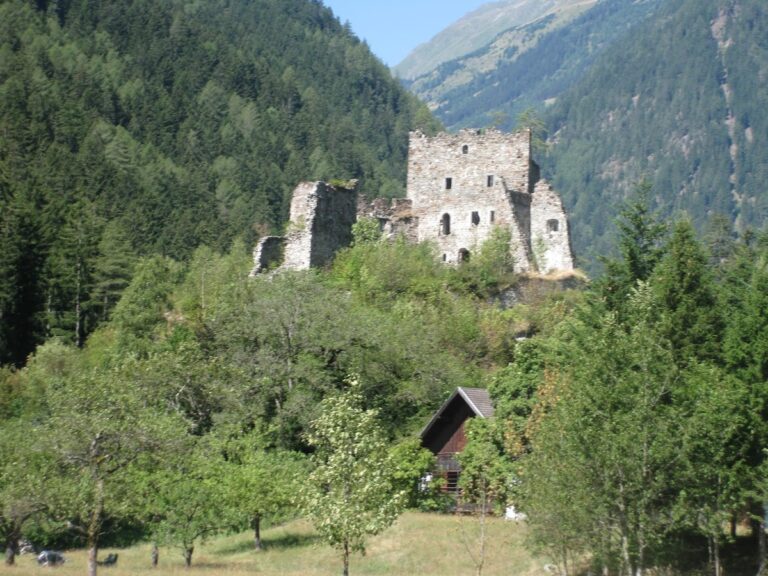
lienzer Klause occupies a constricted position on the left bank of the Drava, at the eastern end of the Puster Valley immediately south of Lienz. The Drava is a major river of the eastern Alps. The fortification once formed a complete barrier across the valley, with walls extending down to the river. Sections below the main fortification were later removed during construction of the Puster Valley railway. The surviving complex is relatively small for a fortress of its type, but its notably thick walls were designed to withstand explosive projectiles.
Defensive structures and internal route
Watchtower
A watchtower survives in the northern part of the complex. It forms part of the remaining defensive fabric, which was shaped by the major expansions of the fifteenth and sixteenth centuries and the later reinforcement associated with the seventeenth-century modernization.
Gates and western buildings
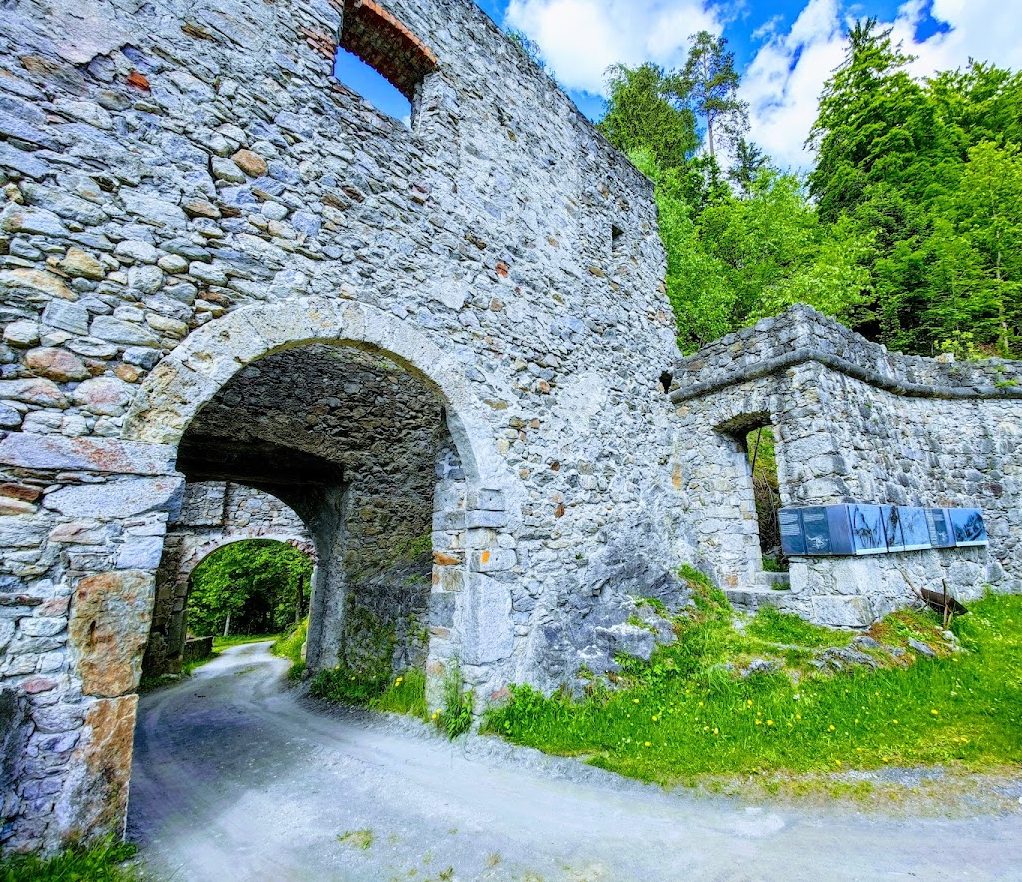
A path from the main entrance runs westward through the fortification to the western gate. Near that gate stand the ruins of an older portico with an attached commercial building, adding evidence of the complex’s defensive and administrative use.
Moat
A moat remains visible around the fortification. This defensive ditch formed part of the site’s protective system, complementing the thick masonry and projecting bastions added during the later phases of construction.
Condition and conservation
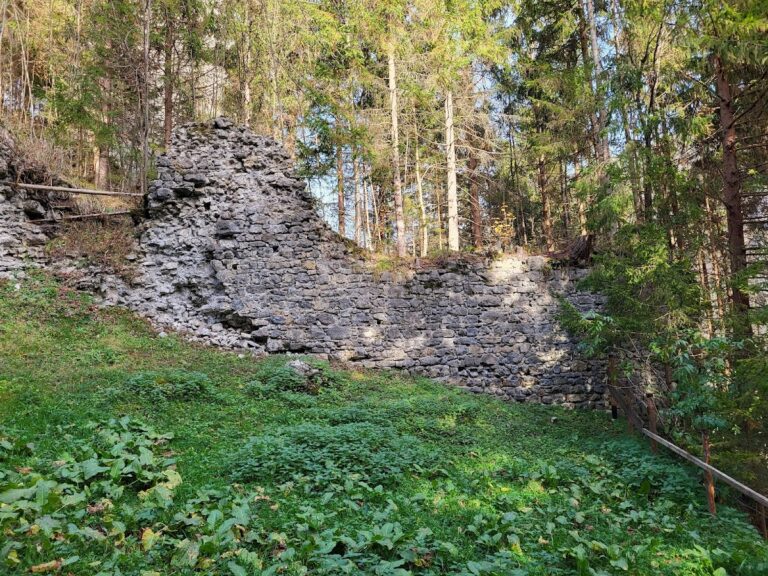
Lienzer Klause survives as a ruin whose fabric has substantially deteriorated. Maintenance and conservation measures have been undertaken to prevent its complete collapse, preserving the remaining walls, tower, gates, moat, and other elements of the fortified pass.
Nearby sites