Oskar-Fredriksborg Fortress: A Coastal Defense Fortification in Sweden


Site at a Glance
- Rating
- 4.3
- Popularity
- Very Low
- Country
- Sweden
- Primary era
- Modern
- External website
- Open
- Eras represented
- Modern
- Civilizations
- Swedish
- Site type
- Military
- Remains
- Fort
On this page7 sections
History
Oskar-Fredriksborg Fortress is a historical fortification on eastern Rindö in Sweden, near Vaxholm, constructed between 1870 and 1877 as part of the nineteenth-century defenses of the Oxdjupet waterway and the approaches to Stockholm. It was built to protect a navigable channel whose military importance had increased as other routes became unsuitable for larger ships.
Strategic background
Rindö’s western side near Vaxholm and the Oxdjupet had long been used for military purposes. During the nineteenth century, the fortress at Fredriksborg on the Värmdö side, east of the channel, was replaced by the rebuilt Vaxholm Fortress. Underwater obstacles made the Oxdjupet impassable, while the nearby Kodjupet channel could no longer accommodate newer ships with deeper draughts.
In 1867, the decision was made to reopen the Oxdjupet to shipping and enlarge the small existing fortification so it could be permanently manned. King Charles XV approved the wider plan for works around Vaxholm in December 1869, and construction began in May 1870.
Construction and expansion
Oskar-Fredriksborg Fortress was completed after a seven-year building phase. King Oscar II inaugurated it in May 1877. During the late 1890s, the defenses at Stockholm’s seaward entrance were strengthened in both the Oxdjupet and Kodjupet with additional fortifications, bunkers, and mine barriers, defensive fields of underwater mines or other obstacles intended to obstruct navigation.
The wider defensive system expanded further with the Värmdö Line, built between 1899 and 1903 to guard against an attack from the direction of Värmdö. It included numerous fortifications and batteries, grouped artillery positions. By this period, the Vaxholm defensive line stretched from Resarö in the west to Värmdö in the north and included 37 batteries, mobile artillery, mine barriers, infantry, and mobile troop reserves.
Later defense and loss of military function
In 1914, the Swedish Riksdag, Sweden’s national parliament, decided to place Vaxholm’s outer defensive line in the central archipelago into operation. More modern weapons meant that an attack had to be stopped farther from the inner defenses. The new line contained five mine barriers, two fortifications, and three batteries, completed between 1924 and 1926.
A disarmament decision in 1925 removed the inner Vaxholm defensive line from the defense plans. Oskar-Fredriksborg Fortress, Vaxholm Fortress, and the fortress on Värmdö consequently lost their military function. Since 2002, Oskar-Fredriksborg has been designated a state-listed building monument by the Swedish National Property Board.
Remains
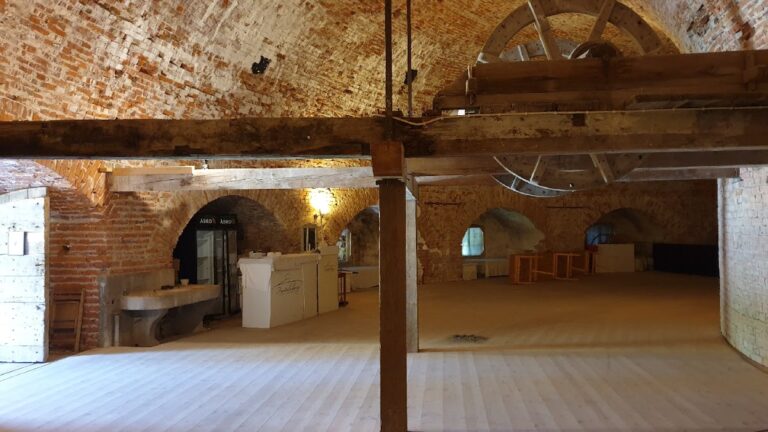
The fortress was arranged on two levels, with an upper section blasted into the rock and a lower section positioned close to the navigable channel. A 300-metre blast-resistant tunnel connected the two parts. The complex was protected by a covering of earth and peat, intended to reduce the effects of bombardment.
Upper level and rock defenses
The upper level carried the principal armament, three 24-centimetre M/96 guns mounted on carriages. These guns, like those positioned in the open defensive trenches, were not protected against enemy fire. Side trenches cut into the rock guarded the fortress against infantry attacks. Projecting caponiers, fortified positions designed to provide flanking fire along a trench, allowed defenders to fire into the sides of attacking troops. Underground passages linked the caponiers with one another.
Lower batteries
Two batteries occupied the lower level. Their guns were protected by casemates, enclosed chambers within a fortification from which weapons could be operated. The firing directions of these protected batteries covered the northern entrance and crossed the waterway, allowing the lower defenses to control movement through the channel.
Nearby sites