Castle of Pena de Aguiar: A Medieval Romanesque Fortress in Portugal


Site at a Glance
- Rating
- 4.5
- Popularity
- Very Low
- Country
- Portugal
- Primary era
- Medieval
- Eras represented
- Classical, Medieval
- Civilizations
- Portuguese, Roman
- Site type
- Military
- Remains
- Castle
On this page12 sections
History
Castle of Pena de Aguiar is a medieval Romanesque fortification in Portugal, built between the beginning of the twelfth and the thirteenth centuries after a Roman military fort had occupied the site in the first century BC. Set on granite cliffs of the Serra do Alvão, it became the strategic center and administrative seat of the medieval territory of Aguiar da Pena, later associated with the municipality of Vila Pouca de Aguiar.
Roman and post-Roman occupation
The Romans established a military fort here in the first century BC to oversee the important road between Aquas Flavias, now Chaves, and Lamecum, now Lamego. Roman interest in the region was encouraged by its deposits of gold, silver, and lead. The site and surrounding territory were later occupied by the Visigoths and Muslims, whose presence began in the eighth century.
After the Christian Reconquista, the medieval expansion of Christian-ruled territories in the Iberian Peninsula at the expense of Muslim-ruled states, the Kings of León recovered and reorganized the former Visigothic administrative center. Countships were reestablished, together with fortified residences for local lords.
The medieval castle and Portuguese independence
The medieval castle was probably completed during the reign of Sancho I, who succeeded Afonso Henriques, the first king of Portugal. It was linked with supporters of Afonso Henriques, and that association was also preserved in the medieval hagiography of Santa Senhorinha de Basto.
Leonese forces invaded the region and besieged the castle in an effort to subdue or capture those supporters. Gonçalo Mendes de Sousa, lord of Aguiar and Panóias and a military companion of Afonso Henriques, came to their aid. The episode is connected with the emergence of Portuguese independence.
Administrative change and decline
During the reign of Afonso III, Telões received its first foral charter on 10 July 1255. This type of medieval legal charter defined a settlement’s rights, obligations, and administrative status. From 1258 onward, the population progressively abandoned responsibility for maintaining the defensive line, and the castle began to lose strategic importance. Its defenses were supplemented by lookout towers at Capeludos, Rebordochão, and Portela de Santa Eulália.
Work on the barbican, an outer defensive structure protecting an entrance, and the embrasure hall was completed at the end of the fourteenth century. The purpose of this work remains uncertain, since it may have provided structural consolidation or repaired earlier damage. Around the beginning of the sixteenth century, Telões lost its administrative importance and was incorporated into the foral charter of Aguiar da Pena in 1515.
The castle was abandoned in 1527 as warfare increasingly relied on gunpowder. Records of its alcaldes, local officials responsible for the castle’s administration or command, include Diogo Lopes de Azevedo, Fernão Martins de Souza from 17 July 1534, João de Souza Guedes, and Jerónimo de Souza Machado from 1583 to 1594.
Military reassessment and conservation
A report dated 28 December 1804 stated that Trás-os-Montes lacked adequate forts and military defenses during the Spanish invasion of 1762. In that conflict, Chaves, Bragança, and Miranda were assaulted, while castles across the region were attacked. A circular issued by the Minister of War on 23 September 1861 again drew attention to the province’s inadequate northern defenses.
Castle of Pena de Aguiar was classified as a National Monument on 26 February 1982. Archaeological interventions followed between 1982 and 1984 under the direction of Mário Jorge Barroca and António J. Cardoso Morais, while Susana Oliveira Jorge investigated the settlement’s prehistoric occupation. A restoration and recuperation program led by the Portuguese Institute for Architectural Heritage included illumination and restoration measures. Later work consolidated and restored the castle’s dependencies, repaired walls threatened with collapse, fenced dangerous areas within the enclosure, and installed metal walkways. These projects sought to connect the castle with the Roman mines of Vila Pouca de Aguiar and the Panóias rock-art sanctuary in Vila Real.
Remains
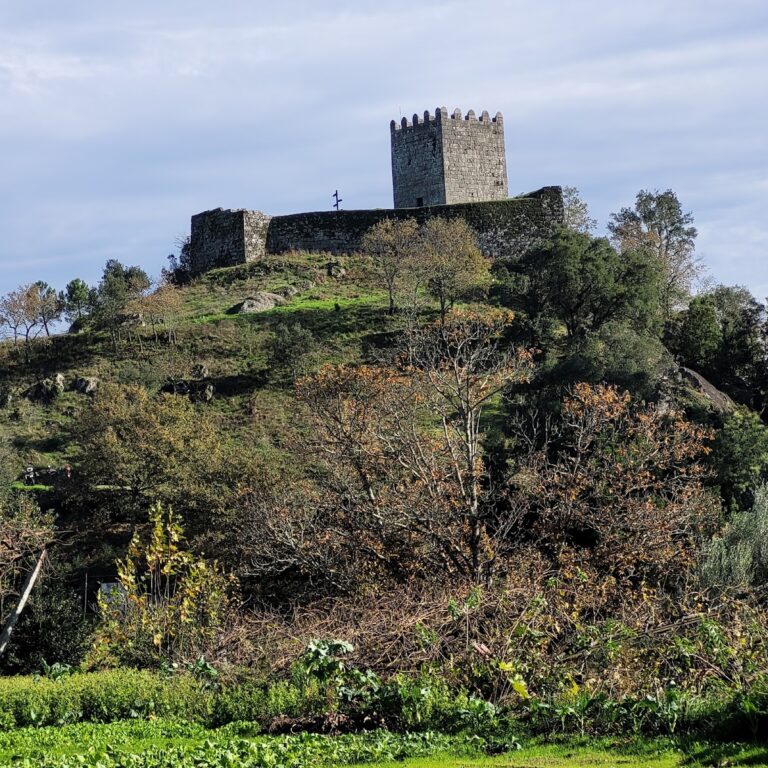
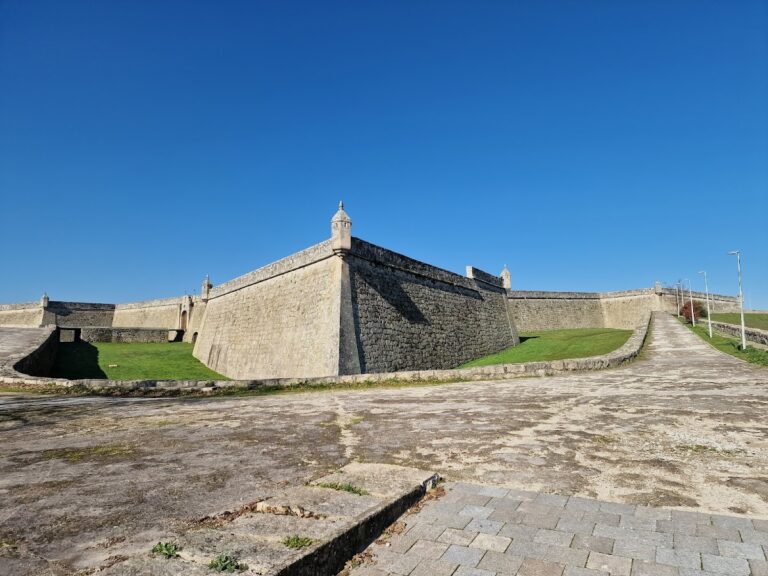
Castle of Pena de Aguiar is an isolated, rock-based fortification on granite cliffs on the eastern side of the Serra do Alvão. It overlooks the fertile valley of Vila Pouca de Aguiar near the village of Castelo. The surviving fabric is predominantly Romanesque. The defensive layout adapts closely to the cliffs, boulders, and irregular ground, creating a compact rock castle centered on two towers and enclosing walls.
Fortification layout
Towers and curtain wall
The northern tower has a rectangular plan. A semi-circular curtain wall, meaning a wall joining defensive towers, connects it with a southeastern tower that has five irregular faces. Together, the towers and curved wall form the principal surviving defensive structure. The western wall contains a doorway leading toward the barbican, whose walls are set against large boulders and follow the rocky terrain.
Barbican and interior court
A second opening in the northern wall leads to a small square or arms court enclosed by the two towers. Both the barbican and this court were adapted to the uneven ground. The complex originally had two floors. The tower adjoining the enclosure contains a vaulted compartment, probably a converted cistern, above other dependencies that are now ruined.
Archaeological evidence
Castle finds
Excavations concentrated on the central area of the castle, while surveys also examined the ground beneath the fortification. The excavated material includes a rich collection of ceramic and metallic objects, among them a documented group of silver artefacts. Arrowheads and dart points recovered at the castle provide evidence of fighting at the fortress.
Prehistoric settlement
About 200 metres below the castle, excavations revealed a prehistoric settlement with residential and defensive features. Several occupation phases extended from prehistory through the Late Bronze Age and into the Roman occupation of the Iberian Peninsula. The settlement adds an earlier archaeological layer to the long sequence of occupation associated with the rocky site.
Nearby sites