Hohenasperg: A Fortress and Prison in Germany


Site at a Glance
- Rating
- 4.7
- Popularity
- Very Low
- Country
- Germany
- Primary era
- Early Modern
- Eras represented
- Iron Age, Early Modern, Modern
- Civilizations
- Celtic, Duchy of Württemberg, German, Holy Roman Empire
- Site type
- Military
- Remains
- Fort
On this page15 sections
History
Hohenasperg is a fortified hilltop site in Germany, above Asperg, whose earliest major settlement was a Celtic princely seat during the Hallstatt period of the Iron Age, around 500 BC. Its elevated position later supported Frankish rule, a Württemberg fortress, and a prison that was used almost continuously from the late Middle Ages into the twentieth century.
Early settlement and medieval rule
Hohenasperg was inhabited from the Stone Age. Around 500 BC, the hill became a fortified Celtic high-status settlement associated with regional elites. After the Franks defeated the Alamanni around AD 500, it served as a Frankish lord’s seat and a Thing site, an assembly used for law, public decisions, and political affairs. At that time it was called Ascicberg.
Asperg was first mentioned in 819, when the district count Gozberg, a medieval official responsible for a territorial district, donated property there to Weissenburg Abbey in Alsace. The settlement gained importance in the thirteenth century with the foundation of the independent town of Hohenasperg. It remained independent until 1909, while Asperg received town rights in 1510. The town was incorporated into the Ludwigsburg district in 1718, became the seat of its own district seventeen years later, and returned permanently to the Ludwigsburg district in 1781.
Württemberg fortress
In 1519, troops of the Swabian League under Georg von Frundsberg besieged Hohenasperg, where Duke Ulrich of Württemberg was holding out. On 12 May 1525, the peasant leader Jäcklein Rohrbach was captured by the governor of Asperg and imprisoned at Hohenasperg before being handed over to the Steward of Waldburg.
From 1535, the castle was expanded into an active Württemberg fortress, and residents within the fortified area were resettled at the foot of the hill. During the Thirty Years’ War, the European conflict of 1618 to 1648 involving religious, dynastic, and territorial struggles, a Württemberg Protestant garrison reinforced by Swedish troops defended the fortress against imperial forces from 1634 to 1635. The garrison surrendered, and imperial troops occupied Hohenasperg until 1649.
After the war, Hohenasperg returned to Württemberg. French troops occupied it in 1688 and again in 1693. The fortress remained active until 1693, after which it lost its importance for territorial defence and became a garrison and state prison.
Prison and political detention
Hohenasperg served as a prison for convicted criminals and political prisoners from the late Middle Ages into the twentieth century. Hartmann I of Grüningen was captured on 6 April 1280, imprisoned there, and died after six months. In 1516, the bailiffs Sebastian Breuning of Weinsberg, Konrad Breuning of Tübingen, and Konrad Vaut of Cannstatt were imprisoned after the conflicts surrounding Ulrich of Württemberg’s killing of Hans von Hutten. Confessions obtained through torture resulted in their execution on 11 December 1516 for allegedly fabricated charges of lèse-majesté, an offense defined as an attack on a sovereign or the state.
Among the prisoners of the eighteenth century were Joseph Süß Oppenheimer, financial adviser to the Duke of Württemberg, who spent seven months at Hohenasperg in 1737 before his execution in Stuttgart in 1738; Marianne Pirker, a chamber singer and confidante of the duke’s wife, who was held from 1756 until the end of 1764; and Johann Ludwig Huber, who was imprisoned for approximately six months from June 1764 without interrogation or formal conviction after opposing a proposed ducal property tax.
The poet Christian Friedrich Daniel Schubart was held without interrogation, charge, or sentence from 1777 to 1787. His imprisonment influenced Friedrich Schiller, who wrote The Robbers with Schubart’s fate in mind. Schiller himself fled to Mannheim to avoid possible imprisonment at Hohenasperg. The intellectuals detained there from the eighteenth to the twentieth century gave the hill nicknames including “the Swabian intelligentsia’s home mountain,” “Democrats’ Hill,” “Mountain of Tears,” and “Hostel of Demagogues.”
In 1800, Victor Hauff, mayor of Tübingen, and Christian Friedrich Baz, mayor of Ludwigsburg, were imprisoned as Württemberg state prisoners for alleged revolutionary activity that was not proven. Nineteenth-century prisoners also included deserters, military prisoners, and separatists associated with the radical Pietist group around Rottenacker. By 1813, approximately 400 prisoners had been held there. Under King William I of Württemberg, corporal punishments such as running the gauntlet were abolished.
Other nineteenth-century prisoners included Friedrich List, Gustav Kolb, Heinrich August Kübel, Carl Christian Knaus, Berthold Auerbach, Georg David Hardegg, Jakob Friedrich Kammerer, Constantin von Waldburg-Zeil, Joseph Fickler, Adolf Krauß, Ludwig Franz Kern, Servatius Bosch, Theobald Kerner, Karl von Hase, Johannes Nefflen, Leo von Seckendorff, and Theodor Griesinger. Most were political prisoners or dissidents detained for anti-monarchical activity. Their recorded periods of imprisonment included List from 1824 to 1825, Kolb from 1824 to 1826, Kübel for six months in 1824, Knaus from 1825 to 1826, Auerbach for two months in 1837 and 1838, Hardegg from 1833 to 1840, Kammerer in 1833, Kerner from 1850 to 1851, and Fickler in 1849 for high treason.
During the national movement of 1848 and 1849, political imprisonment increased. Adolph Majer, editor of the radical Neckar-Dampfschiff, was imprisoned after calling for the violent overthrow of the government. In October 1848, the Interior Ministry established a separate investigating court at the fortress for the growing number of short-term political remand prisoners. Almost 900 French prisoners of war were interned at Hohenasperg during the Franco-Prussian War of 1870 and 1871. A prison for the civilian penal system has operated on the hill since 1894.
Nazi persecution and the Second World War
During the spring and summer of 1933, numerous Catholic, Social Democratic, and Communist opponents of Nazism were imprisoned and tortured at Hohenasperg. They included Eugen Bolz, Württemberg’s state president, who was later murdered in Berlin in 1945 during Aktion Gitter, a Nazi arrest campaign against former political opponents and other groups regarded as hostile to the regime. At least 101 prisoners died under the extremely harsh penal system. Twenty identified names are commemorated on a memorial plaque in the fortress cemetery.
In May 1940, the prison became a transit station for the first centrally planned deportations of Sinti and Roma from southwestern Germany west of the Rhine. Families were escorted under police guard from the railway station through the village, examined at the prison, and assessed by the Ritter Research Institute. Those not classified as “Gypsies” were released, while others were deported to the General Government, the German occupation administration in parts of occupied Poland. Hohenasperg remained a transit camp for Sinti at least until early 1943. Later deportations led to Auschwitz-Birkenau, where most of the prisoners became victims of genocide.
In the final phase of the Second World War, Hohenasperg served as an artillery observation post for a 15-centimetre battery stationed in Asperg. Allied attacks and artillery fire killed twelve residents and damaged several houses. A French infantry company occupied the fortress on 21 April 1945. In July, the site passed to American administration and was used until 1947 as Internment Camp I.C. 76 for denazification and re-education.
Prison hospital and memorial site
German authorities took over Hohenasperg on 1 April 1947 as a penal institution and central hospital for the Württemberg penal system. It became the Baden-Württemberg prison hospital in 1968. From 1977 to 1989, RAF terrorist Günter Sonnenberg was repeatedly treated there. Karl Jäger, a former Einsatzgruppen officer, died by suicide in the prison in 1959. Josef Schwammberger, a former concentration-camp commandant, died there in 2004, and serial murderer Heinrich Pommerenke died there on 27 December 2008.
Hohenasperg currently contains the Baden-Württemberg prison hospital and the state’s social-therapeutic institution, which combines custody with therapeutic treatment and resocialization measures. The hospital has 172 beds, with an average of about 130 occupied. In 2010, the state museum Haus der Geschichte Baden-Württemberg established the permanent exhibition Hohenasperg: A German Prison in the fortress Arsenal Building. It presents twenty-three biographies of mostly prominent prisoners and includes a research reading room. The fortress cemetery and a 1939 exhibition in the casemates marking Schubart’s bicentenary form part of the site’s commemorative history.
Remains
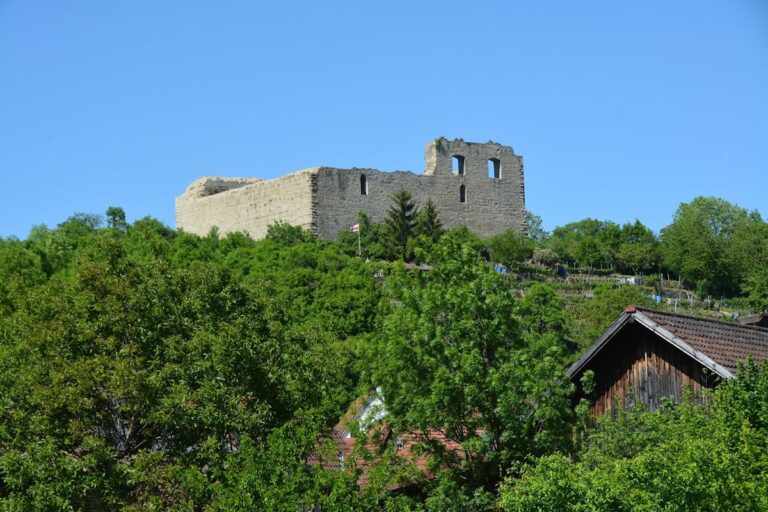
Hohenasperg occupies the summit plateau of Asperg, an isolated Late Triassic Keuper hill formed from Stuttgart Formation reed sandstone. The summit reaches 357.4 metres above sea level and rises about 100 metres above the surrounding moderately hilly landscape. Steep slopes surround an approximately triangular plateau of about six hectares on the watershed between the Enz valley to the west and the Neckar valley to the east. The elevated and highly visible position supported the Iron Age settlement and later fortifications. The eastern and northern slopes are wooded, while vineyards cover the terraced southern slope. Asperg lies below the vineyards in a natural east-west depression, and the Kleinaspergle burial mound stands on the ridge to the south.
Early settlement landscape
The Iron Age settlement was enclosed by a surrounding wall. Nearby burial monuments are materially associated with the Celtic landscape of Hohenasperg, including the Hochdorf Chieftain’s Grave, the Grafenbühl grave near Schwieberdingen, the Ludwigsburg-Römerhügel grave, and the Kleinaspergle burial mound. These graves were positioned to provide views toward Hohenasperg. Excavation identified Kleinaspergle as a Celtic burial mound, and its position gives a particularly clear view of the hill.
Fortress structures
Löwentor
The Löwentor, built in 1675 under Duke Wilhelm Ludwig in the early Baroque style, is the fortress’s only entrance. Its arch is surmounted by an inscription, the construction year, and a four-part ducal coat of arms.
Defensive works
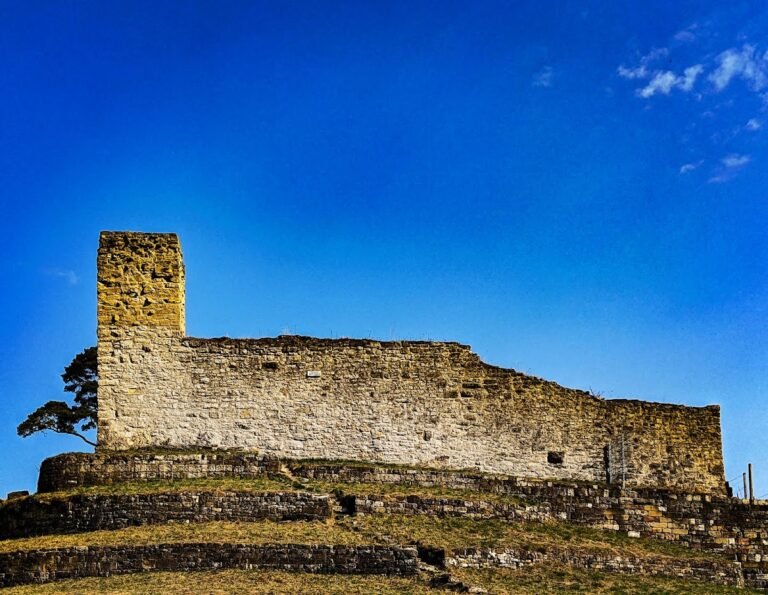
The fortress includes defensive walls, a moat crossed by a bridge, watch-tower structures, casemates, and artillery installations. Casemates are vaulted chambers built into fortifications for protection, storage, or military functions. A cannon is mounted on the fortress wall.
Water tower
A water tower was constructed within the fortress grounds in 1887 and 1888. It now carries antennas for the police radio network.
Cemetery and museum buildings
Fortress cemetery
A cemetery was established on the northern side of the hill after the town of Asperg refused further burials in its municipal cemetery because of limited space and the increased number of deaths among prisoners. A memorial plaque there records the names of twenty prisoners who died under the Nazi penal system.
Arsenal Building
The Arsenal Building, originally used for storing military equipment, houses the permanent prison-history museum. Its exhibition presents twenty-three prisoner biographies and includes a reading room with research facilities. The present institutional complex also contains the prison hospital and the social-therapeutic prison facility. The operating prison complex is not available for ordinary inspection because of security requirements.