Monrepos: A Neoclassical Palace and Hunting Estate in Germany
Site at a Glance
- Popularity
- High
- Country
- Germany
- Primary era
- Modern
- Eras represented
- Early Modern, Modern
- Civilizations
- Holy Roman Empire
- Site type
- Domestic
- Remains
- Palace
On this page13 sections
History
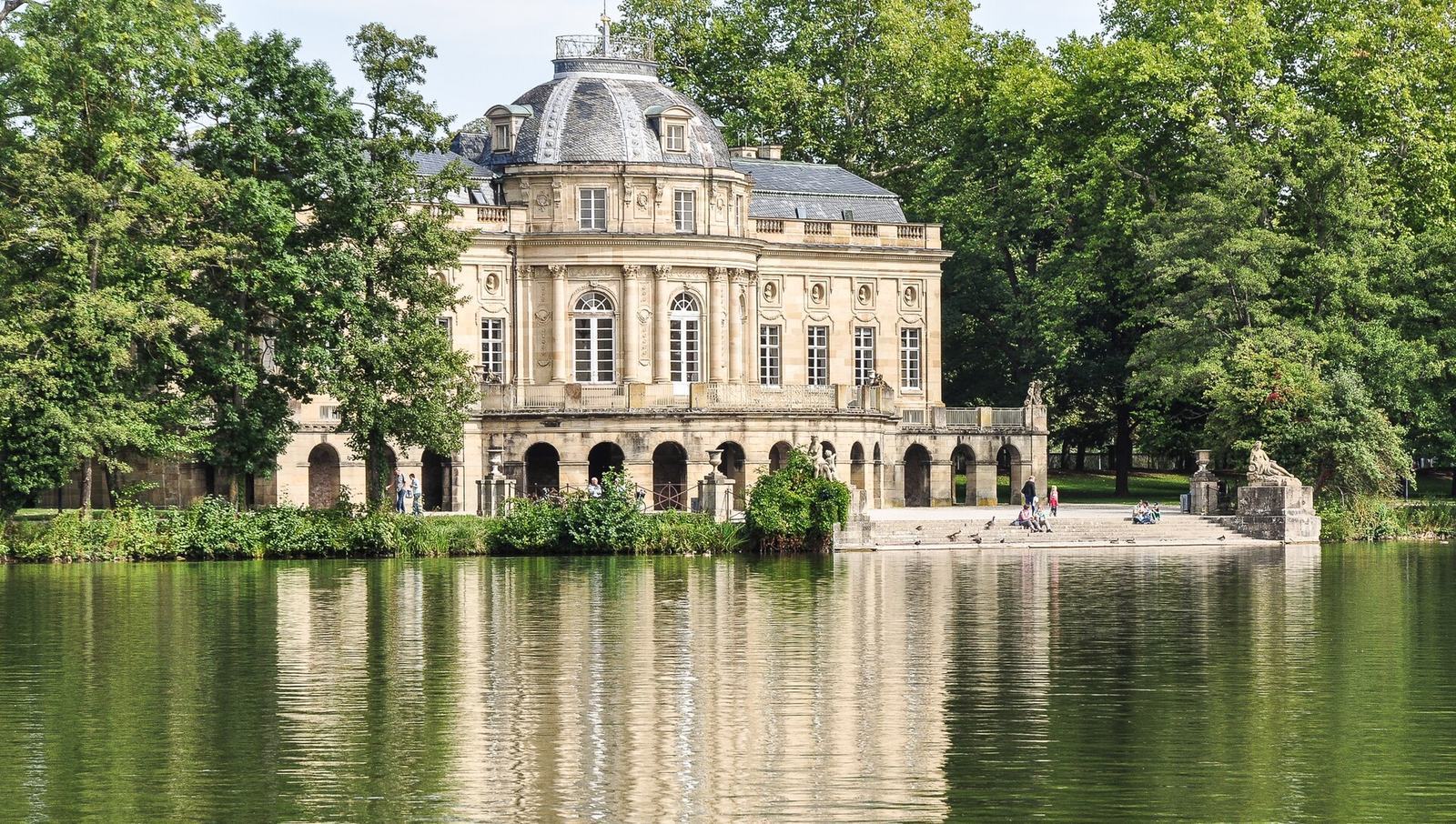
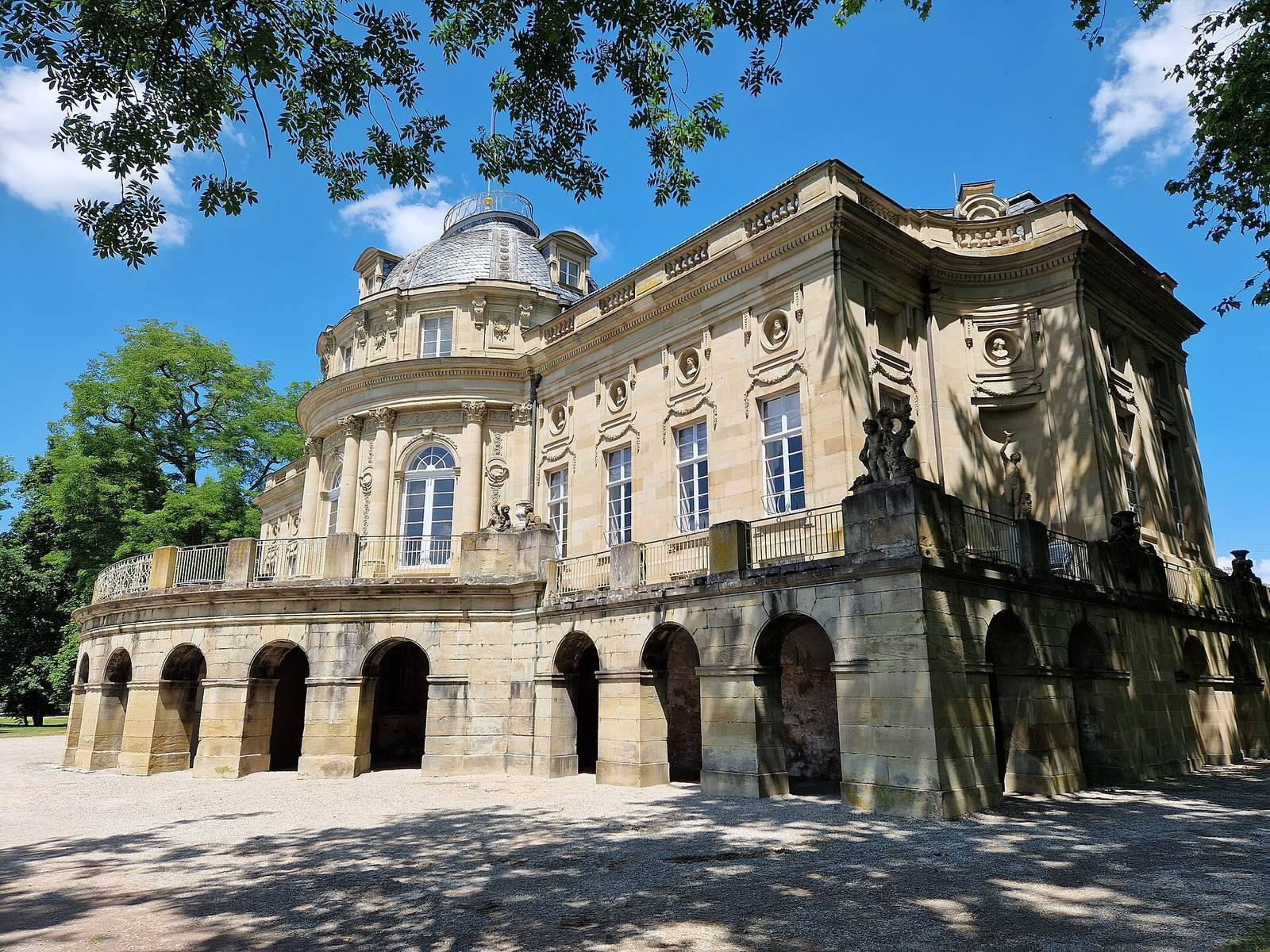
Monrepos is a lakeside palace northwest of Ludwigsburg, Germany, built for Württemberg’s ruling house in 1804. Its neoclassical design draws on restrained Greek and Roman forms. The estate developed from ducal hunting grounds into a royal retreat and later a working property.
From hunting grounds to an unfinished palace
Württemberg’s dukes hunted around Eglosheim Lake from the sixteenth century. In 1714, Duke Eberhard Ludwig ordered an octagonal pavilion built on its northern shore. Under Duke Carl Eugen, the grounds were laid out in Baroque style, and a lake with straight banks was formed from 1755.
A few years later, Carl Eugen commissioned court architect Philippe de La Guêpière to design a Baroque pleasure palace. Construction began in 1760 but ended after four years, when the duke turned to other palace projects. The incomplete complex was then neglected.
Friedrich I’s royal retreat
Duke Friedrich I revived the project and commissioned architect Nikolaus Friedrich von Thouret to redesign the palace and its lakeside garden. The palace was built to Thouret’s plans in 1804. That year, Friedrich named it Monrepos, French for “my repose,” after an estate near Vyborg that he had been forced to sell for political reasons in 1788. As king from 1806, he often came to Monrepos with a small retinue to hunt and withdraw from court life.
The estate served Württemberg’s dukes and kings as a private pleasure residence and hunting lodge. Its grounds also included farmland and a large animal park. A banquet building and a theatre were built opposite the palace. The theatre, transferred from Schloss Grafeneck in the Swabian Jura, was joined to the banquet building by a corridor, making it possible to hold larger court festivities there, including the queen’s birthday celebrations in September.
In 1815, during a meeting in Ludwigsburg between Tsar Alexander I of Russia and Emperor Francis I of Austria, the theatre presented the opera Cortez. The rear wall of its stage opened to reveal Württemberg soldiers acting out a battle scene.
From royal residence to working estate
After Friedrich I died in 1816, his widow, Queen Charlotte Mathilde, received Monrepos as part of her provision. She appears to have visited infrequently and ordered the banquet building and theatre demolished. Following her death in 1829, King Wilhelm I acquired the palace and estate for the Court Domain Chamber, the body that administered Württemberg’s royal domains. He renamed the property Seegut, ended the animal park, and directed the estate chiefly toward sheep and cattle breeding. The farm and livestock operations passed into state ownership, while the palace opened for public inspection. Soon after taking the throne, King Karl I restored the estate’s name to Monrepos.
The estate was leased from 1870, and a public inn opened there in 1890. Monrepos became a recreation area for the Ludwigsburg region. When the monarchy ended in 1918, it was the only one of three nearby Württemberg palaces still owned by the royal family.
Changes in the modern era
A bomb struck the chapel on one of the lake’s islands in 1944, during the Second World War. A hotel was built near the lake from 1967 to 1969 and enlarged in 1975. In 1993, a nine-hole golf course opened on part of the former estate and was later expanded to 18 holes; a separate public six-hole course was also established.
Remains
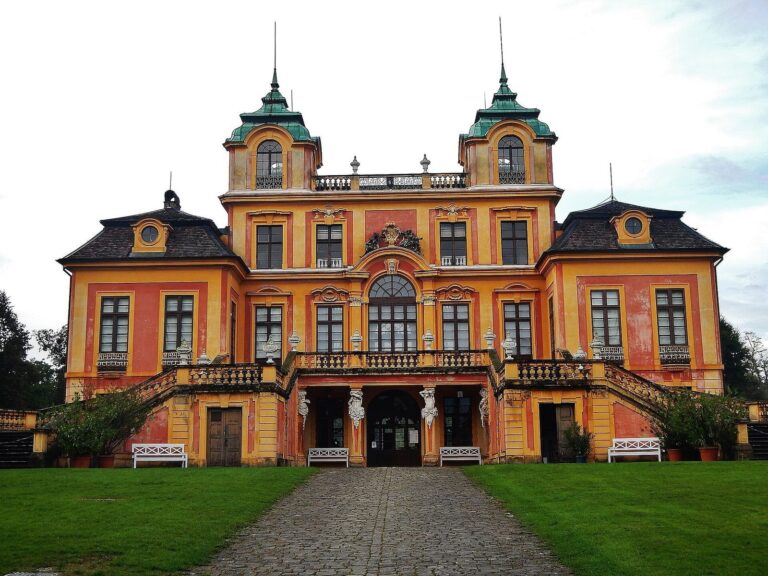
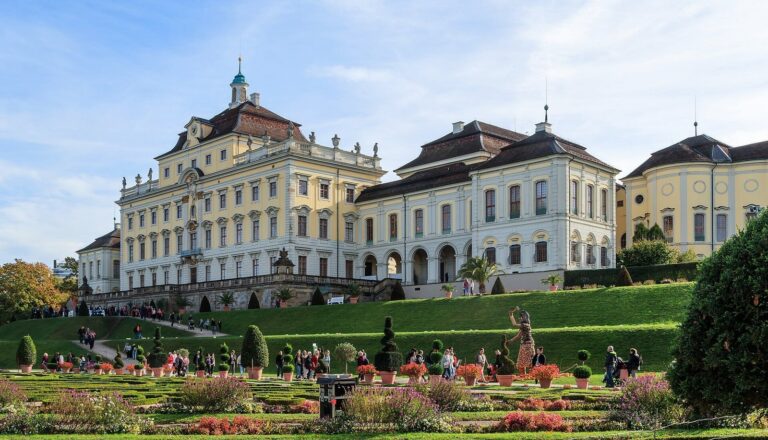
The palace stands beside a lake within a 250-hectare park. The lake has an irregular outline, and two artificial islands form part of its layout. Avenues extend through the surrounding landscape toward Schloss Favorite and the Ludwigsburg Residential Palace. The palace and garden sit within a wider estate that includes both cultivated land and parkland.
The palace
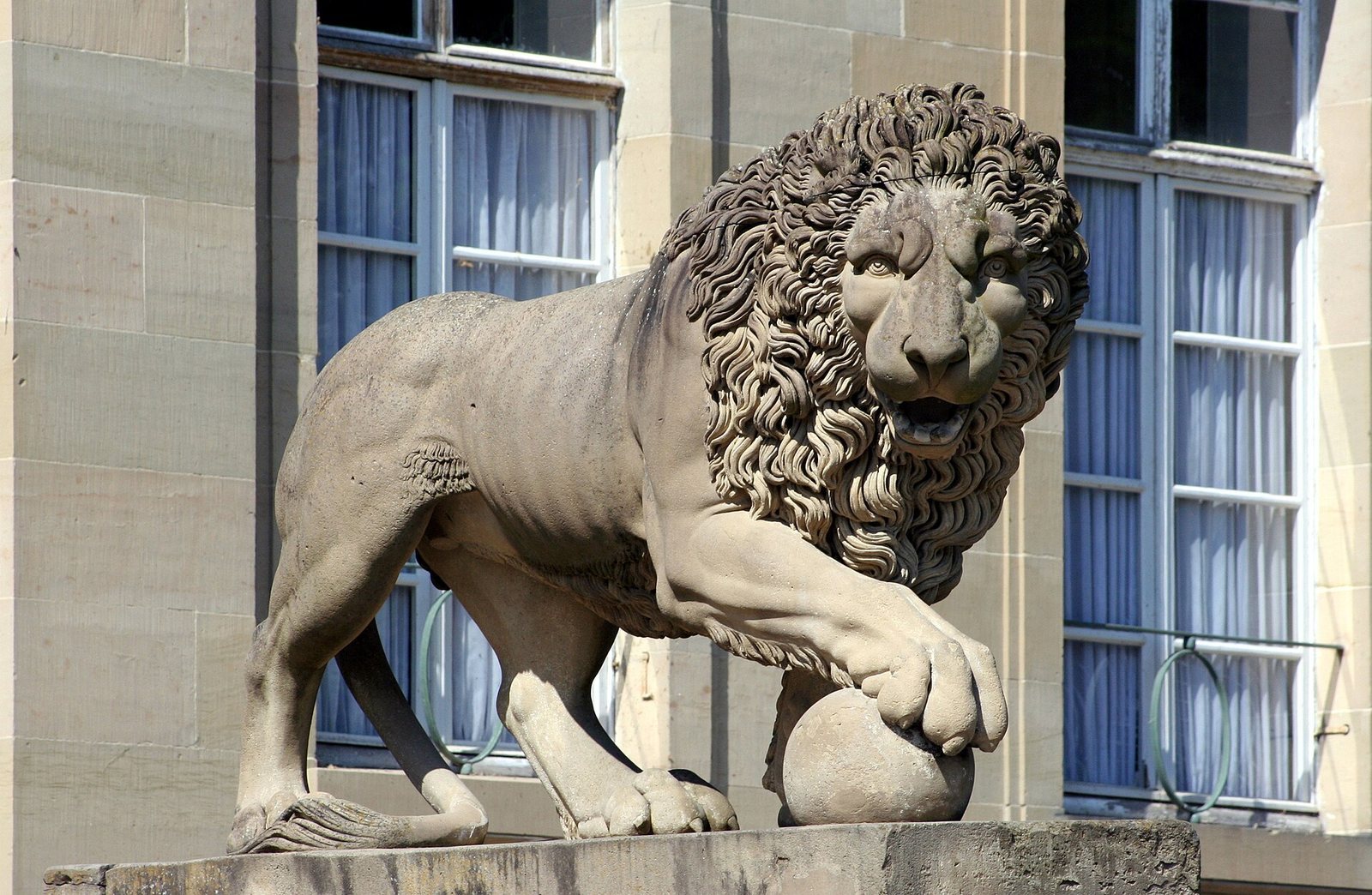
The neoclassical palace retains decoration linked to its hunting function. Its exterior sculpture included a gilded stone figure of Diana, the Roman goddess of the hunt, on the dome, and small childlike figures on the roof balustrade representing subjects that included the four seasons. Four niches on the side façades held statues of Adonis, famed in Greek myth for his beauty, the hunter Meleager, and two nymphs, female nature spirits in classical mythology, with hunting attributes. Copies of the Medici lions in front of the garden façade reproduce figures at Florence’s Loggia dei Lanzi. Inside, a ceiling painting depicts Adonis and Venus, the Roman goddess of love. A second ceiling painting in the great hall has been attributed to Nicolas Guibal, though that attribution remains debated. Sculptors Johann Wilhelm Beyer and Pierre François Lejeune, interior plasterwork artists Ludovico and Materno Bossi, engraver Ludwig Necker, and painter Adolf Friedrich Harper contributed to the palace’s decoration.
Lake and islands
The lake’s irregular shape and its two constructed islands organize the immediate grounds around the palace. Buildings were erected on both islands.
Chapel Island
The chapel on Chapel Island was transferred from Hohenheim. The 1944 bombing destroyed its roof and nave, leaving the building in ruins.
Island of the Temple of Cupid
The second island contains the Temple of Cupid, named for the Roman god of love.
Park and estate buildings
The grounds include an English-style garden, an informal landscape arranged in a naturalistic manner. In the early 1990s, avenues around the lake were recreated from older plans as part of an effort to restore the garden to its appearance under Friedrich I. Nature-conservation requirements limited how fully the work could be completed.
Former theatre and banquet building
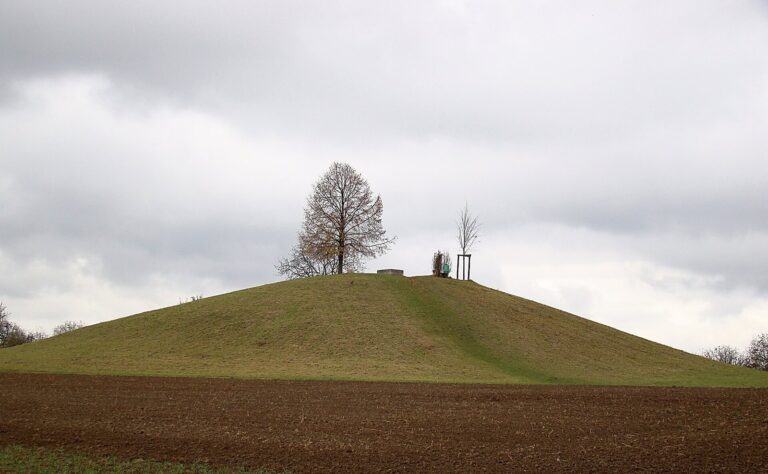
The banquet building and theatre once stood opposite the palace. Their former location is marked by an earth mound.
Present estate uses
Much of the privately owned land around Monrepos is now used for golf and agriculture, while the state-owned portion includes parks and museums. The lakeside garden remains a recreation area. Two former estate granaries have been converted into offices, and the hotel stands near the lake.