Šalek Castle: A Medieval Hilltop Fortress in Slovenia

Site at a Glance
- Rating
- 4.3
- Popularity
- Very Low
- Country
- Slovenia
- Primary era
- Medieval
- Eras represented
- Medieval
- Civilizations
- Duchy of Styria, Habsburg, Holy Roman Empire
- Site type
- Military
- Remains
- Castle
On this page8 sections
History
Šalek Castle is a medieval hilltop fortress in Slovenia above the Paka River near Velenje. It belonged to the historical region of Lower Styria, which formed part of the Duchy of Styria and the Habsburg hereditary lands. The castle was first documented in 1278 as the property of the Lords of Schallegg, while Egeloff of Schalegg had already been recorded in 1264 as a ministerial of the Diocese of Gurk, a medieval bishopric whose bishops granted castles and estates as feudal holdings.
The Lords of Schallegg and the Counts of Cilli
In 1314, the knight Nikl of Schallegg sold the castle to Otto Eckenstein. In 1335, the Bishop of Gurk granted it as a fief to Friedrich of Sanneck. Friedrich later became Friedrich I, founder of the Counts of Cilli, a powerful noble dynasty from the region of Cilli, now known as Celje. From 1341, the castle was in Friedrich’s own possession.
Niklas Kienberger is recorded as holding Šalek Castle as a fief from the Counts of Cilli in 1353. The Knights of Reichenegg held it later and remained there until 1428. These changes placed the castle within the network of noble and feudal relationships that shaped Lower Styria during the Middle Ages.
Later owners and abandonment
In 1561, the property came into the possession of four co-heirs. Erasmus Raumschüssel was its owner in 1575, and the Raumschüssel family retained the castle until 1664. That year, Marietta Raumschüssel, née Baroness Buchheim, sold it to her cousin, Baron Otto Taufenbach.
After Otto Taufenbach died in 1695, ownership passed to Ferdinand Leopold von Teufenbach. The Counts of Maurburg owned the property from 1722, followed by Baron Johann Josef Gabelkhoven in 1732. By the eighteenth century, Šalek Castle had become ruinous. It burned around 1770 and was abandoned.
The castle gave its name to the Šalek Valley, an approximately 8-kilometre-long and 2-kilometre-wide basin between Dobrna and Šoštanj. The ruin stands near the centre of the valley, where the Paka enters from the north and continues toward Šoštanj. Šalek Castle is designated as a Slovenian cultural monument of local importance under EŠD designation no. 4329.
Remains
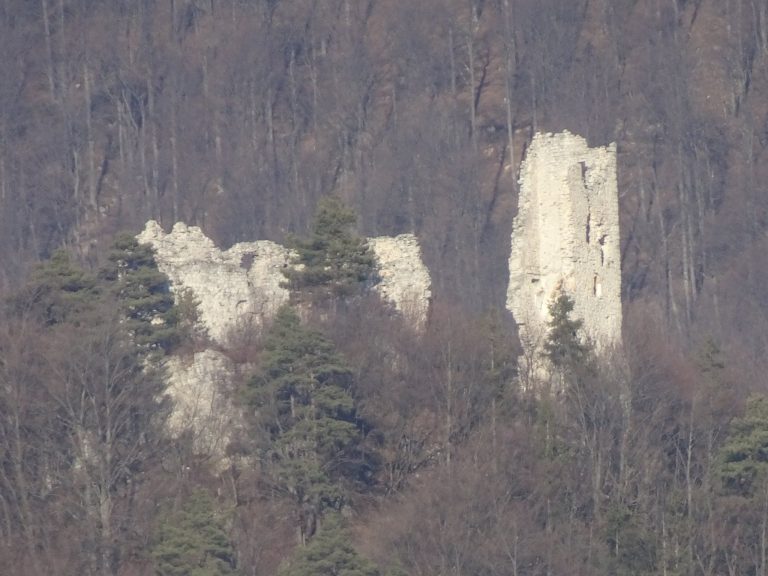
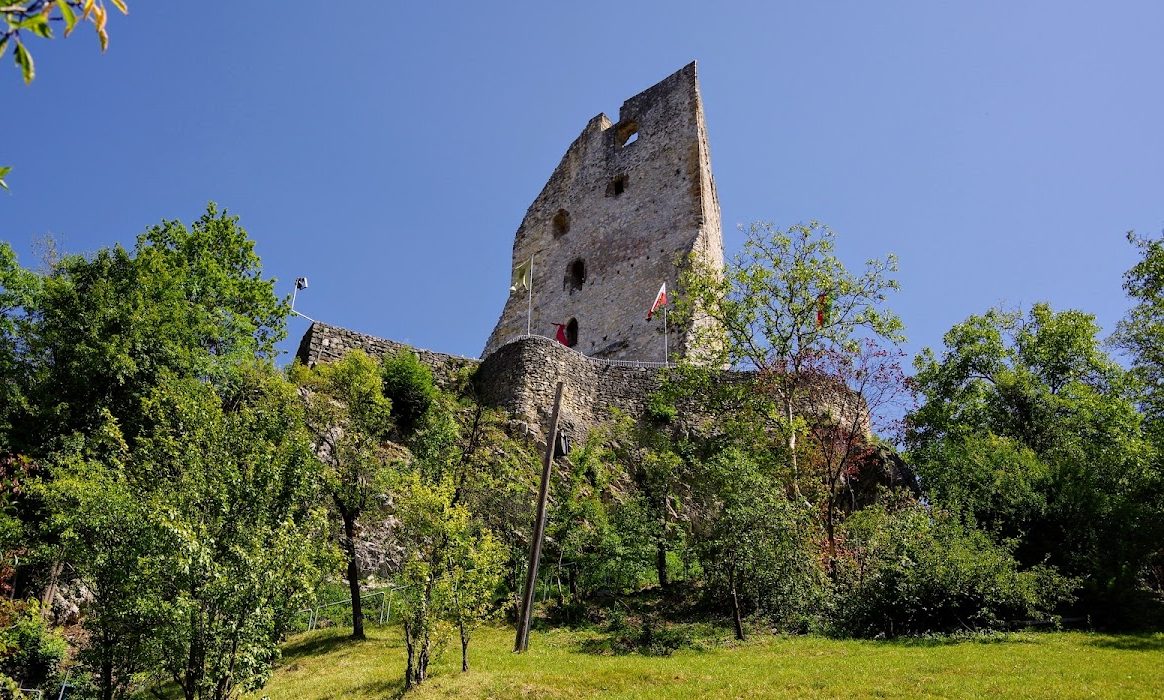
Šalek Castle survives as a stone fortress ruin on a steep mountain above the Paka River, approximately 1 kilometre east of Velenje’s town centre. Its oldest surviving element is a fortified tower with a distinctive triangular ground plan. The narrow mountain was later enclosed with defenses around its perimeter, while a residential and representational building was added to the tower. The surviving layout reflects the development of a compact tower castle into a more extensively fortified hilltop complex.
The fortified core
The triangular keep
The oldest surviving component is the bergfried, the principal fortified tower used for defense and refuge rather than ordinary residence. Its triangular ground plan gives the ruin its most distinctive architectural feature, a form described as very rare in Slovenia and Europe. The tower forms the core of the castle and belongs to its earliest surviving building phase.
The residential building
A palas, the castle’s principal residential and representational building, was added later to the keep. The narrow mountain was subsequently fortified around its perimeter, creating a more enclosed defensive site. Together, these elements show how the castle’s original tower was expanded with residential accommodation and surrounding defenses.
The outer bailey and historical views
A copper engraving by Georg Matthäus Vischer, a seventeenth-century cartographer and engraver known for detailed views of castles and landscapes, was published in 1681. It depicts a recognizable outer bailey connected to the main castle by a wooden bridge. The view presents the complex as broadly comparable to a tower castle and preserves evidence for the relationship between its outer and inner parts.
Historical views record the castle at different stages of preservation. An engraving from around 1680 shows it still complete, while views from 1863 and around 1895 show the later ruin. The earlier view also depicts the ruins of Eckenstein Castle to the southeast, already decayed at that time. State road 4 now passes through a tunnel beneath the castle hill.