Schloss Favorite: A Baroque Hunting Lodge and Pleasure Palace


Site at a Glance
- Rating
- 4.6
- Popularity
- Low
- Country
- Germany
- Primary era
- Early Modern
- External website
- Open
- Eras represented
- Early Modern, Modern
- Civilizations
- Duchy of Württemberg, German, Holy Roman Empire
- Site type
- Domestic
- Remains
- Palace
On this page7 sections
History
Schloss Favorite in Ludwigsburg, Germany, was built between 1717 and 1723 for Duke Eberhard Ludwig of Württemberg as a Baroque hunting lodge and pleasure palace. Designed by the court architect Donato Giuseppe Frisoni, it combined seasonal courtly leisure with hunting and was positioned to overlook the Ludwigsburg residence palace.
Construction and Court Use
The palace was conceived as both a hunting lodge surrounded by extensive hunting grounds and a country villa for summer use. Its design drew on Vienna’s Gartenpalais, a type of country residence intended primarily for courtly leisure, entertainment, and seasonal occupation. An avenue connected Favorite with the Residenzschloss Ludwigsburg, while another linked it with Schloss Monrepos.
In 1748, Schloss Favorite provided the setting for a grand firework display celebrating the wedding of Duke Charles Eugene of Württemberg and Margravine Elisabeth Fredericka Sophie of Brandenburg-Bayreuth. The event reflected the palace’s place within the ceremonial and recreational world of the Württemberg court.
Royal Hunting Grounds and Interior Changes
From 1806, King Frederick I of Württemberg transformed Favorite Park into a menagerie for hunting and entertainment. Wild boar, chamois, and deer were kept there, while the palace continued to serve as a hunting lodge. Around the same period, Nikolaus Friedrich von Thouret, an architect who worked for the Württemberg court, remodeled the interiors in the Neoclassical style. Neoclassicism revived architectural forms and principles associated with ancient Greece and Rome.
Favorite Park was later changed into a landscape garden and continues to function as an animal park. The palace itself remained connected to the wider Ludwigsburg residence complex through its avenues and position within the grounds.
Decline and Restoration
After the fall of the monarchy in the twentieth century, Schloss Favorite was little used and fell into neglect. Comprehensive restoration began around 1980, including the recreation of the interior furnishings. The palace reopened to the public in 1983 and has housed a museum since then. It is state-owned, administered by the State Castles and Gardens of Baden-Württemberg, and counted among the state-owned monuments.
Remains
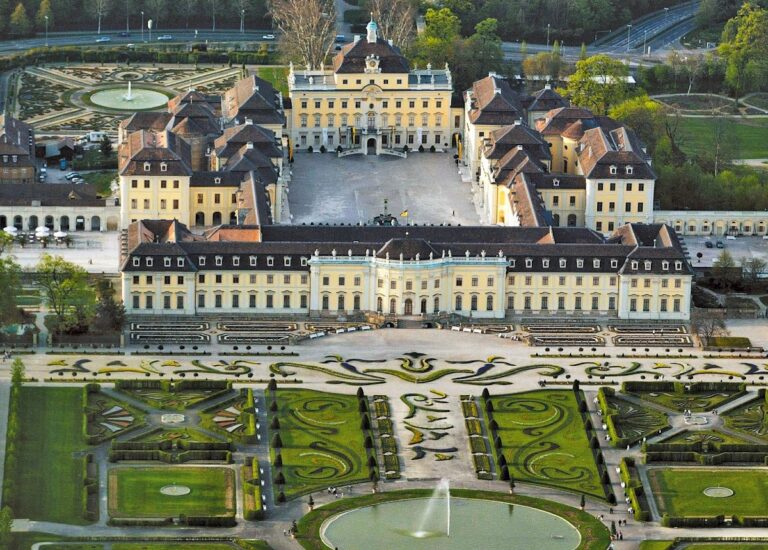
Schloss Favorite is a Baroque pleasure palace and hunting lodge standing on a small rise in Favorite Park directly north of the Residenzschloss Ludwigsburg. The two palaces form a building ensemble. Favorite lies on the direct axis of the residence palace, and an avenue connects the buildings. A second avenue leads toward Schloss Monrepos.
Palace and Park Setting
The surviving arrangement expresses the original combination of a hunting castle, extensive grounds, and a summer country villa oriented toward views of the Ludwigsburg residence palace. The park, first associated with hunting grounds, was later reshaped as a landscape garden and remains an animal park.
Interiors and Furnishings
The palace interiors retain the Neoclassical remodeling carried out around the early nineteenth century. Restoration recreated the interior furnishings and placed valuable furniture in the rooms, where the arrangement conveys aspects of courtly life. The restored interiors form part of the museum housed within the palace.
Nearby sites