Bozhenishki Urvich: A Medieval Fortress in Bulgaria


Site at a Glance
- Rating
- 4.9
- Popularity
- Very Low
- Country
- Bulgaria
- Primary era
- Medieval
- External website
- Open
- Eras represented
- Classical, Medieval
- Civilizations
- Bulgarian, Byzantine
- Site type
- Military
- Remains
- Fort
On this page9 sections
History
Bozhenishki Urvich is a ruined medieval stone fortress in Bulgaria, on the northern slope of the Lakavitsa ridge in the western Balkan Mountains. The site was inhabited from prehistoric times, while its earliest fortifications belong to the fifth or sixth century and formed part of the Early Byzantine defensive system. Ceramic finds and coins from the reigns of Justin I, who ruled from 518 to 527, and Justinian I, who ruled from 527 to 565, indicate that the fortress was probably built during this period.
Early Byzantine beginnings
The first defensive belts were established at the end of the fifth and the beginning of the sixth century, when the eastern Roman Empire developed extensive defenses across the Balkans. Bozhenishki Urvich occupied a high position at about 750 metres above sea level, allowing it to form part of this regional military network.
The Second Bulgarian Empire
The fortress reached its greatest period of activity during the thirteenth and fourteenth centuries, under the Second Bulgarian Empire, the medieval Bulgarian state that flourished from the late twelfth century until the late fourteenth century. An outer defensive wall was built across the only approach from the north. A third defensive belt was added in the fourteenth century during the reign of Tsar Ivan Shishman, who ruled from 1371 to 1395 while Ottoman expansion was advancing through the Balkans.
By the late fourteenth century, Bozhenishki Urvich was the headquarters of the boyar Ognen, also known as Ognyan. He held the office of kephale, a regional military and administrative governorship in the Byzantine and medieval Balkan political tradition, under Tsar Ivan Shishman. A local tradition connects the fortress with a battle between Ognyan and the Turks around 1395. Weapons, projectiles, and human remains found near the walls are associated with the fighting traditionally dated to that time.
The inscription of Sevast Ognyan
The fortress came to scholarly attention in the winter of 1918 to 1919, when a medieval inscription was found beneath the roots of a centuries-old tree brought down by a storm. The local shepherd Nedyalko Umenkovski discovered it, and Academician Petar Mutafchiev read and interpreted the text. The inscription names Dragomir as its writer and preserves the words of Sevast Ognyan, who identifies himself as Tsar Shishman’s kephale, describes the suffering caused by the Turkish war, and declares his loyalty to the tsar. The text is regarded as historically and philologically unique and important.
Excavation and conservation
Bozhenishki Urvich was declared a site of national significance in 1966. The first excavations began in 1971 through the Sevast expedition, led by Pavel Dishev with the participation of Vasil Dimitrov, newspaper editor Mitrofan Velev, and architect Yordan Yordanov. Archaeological research had begun to establish the site’s long chronology by 1972, including its prehistoric habitation. The fortress was fully uncovered during eight years of work, followed by efforts to conserve and restore the surviving remains.
Remains
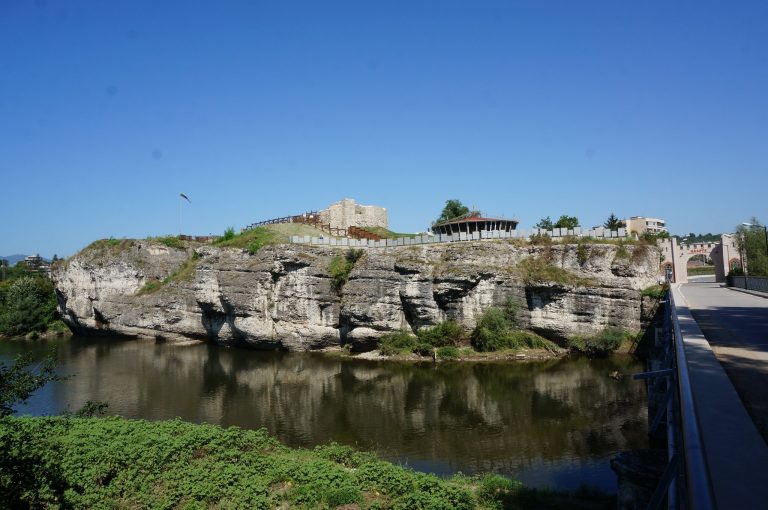
The fortress stands on the northern slope of the Lakavitsa ridge, about three kilometres south of Bozhenitsa and twenty kilometres from Botevgrad. Its defenses occupy a compact rocky position organized in three belts. The inner wall is 200 metres long and reaches 2.70 metres in width in places. The outer wall rises 4 to 6 metres and includes four buttresses. The citadel covers 80 square metres, while the entire fortified area covers 1,600 square metres.
Defensive structures
The southwestern corner tower served as an observation point for other defensive sites, including Panitsa Kale near present-day Lipnitsa, Valchigrad at Litakovo, Cheshkovgrad at Vrachesh Monastery, and Bodilovgrad near the Vitinya mountain pass. The tower contained a secret passage measuring 7.40 metres and a shelter for eight people. Both features are now filled with earth. The defensive layout also includes a 10-metre-deep water cistern, whose water level reached 4 metres.
Rock-cut religious and residential features
The northeastern part of the fortress contained a tower, a dwelling cut into the rock, and a rock church. The church included an image of Saint George the Victorious carved into the rock. Saint George the Victorious is the Christian martyr and warrior saint commonly shown as a mounted figure defeating a dragon. The carved image has since been destroyed. A chapel was also cut into the rock, and a monastery complex lay below the fortress.
Burials and objects from the siege area
A necropolis, meaning a burial area, contained 48 graves. Near the gate, at depths ranging from 0.2 to 1.5 metres, excavators found a hoard of 1,327 silver groschen and half-groschen. The coins show the likeness of Tsar Ivan Alexander, who ruled from 1331 to 1371, but bear the name of his successor Ivan Shishman. Their obverse depicts the Virgin Mary with the infant Christ. Coins from the hoard had been clipped around their edges to conserve precious metal, a practice interpreted as evidence of inflation and severe financial pressure connected with military activity.
The excavated ground beside the walls yielded hundreds of arrowheads and spearheads, stone military balls, and soldiers’ skeletons. These finds provide the material setting for the tradition of the battle involving Ognyan and the Turks around 1395. Pavel Dishev proposed that Ognyan’s grave may lie in the rocky massif in front of Voyvodov Kamak, the fortress’s principal observation point.