Shaki Fortress: Citadel and Administrative Center of the Shaki Khanate



Site at a Glance
- Rating
- 4.4
- Popularity
- Medium
- Country
- Azerbaijan
- Primary era
- Early Modern
- Eras represented
- Early Modern
- Civilizations
- Unclassified
- Site type
- Military
- Remains
- Citadel
On this page9 sections
History
Shaki Fortress, formerly known as Nukha Fortress, is an eighteenth-century citadel in Shaki, Azerbaijan, built under the rulers of the Shaki Khanate. It served as the fortified central enclosure of the settlement, combining defensive, residential, and administrative functions. Its construction is dated either to 1743–1755, during the rule of Haji Chelebi, the first Shaki khan, or to 1765, under Muhammad-Husayn Khan Mushtaq. The fortress and the Khan’s Palace may have been built together in 1765, although the palace may have followed soon afterward.
The khanate and the fortress
The fortress stood at the center of the Shaki Khanate, a regional state in the South Caucasus whose rulers governed from the citadel and its associated palace. Its position reflected Shaki’s earlier role as an administrative and commercial center and as a hub of the silk trade.
In August 1780, Haji Abdulkadir secretly sent men led by Haji Rasul Bey into Nukha. They entered the fortress by surprise, wounded Muhammad-Husayn Khan, and seized the stronghold. Muhammad-Husayn Khan was later strangled, and Haji Abdulkadir became khan. In December 1783, his predecessor’s son, Muhammad-Hasan Khan, captured and killed Haji Abdulkadir and assumed power.
In December 1795, an Iranian general, Develi Mustafa Khan, captured Muhammad-Hasan Khan on the orders of Aga Muhammad Shah, the Iranian ruler. Muhammad-Hasan Khan was blinded and sent to Karabakh, after which his brother Selim Khan became ruler. On 9 May 1797, Muhammad-Hasan Khan attacked Nukha with a large army, forcing Selim Khan to flee.
Russian suzerainty and military occupation
In January 1805, Mustafa Khan of Shirvan defeated Muhammad-Hasan Khan and took him to Shirvan. He appointed Sheikh Ali Bey as his naib, or deputy governor, in Shaki, but the inhabitants rejected Sheikh Ali Bey and appointed Fatali Khan instead. Selim Khan later arranged with Shaki begs to recover power. A conspirator opened one of the fortress gates at night, allowing Selim Khan to re-enter and regain the khanate.
On 26 May/2 June 1805, Selim Khan concluded a treaty placing the Shaki Khanate under the suzerainty of the Russian Empire. The agreement required an annual payment of 7,000 gold coins, ended the khanate’s independent foreign policy, and permitted Russian troops to enter its territory. Russian representatives promised not to interfere in internal affairs. Selim Khan nevertheless refused to admit Russian troops into the fortress, describing it as little more than an enclosure occupied by himself, his relatives, and servants.
Selim Khan rebelled in 1806 after Lieutenant Colonel Lisanevich ordered the killing of Ibrahim Khalil Khan, the ruler of Karabakh, together with his wife, son, daughter, and other relatives. Ibrahim Khalil Khan’s wife was Selim Khan’s sister. Selim Khan expelled Russian troops from his territory, but in October Major General Nebolsin entered the Shaki Khanate with 26 officers, 886 enlisted men, and five guns. Russian forces stormed the fortress on 23 October/4 November, and Selim Khan fled. He was then declared permanently deprived of his domains.
In August 1826, Selim Khan’s son Hussein Khan took the city without a battle, and the fortress again became a khan’s residence. On 19/31 October, General Yermolov, commander-in-chief of the Separate Caucasus Corps, arrived with infantry, dragoons, Cossacks, and 18 guns. Hussein Khan fled to Iran.
Administrative reuse and restoration
On 1 September 1838, a man calling himself Iskander Bey, son of Hussein Khan, occupied Nukha and besieged the long-abandoned fortress. The enclosure then contained the commandant’s house, provincial administration, and treasury. Part of the population had taken refuge inside under the protection of a company from a line battalion. The insurgents withdrew when a force assembled by Bezobrazov, including dragoons, infantry, artillery, and the militia of the Elisuy Sultanate, approached the city.
After the Shaki Khanate was incorporated into the Russian Empire, the palace came under local administrative control and was repaired repeatedly. A plan made in 1853 recorded buildings used by the families of the khan’s nobles, together with military and administrative facilities. A mudflow breached the fortress wall in several places in 1896. The heavily damaged walls and towers were extensively restored between 1958 and 1963. In 2019, the Historic Centre of Shaki with the Khan’s Palace was inscribed on the UNESCO World Heritage List under criteria ii and v.
Remains
Fortifications and setting
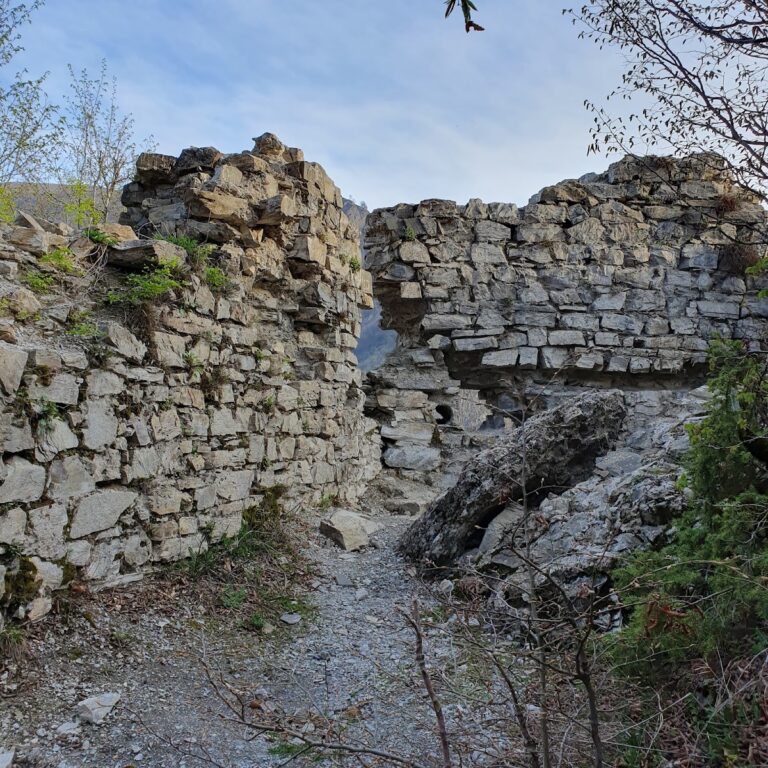
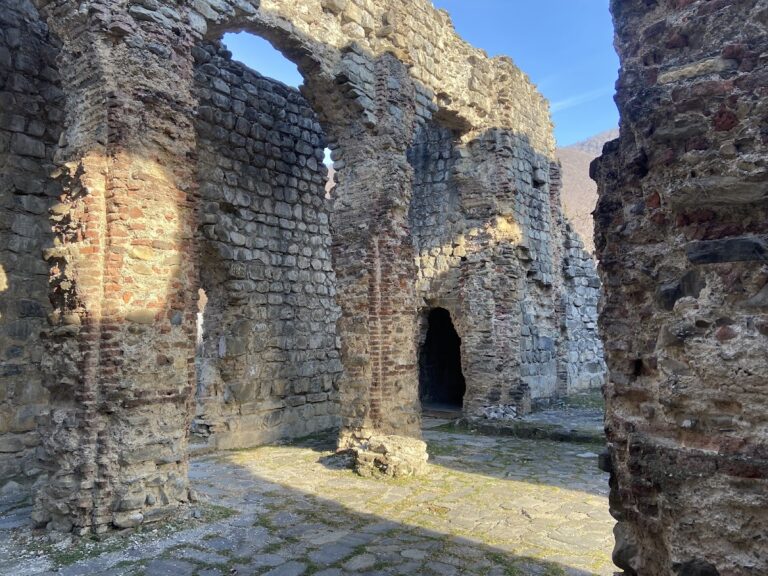
Shaki Fortress occupies the northeastern part of Shaki and was built to protect the city from the northeast. Its enclosure extends for approximately 1.3 kilometres, with walls about 2.2 metres thick. The northern section rises approximately 4 metres, while the southern section reaches about 8 metres. Twenty-one defensive towers are distributed along the length of the walls, which are closed by arched gates at the north and south. The fortress stands at approximately 750 metres above sea level in the north and 710 metres in the south.
Buildings within the enclosure
Khan’s Palace
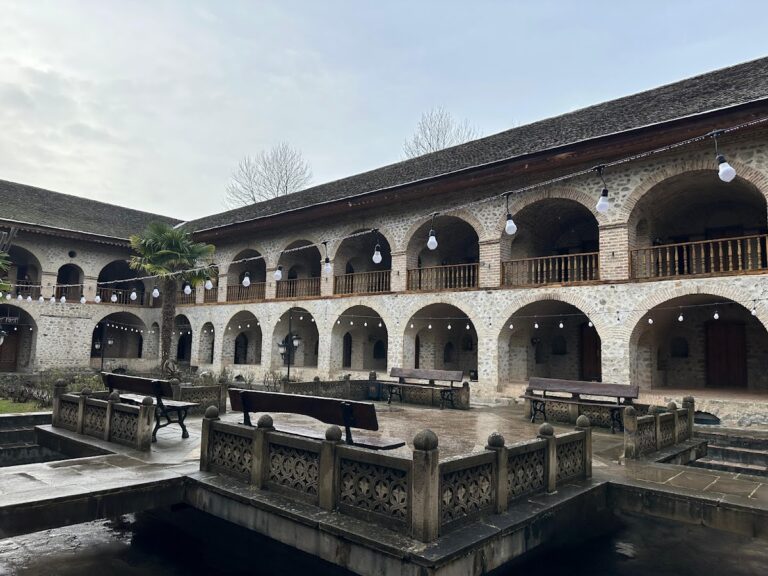
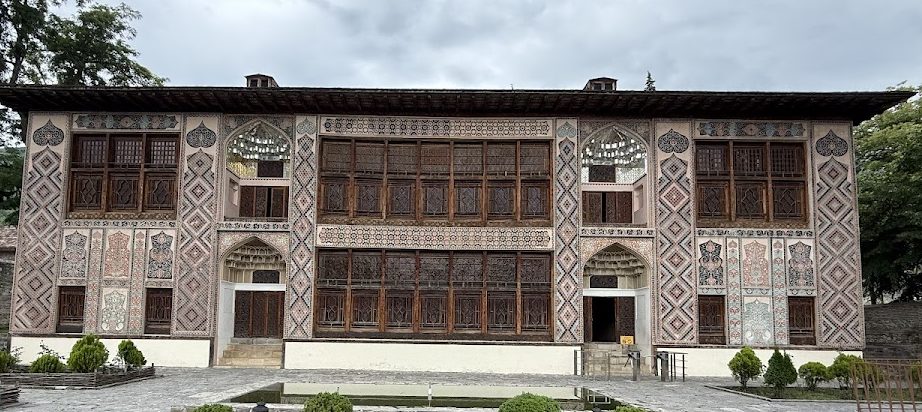
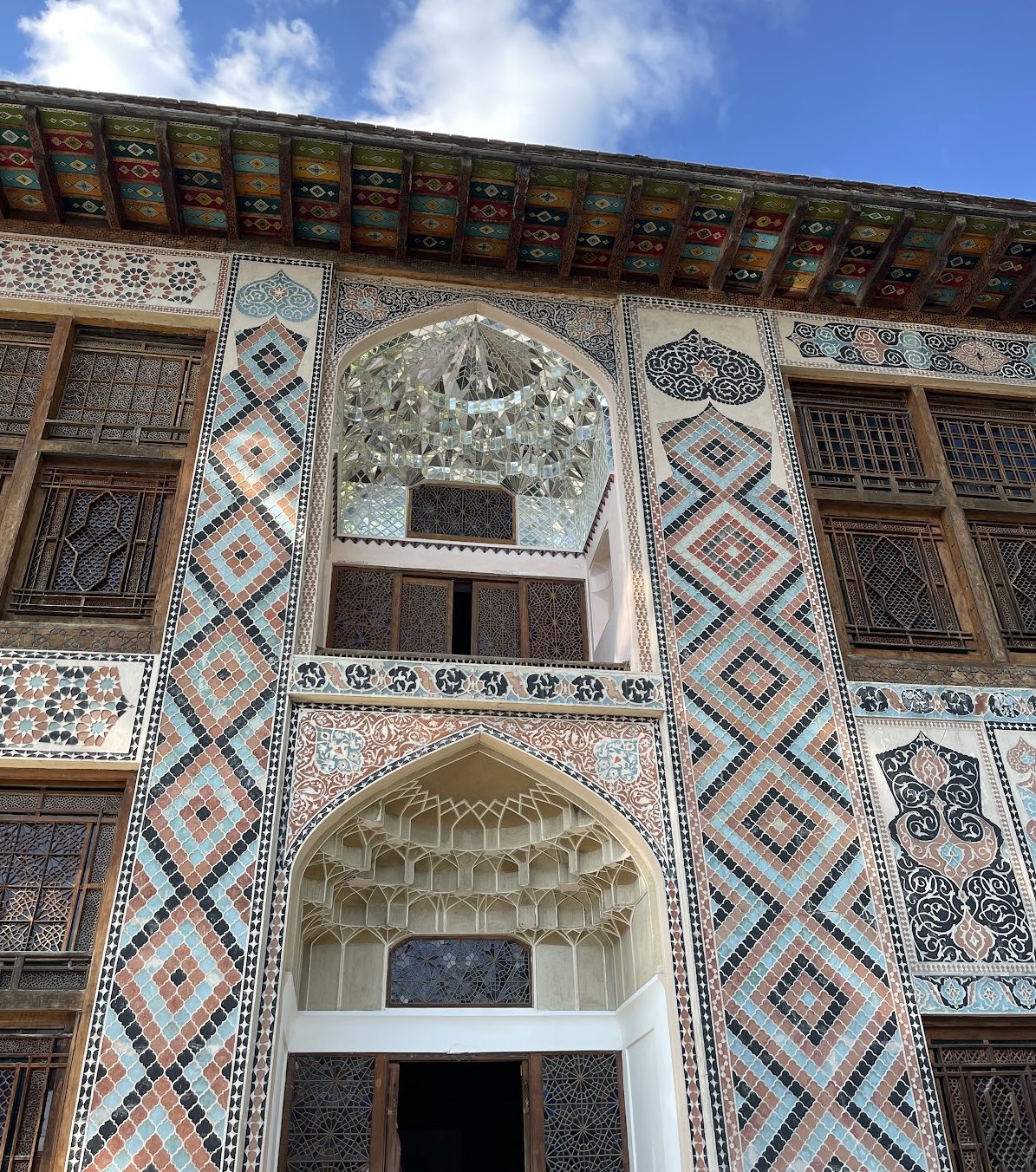
The two-storey Khan’s Palace stands inside the fortress and is described as the only surviving structure from the original complex, which may have contained about 40 buildings. A winter palace built in 1797 served as the khan’s family residence and provided quarters for servants during the khanate. The palace’s original painted decoration made a strong impression on visitors.
Military and administrative buildings
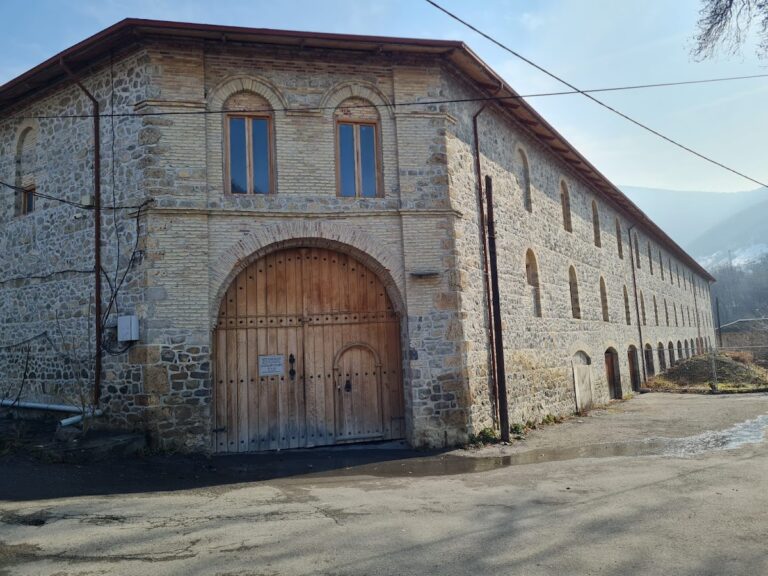
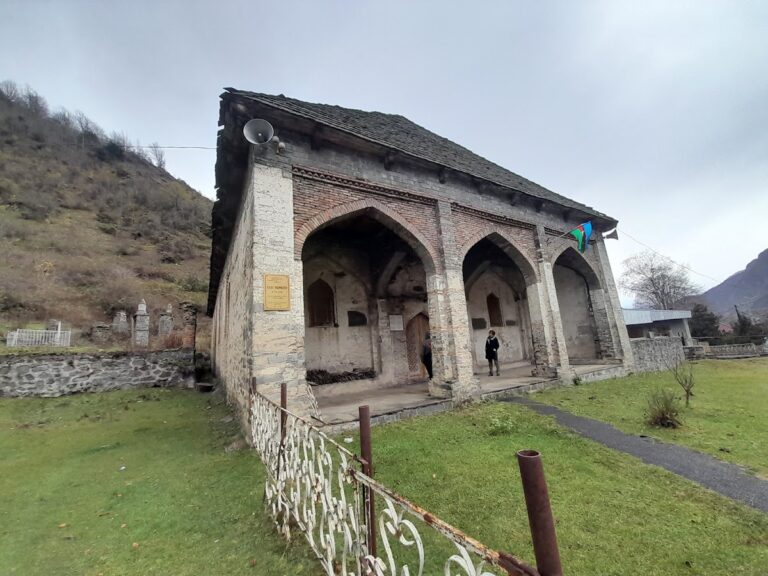
A plan from 1853 recorded barracks, a treasury, and a prison within the fortress, alongside buildings used by the families of the khan’s nobles. It also identified a church converted in 1828 from a khan’s mosque. These structures formed part of the military, administrative, and residential complex associated with the citadel.
Nearby sites