Galarsan-Gorarsan: A Medieval Fortress near Sheki, Azerbaijan


Site at a Glance
- Rating
- 4.4
- Popularity
- Low
- Country
- Azerbaijan
- Primary era
- Medieval
- Eras represented
- Medieval
- Civilizations
- Caucasian Albania
- Site type
- Military
- Remains
- Castle
On this page4 sections
History
Galarsan-Gorarsan is a medieval fortress in Azerbaijan, near Sheki, whose construction dates to approximately the eighth or ninth century. Heavily fortified for defensive purposes, it occupied a strategic position in the region’s medieval landscape.
The medieval fortress
The fortress was built during the medieval period and served primarily as a place of defense. Its later historical identity became closely connected with the Shaki Khanate, a regional state in the South Caucasus ruled by a khan.
The confrontation with Nader Shah
The name Galarsan-Gorarsan came into use in the eighteenth century and means “you will come and see.” It refers to an episode during the attack on the Shaki Khanate by Nader Shah, an Iranian ruler and military leader who founded the Afsharid dynasty. Haji Chalabi Khan, ruler of the khanate, took refuge in the fortress after Nader Shah demanded his surrender. According to the tradition associated with the site, Haji Chalabi Khan replied, “You will come and see.”
In 1744, Nader Shah approached the fortress with a large army but failed to capture it and withdrew. After this episode, the fortress became known as Galarsan-Gorarsan. The site appears in The Khans of Shaki and Their Descendants, compiled in the second half of the nineteenth century by the Azerbaijani historian Haji Seyid Abdul-Hamid, and is also mentioned in a work by Karim Agha Fatehi. Residents of Kish village also call the fortress Bent or Banat, while historical works use the name Galarsan-Gorarsan.
Remains
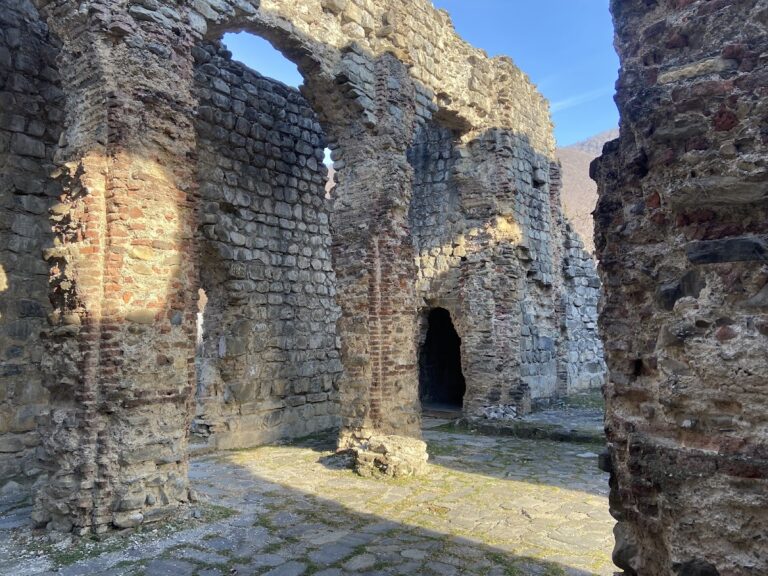
The ruins stand on the bank of the Kish River, about 4 kilometres from Sheki and northeast of Kish village, on the summit of Garatepe Mountain. The fortress was constructed from river stone, and a southern gate remains identifiable as part of the defensive complex.
Nearby sites