Asen’s Fortress: A Medieval Bulgarian Border Stronghold


Site at a Glance
- Rating
- 4.7
- Popularity
- Medium
- Country
- Bulgaria
- Primary era
- Medieval
- External website
- Open
- Eras represented
- Medieval
- Civilizations
- Bulgarian
- Site type
- Military
- Remains
- Castle
On this page7 sections
History
Asen’s Fortress is a medieval fortress in Bulgaria, located 2–3 kilometres south of Asenovgrad on a rocky ridge above the Asenitsa River. The site has earlier associations with the Thracian, Ancient Roman, and Early Byzantine periods, but it became especially important during the Middle Ages.
Early References and Medieval Conflict
The fortress was first mentioned in the eleventh century in the statute of Bachkovo Monastery, a major medieval Orthodox monastery in Bulgaria. That document called the site Petrich, a name that some researchers identify with Asen’s Fortress. Its position brought it into the military conflicts of the late twelfth and early thirteenth centuries. Armies of the Third Crusade, a campaign led by major western European rulers to recover Jerusalem, captured the fortress.
In 1205, Renier of Trit, the Latin Duke of Philippopolis, took refuge at the fortress while Philippopolis faced pressure from Tsar Kaloyan of Bulgaria. Renier and forty knights endured an eleven-month siege before the army of Henry of Flanders, the Latin Emperor, relieved them.
The Renovation of 1231
The fortress was substantially renovated in 1231 during the reign of Ivan Asen II, a medieval Bulgarian tsar. An eight-line inscription on the walls states that this work was intended to strengthen the site as a border fortification against raids by the Latin Empire, the Crusader state established at Constantinople after the Fourth Crusade. The renovation gave the fortress a renewed defensive role on the Bulgarian frontier.
Later Bulgarian and Ottoman Control
After Ivan Asen II’s death, the fortress changed hands between Byzantine and Bulgarian forces for several decades. Bulgarian control was restored in 1344 during the reign of Ivan Alexander, a fourteenth-century Bulgarian tsar. The Ottomans later conquered and destroyed the fortress. After the Ottoman conquest in the fourteenth century, most of the site fell into decay and was abandoned, while the Church of the Holy Mother of God continued to serve local Christians.
Conservation and partial restoration of the church were completed in 1991, and it remains in regular use as a Bulgarian Orthodox church. The nearby town, formerly known as Stanimaka, took its modern name, Asenovgrad, from the fortress. Asen’s Fortress is also included among Bulgaria’s “100 National Tourist Sites.”
Remains
Asen’s Fortress occupies a high rocky ridge on the left bank of the Asenitsa River, about 279 metres above sea level. The surviving remains form a largely ruined medieval defensive site. Excavation has revealed fortified walls, a feudal castle, thirty rooms, and three water reservoirs associated with the thirteenth-century renovation.
Fortifications and Settlement
The outer fortification walls were approximately 2.9 metres thick and survive to about 3 metres in height. They originally rose to roughly 9–12 metres. Within the fortified area, the excavated foundations of the castle and the rooms show the organization of the stronghold, while the three water reservoirs belonged to its thirteenth-century defensive and residential complex.
Church of the Holy Mother of God
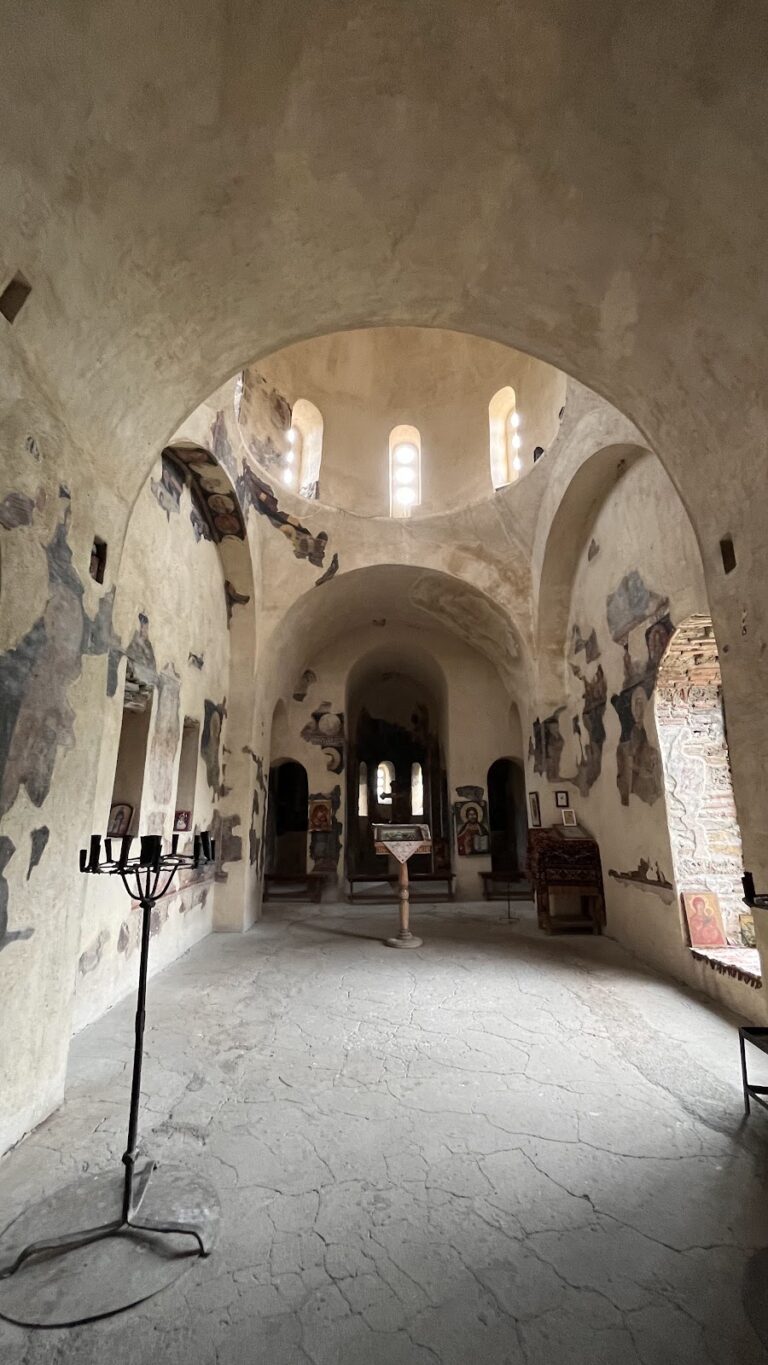
The Church of the Holy Mother of God dates from the twelfth or thirteenth century and is the most fully preserved surviving feature of the fortress. It is a two-storey, cross-domed church, meaning that its dome is supported within a cruciform structural plan. The single-naved building has a wide narthex, an entrance vestibule at the western end, and a large rectangular tower. Fourteenth-century mural paintings survive inside, and the church has retained its original appearance more fully than the other parts of the fortress.