Bachkovo Monastery: A Medieval Orthodox Monastic Center in Bulgaria


Site at a Glance
- Rating
- 4.8
- Popularity
- High
- Country
- Bulgaria
- Primary era
- Early Modern
- External website
- Open
- Eras represented
- Medieval, Early Modern, Modern
- Civilizations
- Bulgarian, Byzantine, Georgian
- Site type
- Religious
- Remains
- Monastery
On this page18 sections
History
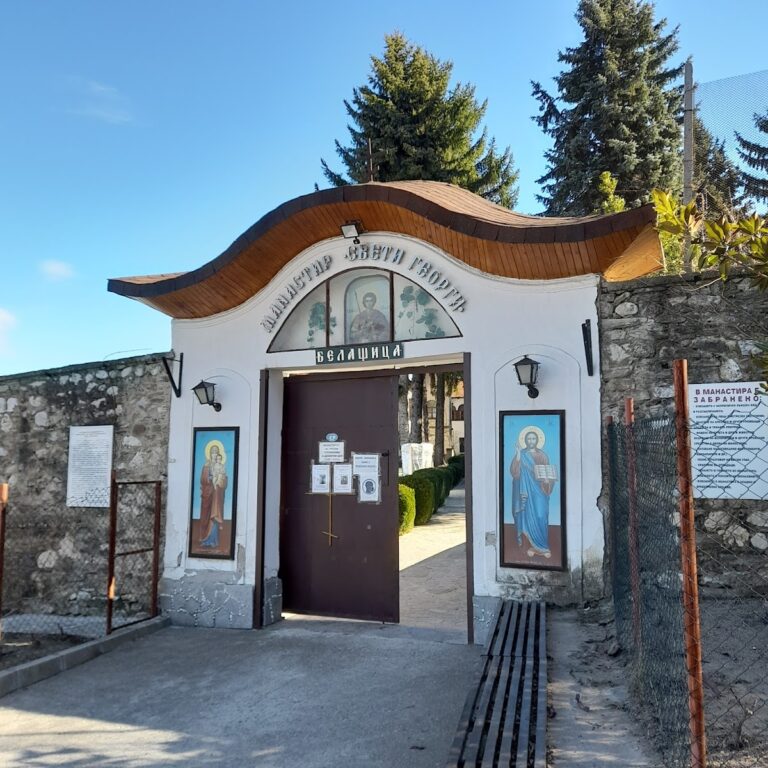
Bachkovo Monastery is a Bulgarian Orthodox monastery in Bulgaria, founded in 1083 as a Byzantine Iberian Orthodox institution by the Georgian aristocrat and military commander Gregory Pakourianos. Located near Bachkovo in the valley of the Chepelare River, it became a center of Georgian monasticism and remains an active male monastery directly subordinate to the Holy Synod of the Bulgarian Orthodox Church. It is the second-largest Bulgarian monastery after Rila Monastery.
Foundation and Byzantine Iberian Beginnings
Gregory Pakourianos served as grand domestikos of the western armies under the Byzantine emperor Alexios I Komnenos. His brother Abasios, also known as Apasios, took part in the foundation. Pakourianos endowed the monastery with extensive resources, including land, vineyards, pastures, mills, fortified settlements, a fishing lake, a hospital, a guesthouse, and dependent villages. He also provided icons, books, crosses, and clerical vestments.
The monastery’s typikon, or foundation charter and rule, survives in Greek and Georgian copies. It excluded secular and ecclesiastical authorities, including the metropolitan of Philippopolis, from intervention in the monastery’s affairs and limited the admission of Greek monks. As a stauropegial monastery, an institution exempt from ordinary diocesan authority and placed directly under a higher ecclesiastical authority, Bachkovo held a special administrative position.
By the end of the eleventh century, the Petritzonian School had developed at the monastery. It took its name from Petrich, the former name of the neighboring fortress. Its translators and scholars helped connect medieval Georgia with Byzantium. The Georgian philosopher and Neoplatonist John Petritsi, a pupil of John Italos, was associated with this intellectual activity. Georgian manuscripts continued to be copied at Bachkovo in the fourteenth century, while the monastery also maintained a school teaching religious studies, mathematics, history, and music.
Medieval Transfers and Religious Refuge
By the thirteenth century, Byzantine Iberian monks had lost control of Bachkovo, although Georgian traditions continued into the early fourteenth century. Crusaders raided and looted the monastery in 1204.
In 1344, the Byzantine empress Anna of Savoy ceded the Stanimaka region to the Bulgarian ruler Ivan Alexander in exchange for promised assistance against John Kantakouzenos. Bachkovo then received about two decades of Ivan Alexander’s protection and remained within the Bulgarian state centered at Tarnovo. This phase ended when the Ottomans conquered Plovdiv, Stanimaka, and neighboring Rhodope fortresses in 1364.
After Tarnovo fell in 1393, Patriarch Euthymius, the last medieval patriarch of the Bulgarian Orthodox Church and an important Bulgarian literary figure, was exiled to “Stenimah,” generally identified with Bachkovo. He continued his literary work there with his pupil Andronik and died around 1404. The deposed Ecumenical Patriarch Simeon also withdrew to the monastery in 1467. Donations from Mara Brankovic may belong to this period, as her name appears in two old Bachkovo commemorative books.
Ottoman Period and Rebuilding
The monastery survived the first Ottoman incursions but was later looted and seriously damaged or destroyed. A note in the Second Lovech Miscellany states that the church had “fallen to its foundations” during the period of foreign rule, although the precise sixteenth-century circumstances remain uncertain. By the end of that century, the brotherhood had secured Ottoman permission to renew the ruined church.
Under Abbot Parthenius, the present Church of the Dormition of the Mother of God was erected in 1604, and the refectory followed in 1623. Their frescoes were completed in 1643. The monastery’s stauropegial rights were confirmed by a charter dated 15 February 1628, issued by Patriarch Cyril I Loukaris. The charter also recognized earlier confirmations by Patriarchs Dionysios, Joasaph, Metrophanes, Jeremiah, and Neophytos.
In 1801, the hieromonk Makarios was confirmed as abbot by the metropolitan of Plovdiv rather than by the Patriarch of Constantinople, following an older local practice. Bulgarian monks were present by the nineteenth century, as shown by dedicatory inscriptions on donated objects and by Slavonic manuscripts. In 1869, the monastery school taught children from nearby settlements in Greek.
Bulgarian Jurisdiction and Modern Preservation
At the monks’ request, Bachkovo was transferred to the jurisdiction of the Bulgarian Exarchate on 8 December 1894, and monks from Rila Monastery were sent to establish a Bulgarian brotherhood. The monastery remains directly subordinate to the Bulgarian Orthodox Church’s Holy Synod and is protected as a cultural monument.
The Plovdiv Theological Seminary was evacuated to Bachkovo from 1941 to 1947. A fire during the night of 10 December 1947 destroyed its substantial library. Fires also damaged parts of the residential buildings in 1912 and 1947. The eastern side of the northern courtyard was rebuilt in 1928 and 1929, the western side between 1949 and 1955, and the northern side in 1964. The wings of the southern courtyard were restored in the early 1980s, with their interiors completed between 1984 and 1988.
The ossuary church and its frescoes were restored by 2002. The frescoes in the old refectory were cleaned between 1967 and 1972 under the direction of the Czech restorer Raimund Ondracek. Bachkovo is also associated with the burials of Exarch Stefan I and Patriarch Cyril. Patriarch Euthymius was traditionally believed to have been buried in the “Church of Petriotissa,” usually identified with Bachkovo, but a grave found beneath the Church of the Holy Archangels in 1905 is generally not accepted as his burial place.
Religious Traditions
The monastery’s principal feast is celebrated on 15 August. Its most important continuing religious practice is the annual procession of the miraculous Virgin Mary icon on the second day of Easter. The procession leads to Kluvion, or Kluviata, where a service or prayer ceremony is held. Tradition connects the icon with a cave and a spring near a Church of the Virgin Mary. One account says it was found there after being hidden during an invasion, while another states that it miraculously arrived from Georgia.
Remains
Courtyards and Monastery Churches
The monastery complex is arranged around two rectangular courtyards. The northern courtyard is the original one, while the southern courtyard was added during the 1830s. The principal churches and monastic buildings are grouped within this layout, with a fountain installed at the center of the northern courtyard in 2009.
Church of the Dormition of the Mother of God
The main church was built in 1604 over the foundations of the earlier church attributed to Gregory Pakourianos. Its plan follows the model of the three-conch churches of Mount Athos. The building is a domed, three-aisled, cross-shaped basilica with three pentagonal apses.
Inside is one of the earliest surviving carved wooden icon screens in the Bulgarian lands, dating from the first decades of the seventeenth century. Its lower part is a masonry altar barrier of porous limestone. Above it are the wooden royal-icon zone, a three-part architrave, and two rows of small icons. Vine ornament decorates the raised architectural frieze, which is crowned by a tall wooden cross and two liturgical fans. The festival-row icons date from the seventeenth century, while Jacob, a monk of the Athonite monastery of Iviron, painted the royal icons of Christ and the Virgin Mary in 1793. The episcopal throne and related furnishings date from the eighteenth century.
The nave paintings were entirely repainted in 1850 by Moschos of Adrianople, who also produced icons preserved in the church. A donor inscription dates the narthex, or entrance hall, frescoes to 1643 and identifies George and his son Constantine from the Thessalian town of Vlasi as donors. The paintings include Old Testament subjects, scenes from the church calendar, and the Dormition of Saint Ephrem the Syrian.
Church of the Holy Archangels
The Church of the Holy Archangels stands directly west of and adjoining the principal church. It is a two-storey building dedicated to the archangels Michael and Gabriel. Tradition attributes its construction to Alexios I Komnenos, while archaeological evidence places it before the thirteenth century and points to a renewal under Ivan Alexander in the fourteenth century. Its fourteenth-century icon of the Assembly of the Archangels is preserved in Sofia.
Zachari Zograf painted the vaulted passage beneath the church in 1841 with scenes from Gospel parables and a portrait of Alexios I Komnenos. Moschos of Adrianople painted the upper church in 1846, including a scene of a miracle attributed to the Archangel Michael at the Athonite monastery of Docheiariou.
Church of Saint Nicholas
The Church of Saint Nicholas was built between 1834 and about 1837 during the abbacy of the hieromonk Ananias, a Bulgarian from Sliven. Zachari Zograf painted its interior and open entrance hall in 1840. His extensive Last Judgment includes portraits of wealthy people from nineteenth-century Plovdiv among the condemned. The façade shows Abbot Matthew of Stara Zagora, his predecessor Ananias, and a self-portrait of Zograf, identified by an inscription as his own work.
Refectory and Exterior Frescoes
Old Refectory
The old refectory occupies the ground floor of the southern wing. It is a rectangular room with a semi-cylindrical vaulted ceiling and a western apse where the abbot sat. A marble table bearing an inscription dated 1690 remains in the room. Built in 1623 and painted in 1643, the refectory was reportedly financed by George.
The frescoes show the Last Judgment, saints and monks, the seven ecumenical councils, twenty-four scenes from the Akathist, a long hymn in honor of the Virgin Mary, and the Tree of Jesse, a Christian genealogical image of Jesus Christ’s ancestry through Jesse, the father of King David. Ancient philosophers and writers, including Aristotle, Socrates, and Diogenes, appear beside biblical prophets as figures regarded as forerunners of Christianity.
Panorama Fresco
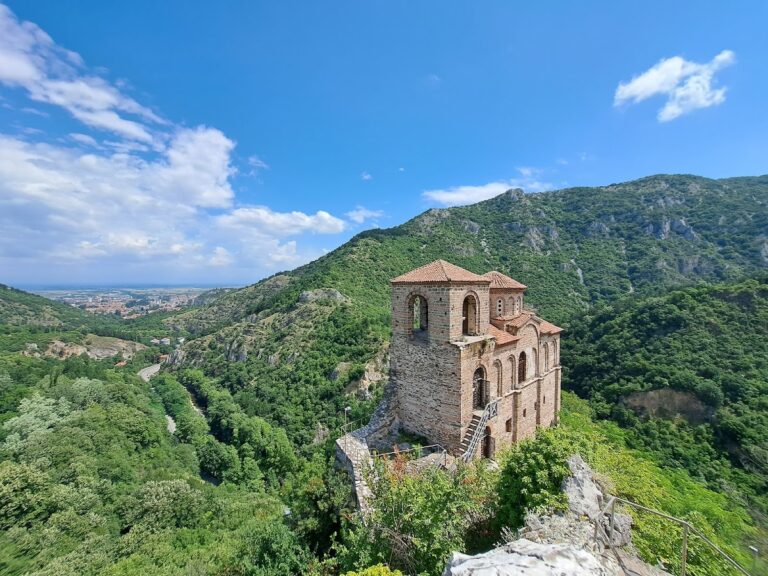
The exterior wall of the refectory carries the “Panorama,” a fresco depicting the monastery complex as it appeared in the nineteenth century. It includes the buildings, riverside buttresses, wells, chapels, and the bell tower of the Church of the Holy Archangels. The composition also represents the founders and later benefactors, the nearby Asen fortress, the women’s monastery at Asenovgrad, processions accompanying the miraculous icon, local and aristocratic clothing, and scenes from the passions of Saints George and Demetrius.
An inscription dates the work to 22 July 1846 and identifies Alexi Atanasov of Negush as its painter. He used an 1807 Vienna engraving as a model but added details of his own. The fresco was made with fresco buono, a technique in which pigments are applied to smooth wet plaster and become integrated as the plaster dries. The colors followed Atanasov’s own recipe, possibly involving grass mixed with egg emulsion.
Ossuary Church
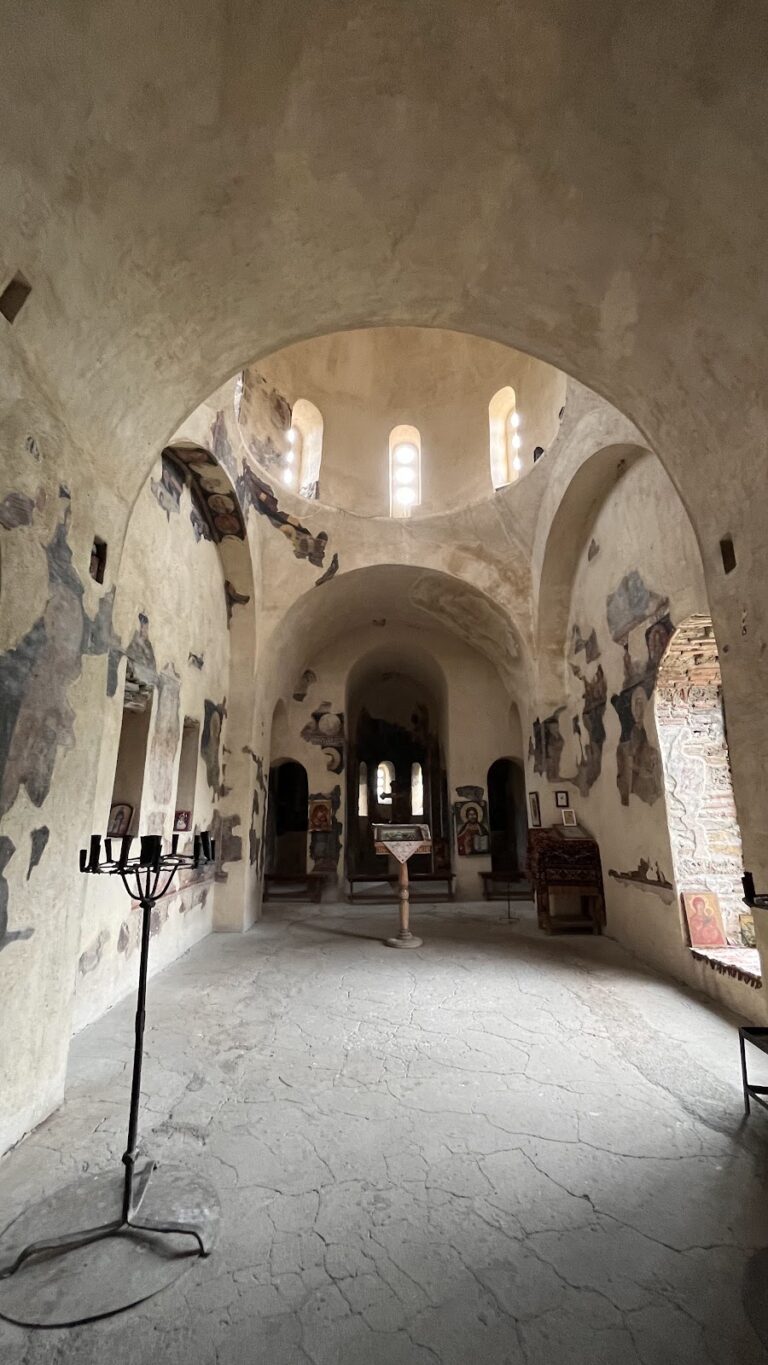
The two-storey ossuary church stands about 300 meters east of the principal buildings on steep terrain. An ossuary is a structure used to store human bones. The lower storey contains a crypt, or burial chamber, with fourteen burial places, while the upper storey contains a chapel also identified as the Church of the Holy Trinity. Each level has a narthex, a single nave, and an apse. The vaulted building has a semicircular inner apse and a pentagonal outer apse on the upper level, with three openings admitting limited light into the sanctuary.
The design resembles Syrian-Palestinian funerary structures and combines Armenian, Georgian, and Byzantine construction traditions. Eight blind arches articulate the façade, whose alternating courses of brick and stone are joined with mortar. Its frescoes include a comparatively well-preserved layer generally dated to the twelfth century, with other assessments proposing an earlier phase and another from the mid-fourteenth century. The paintings include the Last Judgment and the prophet Ezekiel’s vision of the valley of dry bones. Greek inscriptions attribute the painting to John Iveropoulos, while partly damaged Georgian inscriptions include references to Saint George of Kashueti and Saint John the Theologian.
During the fourteenth century, under Ivan Alexander, the open arcades of both ossuary levels were closed, creating painted niches. These show Ivan Alexander, his patron saint John the Theologian, Saints Constantine and Helena, Gregory Pakourianos, his brother Abasios, and the later benefactors George and Gabriel. Ivan Alexander appears in imperial dress holding a cross-topped sceptre and a scroll. His inscription, which was in Greek, has been destroyed.
Icon and Monastery Collections
Miraculous Virgin Mary Icon
The monastery’s principal relic is the miraculous icon of the Virgin Mary, kept in a special place in the main church. Only the faces of the Virgin and Child remain visible, while two silver revetments, protective and ornamental coverings, conceal the rest. An inscription on the older revetment states that it was donated in 1311 by the Georgians Athanasius and Okropir. The newer revetment dates from 1819. The icon is associated with Georgia, although its origin and arrival at Bachkovo remain uncertain, and one tradition attributes it to Saint Luke.
Museum Collections
The monastery museum contains liturgical vessels and ecclesiastical art from different periods. Among them is a silver diskos donated in 1644 by Theodosius of Peshtera and made by the Chiprovtsi craftsman Peter. The collections also include icons, books, a carved and finely worked cross, and objects identified as the sword of Frederick I Barbarossa and a 1452 sultan’s firman.
Items originating at Bachkovo are also held in the Church Historical and Archaeological Museum in Sofia and the Byzantine and Christian Museum in Athens. Most manuscripts from the former monastery library are preserved in the Church Historical and Archival Institute of the Bulgarian Orthodox Church. A large persimmon tree in the courtyard was brought from Georgia more than two centuries ago.