Crom Castle: Seat of the Earls Erne


Site at a Glance
- Rating
- 4.7
- Popularity
- Low
- Country
- United Kingdom
- Primary era
- Modern
- External website
- Open
- Eras represented
- Early Modern, Modern
- Civilizations
- British, English
- Site type
- Domestic
- Remains
- Castle
On this page12 sections
History
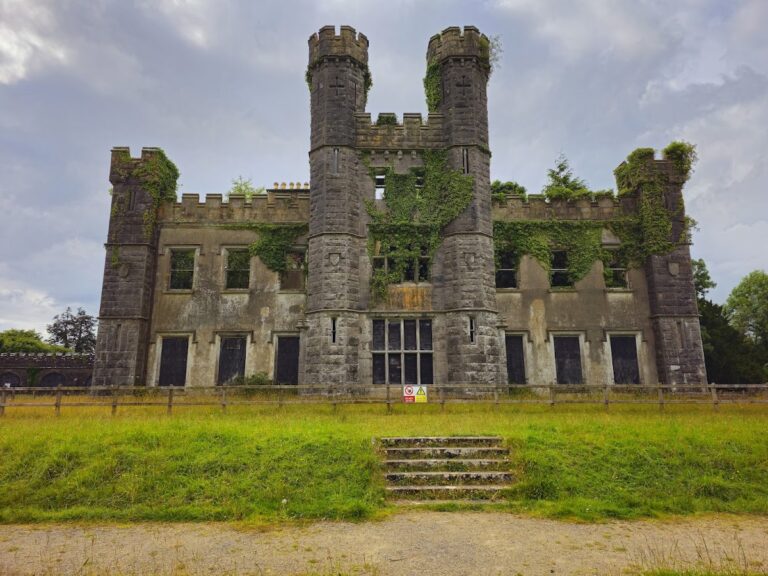
Crom Castle is a country house in the United Kingdom, standing on Upper Lough Erne in County Fermanagh, Northern Ireland. The present building was constructed in 1840 for the Crichton family, the holders of the earldom of Erne, and was designed by the English architect Edward Blore. It forms the centre of the 1,900-acre Crom Estate and remains the seat of the Earls Erne.
The Plantation of Ulster
The first house at Crom was built in 1611 by Michael Balfour, Laird of Mountwhinney. A laird was a Scottish landowner, and Balfour established the residence as part of the Plantation of Ulster, a seventeenth-century English-sponsored colonisation programme that created settler estates and fortified residences in Ulster. His house stood on the lough shore opposite Inishfendra Island.
The earlier fortified residence, later known as Old Crom Castle, followed the typical form of a Plantation castle. It was enclosed by a bawn, a defensive courtyard surrounding the house. The Balfour lands and Old Crom eventually passed to the Crichton family.
The Williamite War
Old Crom Castle played a defensive role during the Williamite War in Ireland, the late-seventeenth-century conflict between supporters of the Catholic King James II and forces backing William III and Mary II. In 1689, Colonel Abraham Crichton and his family held the castle against two Jacobite sieges. Jacobites supported James II, while Williamites supported William, until reinforcements arrived from Enniskillen.
The local fighting culminated in the Battle of Newtownbutler in July 1689. A Williamite force of fewer than 1,500 Enniskillen troops captured or killed as many as 3,000 soldiers of King James II. The principal fighting took place at Kilgarrett, about one mile south of Newtownbutler. Old Crom Castle was later destroyed by a domestic fire in 1764.
The Crichton earldom
The Crichtons retained the estate as their family titles developed. Abraham Crichton received the title Baron Erne in 1768, and his son John Crichton, the second Baron Erne, became Earl Erne in 1789. The present Crom Castle was built for this aristocratic family in 1840.
The later Earls Erne held prominent public and political positions. The third Earl served as Lord Lieutenant of County Fermanagh and employed Charles Boycott. The treatment of tenant farmers and the protests that followed gave rise to the word “boycott.” The fourth Earl was a Conservative politician in Benjamin Disraeli’s government, while the fifth Earl served in the governments of Stanley Baldwin and Neville Chamberlain before being killed during the Second World War.
Henry Crichton, the sixth Earl Erne, inherited the title in 1940 and served as Lord Lieutenant of County Fermanagh from 1986 to 2012. He died in 2015, after which his son became the seventh Earl Erne. In 1987, Henry Crichton gave the Crom Estate to the National Trust, a conservation organisation that manages historic buildings and landscapes in the United Kingdom. Crom Castle itself remains privately owned by John Crichton, the seventh Earl Erne. The building is a legally protected Grade A listed building.
Estate institutions
Crom Castle Loyal Orange Lodge 1219 occupies the former laundry at the estate. The lodge belongs to the Orange Order, a Protestant fraternal organisation founded in Ireland in the late eighteenth century. It dates from the period of John Crichton, the fourth Earl Erne, who served as Grand Master of the Grand Orange Lodge of Ireland from 1886 until his death in 1914.
Remains
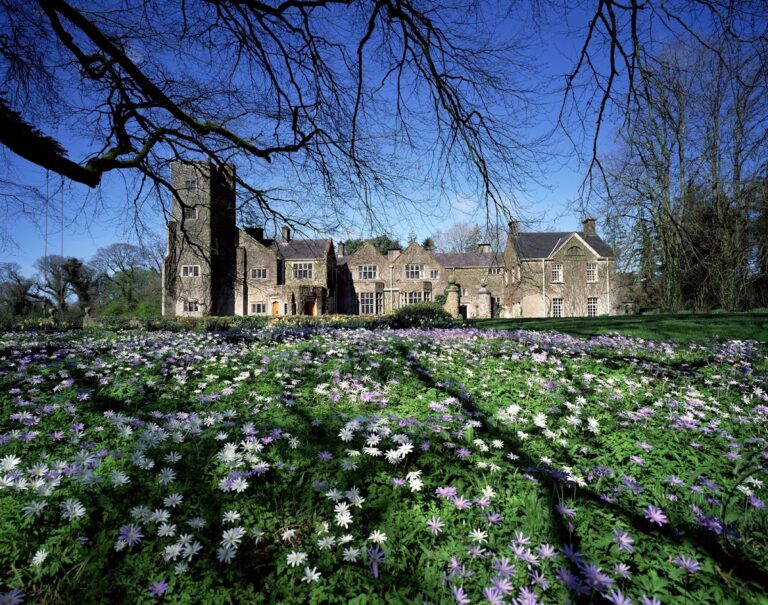
Crom Castle is built of stone beside Upper Lough Erne and within a formal garden. Its central battlemented tower contains the main entrance, while smaller towers stand to one side. The present house occupies a separate position from the ruins of Old Crom Castle, allowing the nineteenth-century residence and the earlier fortified site to survive as distinct parts of the estate.
The two castles
Crom Castle
The present castle’s principal feature is its central tower with battlements and the main entrance below. Smaller towers extend to one side, and the West Wing forms part of the building and provides accommodation. The stone house stands within the formal garden beside the lough.
Old Crom Castle
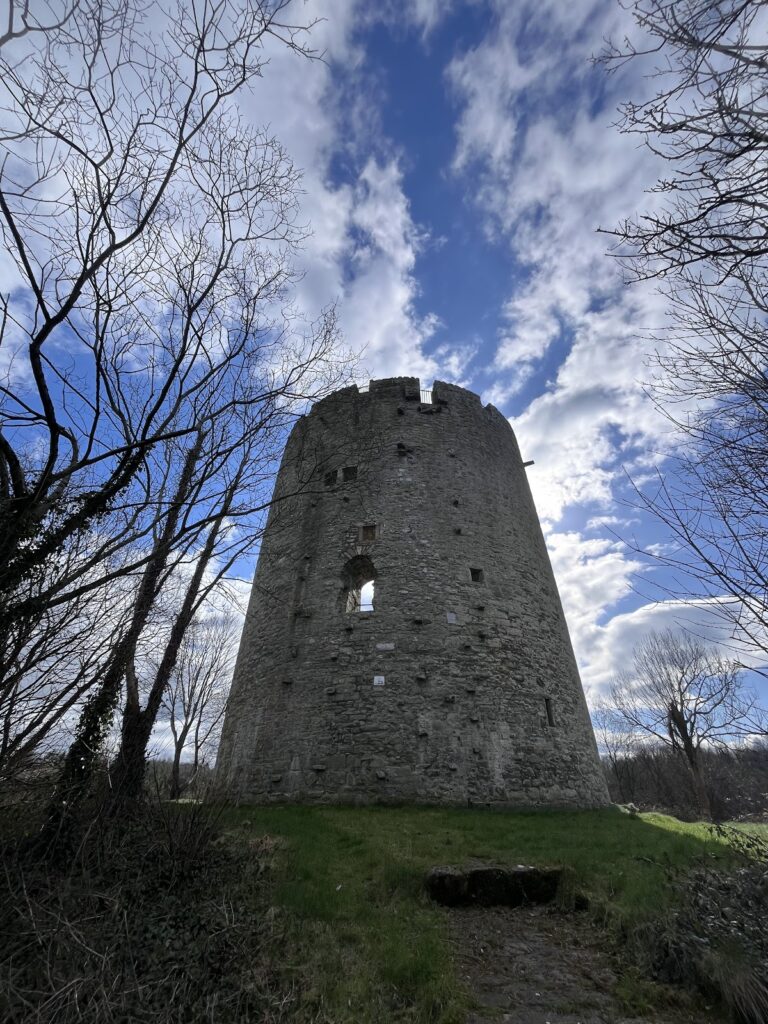
The remains of Old Crom Castle include two towers, sections of wall, and a ha-ha. A ha-ha is a sunken boundary ditch that separates a garden or park from surrounding land without a conventional visible wall. Two ancient yew trees grow near the castle and are believed to be at least 800 years old.
Boathouse and estate buildings
Lough Erne boathouse
The castle boathouse stands on the shore of Upper Lough Erne. George Sudden rebuilt it in 1841 in the Tudor style. Arched doors and windows occupy the ground floor, while an upper room overlooks the lake. Before the twentieth century, the building served as an arrival point for guests travelling by water. It later became the home of the Erne Yacht Club and is now empty and unused except by the Earl of Erne.
Associated estate features
The wider estate includes houses, stables, yacht-club buildings on Lough Erne, tea houses, gazebos, a church, and a schoolhouse. Together with the castle, the earlier ruins, the formal garden, and the boathouse, these features form the surviving architectural and landscape setting of Crom.