Castle Lichtenburg: Monastery, Renaissance Residence, and Prison in Germany


Site at a Glance
- Rating
- 4.4
- Popularity
- Low
- Country
- Germany
- Primary era
- Early Modern
- External website
- Open
- Eras represented
- Early Modern, Modern
- Civilizations
- Electorate of Saxony, German, Holy Roman Empire, Kingdom of Prussia
- Site type
- Domestic
- Remains
- Castle
On this page17 sections
History
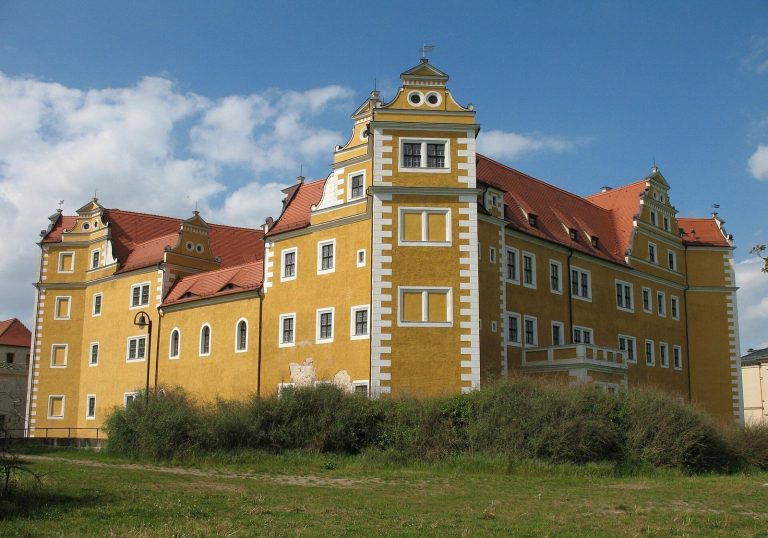
Castle Lichtenburg is a former monastery, Renaissance residence, prison, and memorial complex in Prettin, Germany. Elector August I of Saxony commissioned the multi-wing castle in the Saxon Renaissance style between 1574 and 1582 on the site of a medieval religious settlement. Its later history includes use as a residence for Saxon electresses, a state estate, a penitentiary, and concentration camps under National Socialist rule.
Medieval religious settlement
The site originated around 1200 as a settlement of the Kaland Brotherhood near the Prettin sand dunes. The medieval brotherhood combined communal religious life with devotional and charitable activity. The dunes were associated with the name mons clarus, meaning “bright” or “light mountain,” which later gave Lichtenburg its name.
Members of the Antonite Order from Eilenburg joined the Kaland brothers at the end of the thirteenth century. Around 1312, the combined foundation probably became the Antonites’ principal house in the Electoral District. It was known as Lichtenbergk or Antoniterhof Lichtenburg, near Prettin. The Antonites were a religious order devoted especially to caring for the sick, and the house combined nursing with intensive agricultural activity.
Reformation and electoral residence
In 1518, Martin Luther first met the Saxon electoral chancellor Georg Spalatin at the Antonite house. Spalatin assured Luther that Elector Frederick the Wise supported his church reforms. The Reformation, a sixteenth-century movement that challenged the authority and practices of the Western Church and produced Protestant churches, soon transformed the institution itself.
In 1525, the last Antonite monks adopted the Reformation. The monastery was then dissolved, and some of its former members received life pensions. From 1536 to 1546, Elisabeth, Electress of Brandenburg, lived in the former monastery after fleeing her Catholic husband, Elector Joachim I of Brandenburg. Much of the complex may have been destroyed by a fire in the middle of the sixteenth century.
From 1574, Elector August I of Saxony ordered the monastery buildings demolished and commissioned a new residence at the request of his wife, Anna. The castle was largely complete by 1582 and included service buildings and a farm estate. It was initially intended for the electoral couple. After Anna’s death in 1585 and August’s death in 1586, Lichtenburg became a widow’s residence, a home assigned to the widow of a Saxon elector.
The castle remained a residence for Saxon electresses until 1717. Hedwig, widow of Elector Christian II, lived there from 1611 to 1641. The widowed Electress Anna Sophie, mother of August the Strong, occupied it from 1647 to 1717, while her sister Wilhelmine Ernestine of the Palatinate lived there from 1650 to 1706. From 1717 to 1800, Lichtenburg functioned as a Kammergut, an estate administered for the Dresden court and providing revenues to the ruling court.
Conversion into a penitentiary
After the old imperial order ended in 1806, Napoleon required Saxony to join the Confederation of the Rhine and demanded an Elbe fortress as a base for a planned campaign against Russia. The decision to expand Torgau into a fortress was taken in 1810, and construction began in 1811. Since the prison at Hartenfels Castle in Torgau had to be moved, King Frederick August selected Lichtenburg as its new location in February 1811.
Alterations prepared the former residence for penal use, and the first prisoners arrived in April 1812. The prison held 373 inmates that year. After the Congress of Vienna, Prettin and Lichtenburg came under Prussian administration, but the penitentiary continued operating and was repeatedly modified.
Following the introduction of the Prussian Penal Code in 1851, Lichtenburg remained a penitentiary for prisoners from the Province of Saxony until 1928. It initially held people sentenced to as much as five years in prison. From 1893, prisoners over thirty were sent there regardless of sentence length, while younger prisoners went to Halle’s Roter Ochse prison. From 1860, Lichtenburg housed only men, because female prisoners were transferred to Delitzsch.
The population grew from 620 inmates in 1829 to 729 in 1838, including 556 men and 173 women. By 1856, it had reached 1,134, comprising 872 men and 262 women. The increase that year was also connected with convictions resulting from the revolutions of 1848 and 1849, which brought political upheaval across Europe. Around 1900, the prison held an annual average of 600 to 800 inmates.
The irregular castle layout and later additions made surveillance difficult, while the complex’s poor condition encouraged escape attempts. These problems became especially serious after the First World War. Lichtenburg lacked the physical requirements of a modern prison, so clearance began in 1927 and the last prisoners left in July 1928. Local residents opposed the closure because they feared losing inexpensive prison labor, but the penitentiary was not reopened.
Uses after the penitentiary
After the prison closed, the former castle and prison church were made available to the Prettin parish for ten years. Mushroom cultivation began in the castle cellars, while most of the other buildings remained largely empty.
Under National Socialist rule, Lichtenburg operated as a concentration camp for men from 1933 to 1937 and for women from 1937 to 1939. A concentration camp was a detention facility established by a state or ruling regime outside ordinary judicial procedures. From 1939, the SS used the castle for replacement units of the SS Death’s Head formations until 1941, as a clothing store until 1945, and as a main ordnance office from 1941 to 1945. The SS Death’s Head formations guarded concentration camps and performed related camp duties.
After the Second World War, when Saxony-Anhalt formed part of the Soviet occupation zone, the castle held members of the Russian Liberation Army in internment and accommodated refugees from the former German eastern territories until 1946. The Soviet occupation zone was the part of postwar Germany administered by the Soviet Union before the establishment of the German Democratic Republic in 1949. From 1948, the extensive grounds were used for agriculture, and the site also included an apprentice residence.
Memorial and museum history
Museum use began during the postwar period. A memorial and remembrance site opened in the former concentration-camp bunker in 1965. A museum devoted to the castle’s history opened in part of the old castle in 1974, followed by a permanent exhibition on the concentration-camp period in 1978.
Agricultural use ended in 1992. In 1993, the Federal Republic of Germany became the owner of the complex, which was placed under the administration of the Federal Agency for Real Estate. Continuing maintenance has included ground remediation in 2015 and repairs to a tower in 2016. Since 2008, Lichtenburg has formed part of the Saxony-Anhalt Memorial Foundation. The permanent concentration-camp exhibition was comprehensively redesigned and opened in 2011. The Prettin town museum continues to operate in the castle, while the memorial and the Aachen University of Applied Sciences are developing a future use concept through a participatory process.
Remains
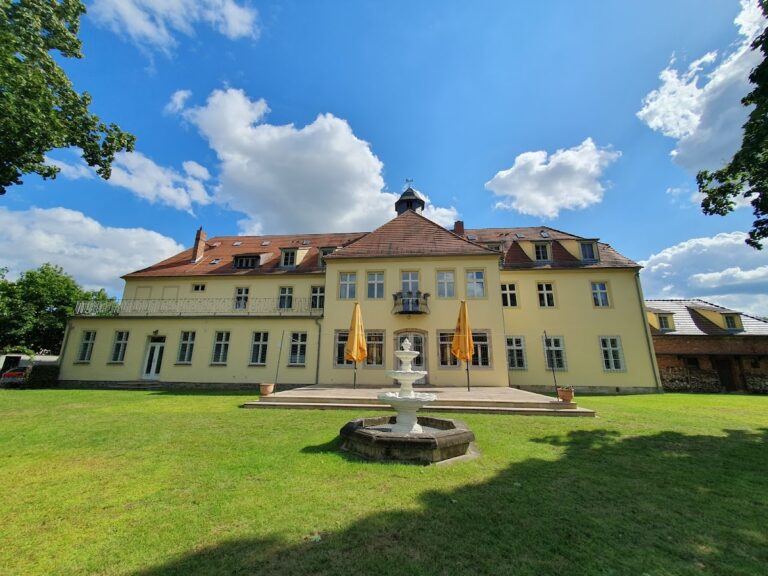
Castle Lichtenburg occupies the site of the earlier monastery near the sand dunes historically called mons clarus. The surviving complex consists of an irregular, multi-wing main castle in the Saxon Renaissance style, later service buildings, a farm estate, and additions made during its long use as a prison. The arrangement preserves evidence of the change from electoral residence to penitentiary and concentration camp.
Renaissance castle and church
Main castle
The main castle is a multi-wing building whose irregular arrangement developed from the Renaissance rebuilding of the former monastery site. Elector August I ordered the earlier monastery buildings demolished from 1574 and had the new residence constructed largely by 1582. Service buildings and a farm estate supplemented the main complex. The uneven arrangement later created difficult surveillance conditions when the buildings were converted into a prison.
Castle Church of St. Anna
The late Gothic Castle Church of St. Anna was built in 1581. It served first as the castle church and later as the prison church. After the penitentiary closed, the building was temporarily used by the Prettin parish, preserving its connection with the religious history of the site.
Penitentiary additions
Western outer wing
The western outer wing was extended northward in 1829 and raised by an additional story in 1839. This section contained individual cells and the prison infirmary, adapting part of the former residence to the requirements of nineteenth-century penal administration.
Eastern wing
In 1878 and 1879, the eastern wing was extended northward with a detached clinker-brick building. The prominent addition contained 78 individual and group cells and formed part of the expansion undertaken as the prison population increased.
Old castle dormitories
From 1883, attic spaces in the wings of the old castle were converted into dormitories. This adaptation provided further accommodation within the earlier Renaissance structures as the penitentiary received more inmates.
Memorial and later-use features
Concentration-camp bunker
A memorial and remembrance site occupies a former bunker within the castle complex. It was established in 1965 and forms part of the present concentration-camp memorial. The permanent exhibition on the camp’s history was comprehensively redesigned and opened in 2011.
Cellars and tower
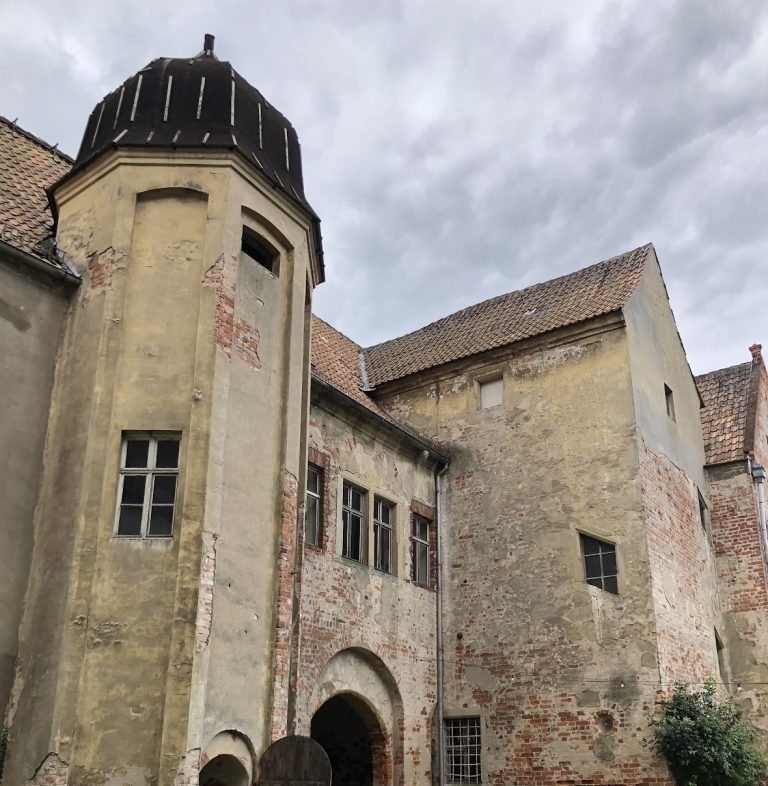
The castle cellars were later used for mushroom cultivation after the penitentiary closed. A tower within the complex underwent repairs in 2016, following a ground-remediation project at the site in 2015.