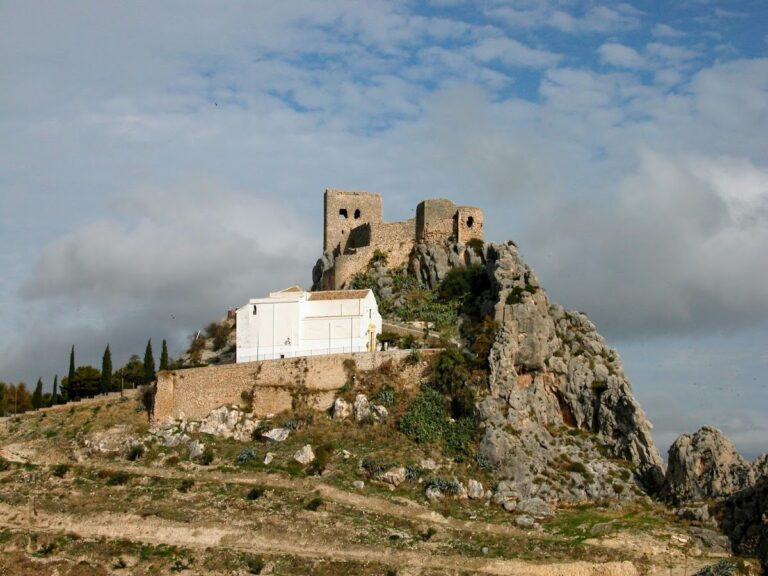
Castillo de los Duques de Sessa: A Hispano-Muslim Fortress in Cabra


Site at a Glance
- Rating
- 4.2
- Popularity
- Low
- Country
- Spain
- Primary era
- Medieval
- External website
- Open
- Eras represented
- Medieval, Early Modern, Modern
- Civilizations
- Crown of Castile, Spanish, Umayyad
- Site type
- Military
- Remains
- Castle
On this page14 sections
History
Castillo de los Duques de Sessa is a Hispano-Muslim fortress in Cabra, Spain, whose earliest references date to the ninth century, during the Emirate of Córdoba, the early medieval Muslim state that ruled much of the Iberian Peninsula before the Caliphate of Córdoba. The fortress played a part in conflicts involving the Andalusi rebel Omar ibn Hafsún and the emirate, and later became a stronghold, noble residence, convent, school, and protected heritage site.
From the Emirate to the Christian conquest
The fortress and its surroundings were involved in the Battle of Cabra in 1079, a conflict between the taifa kingdoms of Seville and Granada. A taifa was an independent Muslim kingdom that emerged after the disintegration of the Caliphate of Córdoba. Abd Allah ibn Buluggin of Granada faced al-Mutámid of Seville, whose forces were supported by Rodrigo Díaz de Vivar, later known as El Cid, a Castilian military leader and mercenary of the eleventh century.
Alfonso I of Aragon briefly took the fortress in 1126 during his expedition into Andalusia. He abandoned it after capturing Castillo Anzur during the Battle of Arnisol. The definitive Christian conquest followed in 1240, when Ferdinand III, king of Castile and León, took Cabra.
Castilian rule and the Order of Calatrava
In 1279 Alfonso X granted the castle and town to his son Pedro of Castile. After Pedro died four years later, his widow, Margaret of Narbonne, retained the territory until 1295. She then exchanged it for Santa Olalla with the Order of Calatrava, a Catholic military order founded to defend Christian territories in Iberia. The order held the castle until 1331.
In the early 1320s, the Cordoban nobleman Juan Ponce de Cabrera seized the castle. Alfonso XI ordered him to return it to Juan Núñez de Prado, master of the Order of Calatrava, but Ponce refused and defeated the master’s forces. He was captured and executed in Córdoba in 1328. Alfonso XI subsequently ordered the castle and its walls to be rebuilt, probably adding the external towers.
In 1331 the Nasrid ruler Muhammed IV sacked the town after its governor, Pero Díaz de Aguayo, secretly promised to surrender the castle. The Nasrid dynasty ruled the Kingdom of Granada, the last major Muslim state in medieval Iberia. The attack destroyed many of Cabra’s towers and fortifications. In 1342 Alfonso XI granted the castle and town to Leonor de Guzmán to ennoble Cabra and encourage its repopulation.
The Counts of Cabra
Leonor de Guzmán gave birth at the site in 1333 or 1334 to the future Henry II of Castile. As king, Henry established the County of Cabra and granted it to his illegitimate son Henry of Castile. The county’s lands returned to the Crown after his son’s death.
John II appointed Diego Fernández de Córdoba lord of Cabra in 1439. In 1455 Henry IV made him the first Count of Cabra in recognition of his campaigns against the Nasrid Kingdom of Granada. The succeeding counts used the castle as their official residence.
The second Count of Cabra imprisoned his cousin Gonzalo Fernández de Córdoba, later known as the Great Captain, at the castle in Santaella after capturing him there. Queen Isabella I of Castile intervened and secured his release. In 1483 the second count defeated the Nasrid ruler Boabdil at the Battle of Lucena. Boabdil, the final Nasrid ruler of Granada, was captured and held in the fortress.
Convent, school, and wartime use
In 1635 Antonio Fernández de Córdoba, ninth Count of Cabra, founded a Franciscan convent on the castle grounds because of his devotion to Saint Francis. The building was completed in 1649 and assigned to the Capuchins, a reform branch of the Franciscan Order.
In 1899 the Counts of Cabra sold the castle and convent for 25,000 pesetas because of their lack of liquidity. Escolapian nuns, members of a Catholic order traditionally devoted to education, converted the complex into an institution exclusively for girls. It was officially inaugurated on 26 November 1899. A medieval tower was demolished in 1925 because it was considered at risk of collapse.
During the Spanish Civil War, the complex housed the Civil Guard and Italian militias and served as a field hospital. On 7 November 1938, during the Bombing of Cabra, a bomb struck the preschool at 7:30 a.m., half an hour before the pupils were due to arrive, avoiding a greater loss of life. The 1970 General Education Law ended the distinction between the school’s free and fee-paying units, and the institution became coeducational. It continued as the subsidized San José Escolapias school, providing infant, primary, and secondary education.
Recent changes and protection
In December 2010 the municipality leased part of the gardens, which were in very poor condition, restored them, and constructed a new building on acquired land for the tourist office. The Escolapian nuns left the castle in September 2021 but retained ownership. In summer 2022 a crypt beneath the former Capuchin convent was found to contain the remains of José María Osorio de Moscoso y Carvajal, twentieth Count of Cabra, his grandmother María del Carmen Ponce de León y Carvajal, wife of the eighteenth count, and two unidentified individuals.
Castillo de los Duques de Sessa is protected as an Asset of Cultural Interest in the category of Picturesque Site. The protection was declared on 16 March 1961 and published in the Official State Gazette on 11 April 1961.
Remains
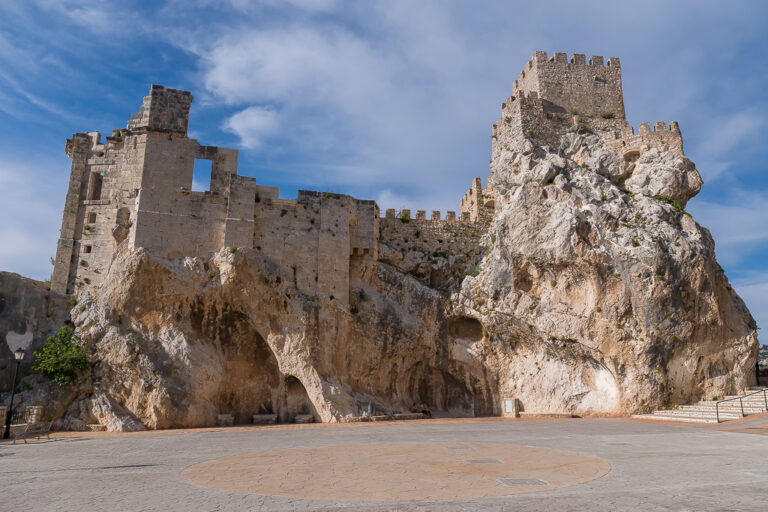
The surviving complex stands in Cabra’s historic La Villa quarter, within the former town walls and beside the Church of the Assumption and Angels, which occupies the site of a former congregational mosque. The fortress was organized around a quadrangular parade ground, an open military assembly area large enough for up to 10,000 men. Its defenses included a double wall and 18 towers, with approximately half of the wall surviving and a stated thickness of 2.60 metres.
Fortress walls and towers
Tower of Homage
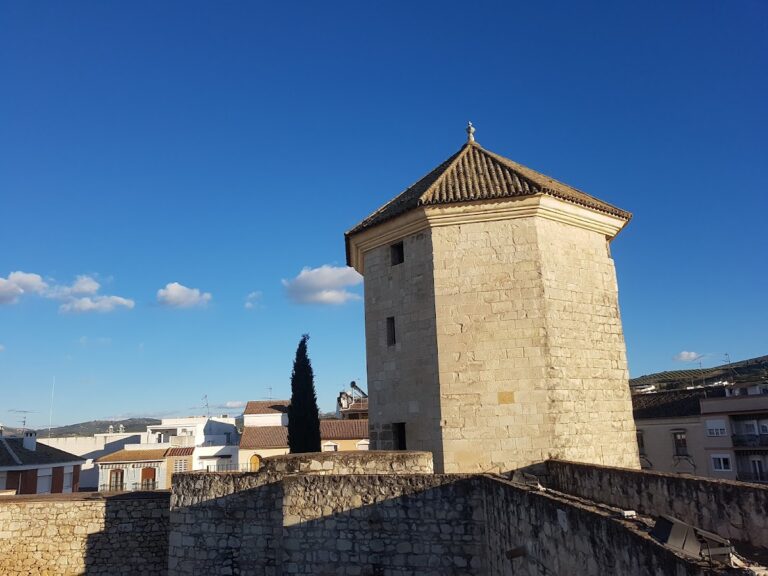
The Tower of Homage, the castle’s principal defensive or residential tower, remains in good condition. It is almost square, approximately 20 metres high, and contains a ground-floor chamber with an octagonal vault known as the Salón Redondo. That chamber was remodelled in the Neo-Mudejar style, a later revival of Christian architecture incorporating Islamic artistic and building traditions. Luis Osorio de Moscoso y Borbón, the twenty-first Count of Cabra, commissioned the remodelling.
Juana Tower
The Juana Tower is approximately 10 metres high and square in plan. Its lower portion is solid, while the upper part contains a vaulted room.
Entrance towers and surviving walls
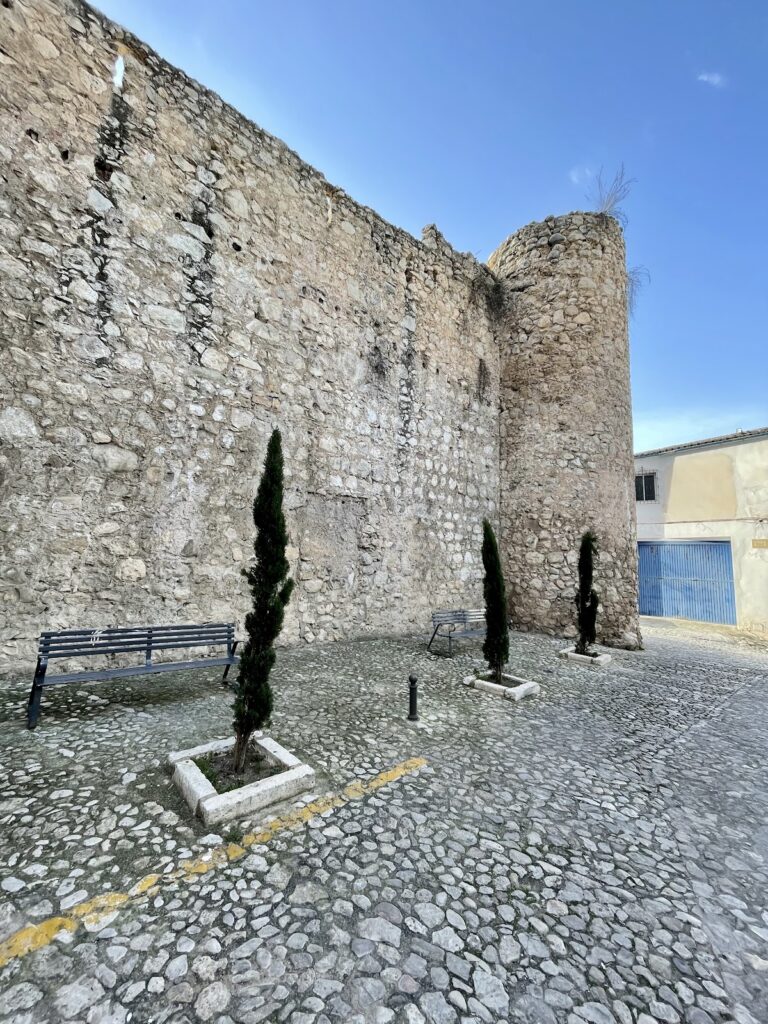
Works carried out in 2016 revealed the remains of two fourteenth-century towers that flanked the fortress entrance. The most substantial surviving wall remains stand opposite the Church of the Assumption and Angels. They include a solid cylindrical tower and the remains of an adjoining tower, probably demolished by an earthquake in 1673.
Entrance monuments
A cross erected during the Franco dictatorship stood at the entrance until 2004. It commemorated those who died in the Bombing of Cabra and was then moved to the town cemetery with the unanimous support of the municipal political parties. After its removal, a stone monument to the Andalusi poet Ben Mocádem was installed at the entrance. That monument was replaced by a bronze bust in January 2017.
Former Capuchin convent
The Capuchin convent occupies part of the former castle grounds. Its central altarpiece includes The Vision of Saint Francis at La Porziuncola, painted by Juan de Valdés Leal in 1672. The Baroque painting was restored in 1991. A preparatory sketch is held by the Museum of Decorative Arts in Paris.
Crypt and later buildings
The crypt beneath the former Capuchin convent contains the remains of José María Osorio de Moscoso y Carvajal, twentieth Count of Cabra, his grandmother María del Carmen Ponce de León y Carvajal, wife of the eighteenth count, and two unidentified individuals. María del Carmen Ponce de León y Carvajal’s gravestone is now situated out of context in one of the castle’s courtyards.
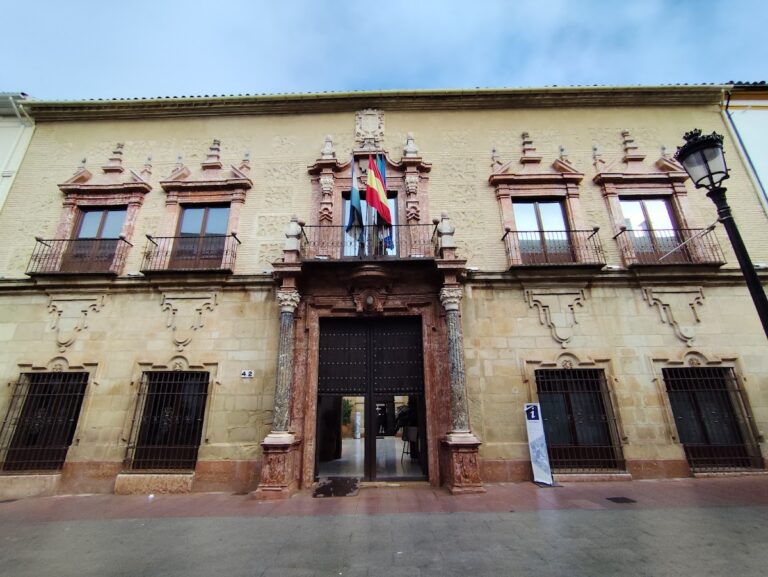
The complex also contains educational buildings and restored garden areas. A newer building on acquired land is used by the tourist office.