Ruine Albeck: Medieval Hilltop Castle near Sulz, Germany


Site at a Glance
- Rating
- 4.6
- Popularity
- Low
- Country
- Germany
- Primary era
- Medieval
- External website
- Open
- Eras represented
- Medieval
- Civilizations
- Holy Roman Empire
- Site type
- Military
- Remains
- Castle
On this page8 sections
History
Ruine Albeck is the ruin of a medieval hilltop castle in Germany near Sulz, built on a site that the Alemanni fortified around AD 380. The Alemanni were a Germanic confederation active in the region during late antiquity and the early medieval period. The castle, formerly called Sulz Castle, later became associated with the Counts of Sulz and the House of Geroldseck.
Early fortification and the Counts of Sulz
Bronze Age pottery sherds found at the site indicate earlier activity on the hill. After 910, Count Alwig I of Sulz is identified with the rebuilding of the fortification. The Counts of Sulz appear in written records from 1095, establishing the castle within the medieval history of the surrounding territory.
In 1251 or 1252, the castle passed to the House of Geroldseck through the marriage of a countess to Walter of Geroldseck, also associated with Diersburg. During the rule of Heinrich I, lord of Hohengeroldseck and Count of Sulz, King Rudolf of Habsburg granted town rights to Sulz below the castle in 1284. Rudolf was the Roman-German king from 1273 to 1291.
Expansion and military conflict
At the end of the thirteenth century, the barons of Geroldseck expanded the castle into the form represented by the surviving ruin. During the feud against Bubenhofen in 1414, the castle resisted capture even though the town of Sulz was taken.
Count Eberhard im Bart besieged Albeck Castle in 1469 with 4,000 men and 400 mounted troops. The castle fell on 3 October 1471, and Hans of Geroldseck and his three sons were imprisoned at Hohenurach Castle. In 1473, the Geroldseck family renounced its possessions and received compensation from Count Eberhard of Württemberg, who later became the first Duke of Württemberg in 1495.
War, destruction, and later ownership
Bavarian troops occupied the castle at different times during the Thirty Years’ War, the major European conflict fought from 1618 to 1648. Villages around the castle were required to provide forced labor for renovations during the war and again in 1678.
French troops destroyed the castle by fire and blasting on 30 December 1688. The castle and an associated estate later passed to the Barons of Hayn. On 20 July 1864, the Württemberg Court Domain Chamber purchased the Geroldseck estate from Herr von Hayn for 150,000 guilders.
Ownership and protection
Dr. Brand of Lahn bought the ruin from the Württemberg court chamber in 1969 for 5,000 Deutsche Mark. The City of Sulz acquired it in 1978 for 33,000 Deutsche Mark, and the Albeck Ruin Support Association was founded on 10 March 1995.
The area around the ruin became a protected landscape under the name “Schafweide bei der Ruine Albeck” on 9 July 1959. After that designation was partly revoked on 29 March 1971, most of the protected landscape was incorporated into the Albeck nature reserve. A residual area of 0.6 hectares, called “Ruine Albeck und Umgebung” and covering parcel 5774, remains protected under designation number 3.25.023.
Remains
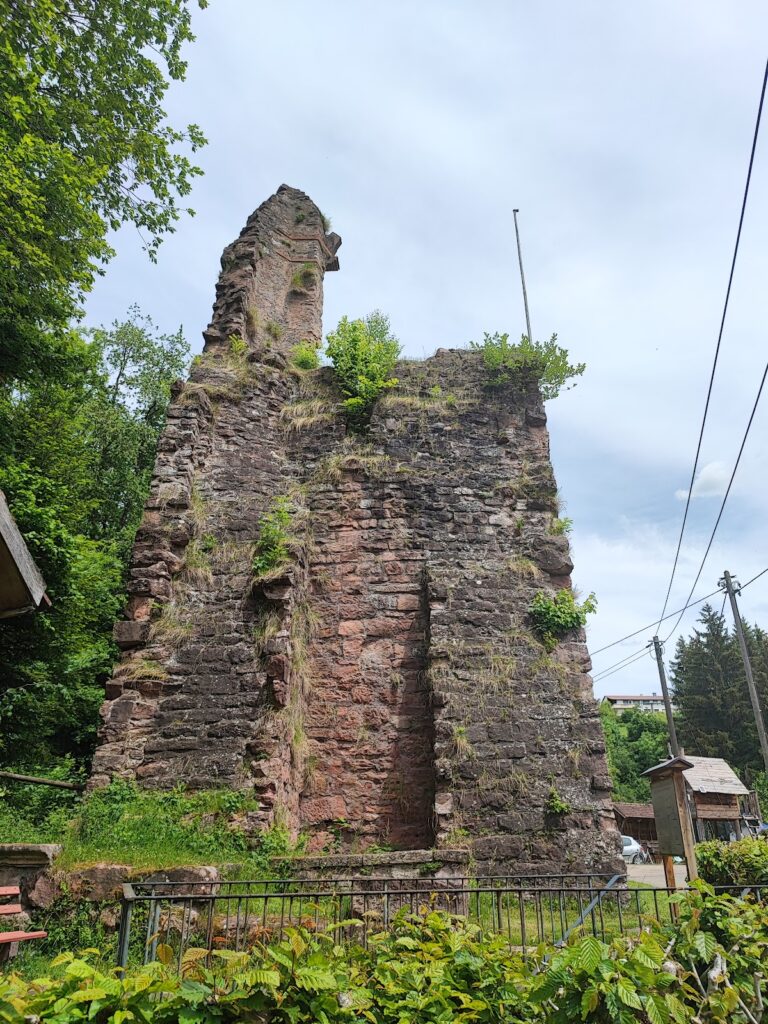
Ruine Albeck stands on a spur at 548.3 metres above sea level near Sulz am Neckar in the Rottweil district of Baden-Württemberg. The surviving castle fabric includes sections of defensive walls and the palas, the principal residential and representational building of a medieval castle. The ground plan also indicates the former organization of the hilltop complex.
Residential building
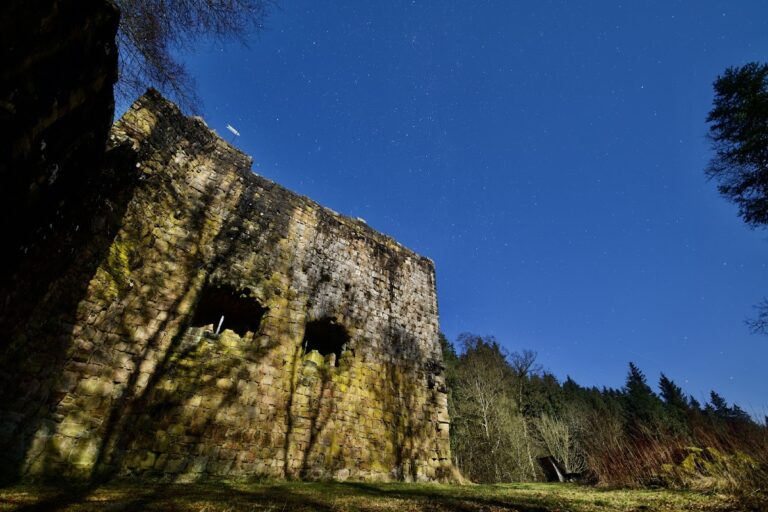
The surviving palas contains numerous old round-arched windows. Old seating niches remain visible in the masonry, together with beam sockets, which are recesses that held the ends of wooden beams. These features preserve evidence of the building’s residential and structural arrangements.
Defensive works and buried structures
Sections of the defensive walls survive, while an outer defensive installation extends through the surrounding forest. A courtyard and another defensive installation are probably buried beneath the hill. Their presence can be recognized in the castle’s ground plan, linking the visible masonry with the larger arrangement of the medieval fortress.