Ramburg: A Ruined Hohenstaufen Imperial Castle in Germany


Site at a Glance
- Rating
- 4.6
- Popularity
- Low
- Country
- Germany
- Primary era
- Medieval
- External website
- Open
- Eras represented
- Medieval, Early Modern
- Civilizations
- Holy Roman Empire
- Site type
- Military
- Remains
- Castle
On this page8 sections
History
Hohenstaufen origins
Ramburg is a ruined hill castle in Germany, above the village of Ramberg in Rhineland-Palatinate. It was built in the twelfth century under the Hohenstaufen dynasty, a medieval German ruling house that held the imperial throne of the Holy Roman Empire during part of the twelfth and thirteenth centuries. Ramburg served as an imperial castle, meaning that it was held directly for the Holy Roman Emperor, and was intended to protect nearby Trifels Castle.
Imperial ministeriales, members of the medieval service nobility who often performed administrative and military duties, were associated with Ramburg from 1163. Nobles, ministeriales, and counts were connected with the castle during its medieval history.
Ownership and destruction
In 1519, Hans of Ramburg, the last member of the noble family associated with the castle, sold Ramburg and the village for 2,200 gulden to Philipp IV of Dalberg and his brother Wolfgang VII Kämmerer von Worms. Six years later, during the Peasants’ War, the major uprising of 1524–1525 involving peasants and lower social groups in parts of the German-speaking lands, the castle was completely burned out.
The ruins were sold to the counts of Löwenstein in 1536. A lightning strike completely destroyed the castle in 1560, after which it was rebuilt as a residential castle. During the Thirty Years’ War, the European conflict of 1618–1648, Ramburg was plundered but not destroyed. It continued in use as a district administrative seat until 1638.
Decline
After 1638, Ramburg increasingly deteriorated. From the beginning of the eighteenth century, the abandoned castle was also used as a quarry, further reducing its surviving fabric.
Remains
Hilltop setting and defenses
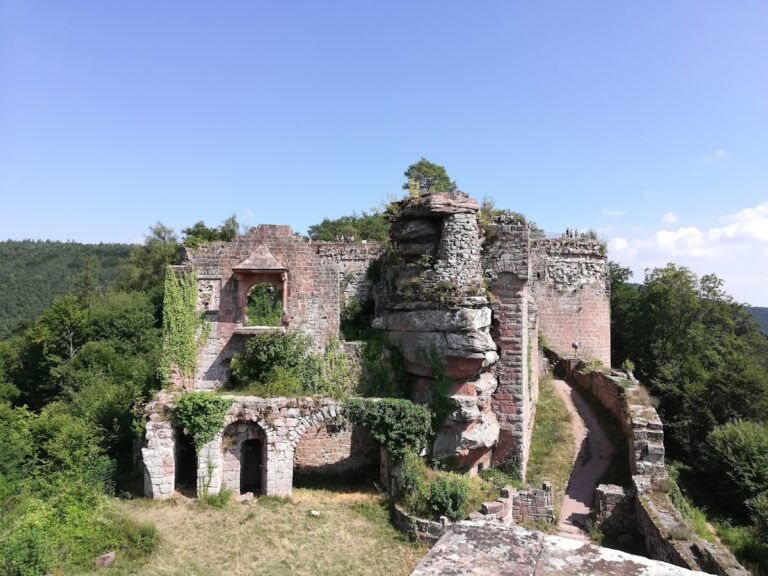
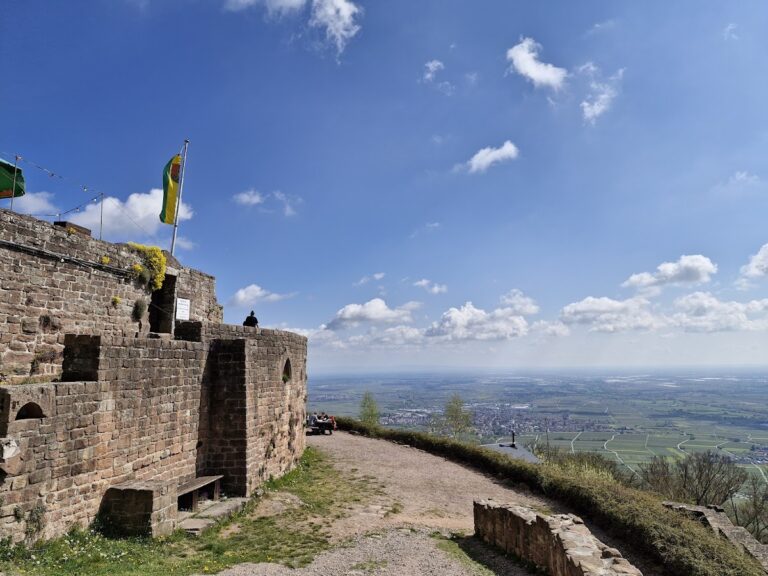
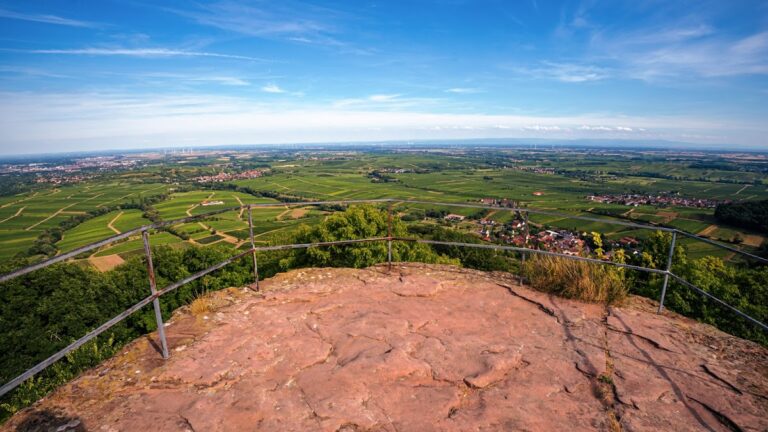
The ruins stand on the 444.2-metre Schlossberg above Ramberg, with the Dernbach, the left-hand headstream of the Eisbach, flowing through the valley below. Ramburg occupies a hilltop position and retains sections of its curtain walls, a massive shield wall, a neck ditch cut across the approach to the castle, and additional wall remains. The shield wall and the principal residential building are visible from the valley. A very large rock cellar also survives within the ruins.
Residential castle remains
The palas, the principal residential building of a medieval castle, forms part of the surviving core. The side wall of the core castle contains unusually large window arches dating from the rebuilding after 1560. Their size and form belong to the castle’s residential conversion rather than to the practical requirements of a medieval defensive structure.
Nearby castle landscape
Other castle ruins lie near Ramburg. Modeneck is approximately 2 kilometres east-northeast, Frankenfelsen about 2.5 kilometres east-northeast, and Neuscharfeneck approximately 2 kilometres southeast.